Full Text (PDF)
Journal of Social Welfare and Management 14(3 (Part-I)):p 83-88, September-December 2022. | DOI: https://doi.org/10.21088/jswm.0975.0231.14322.7
Review Article
Influence of Social Media in Impulsive Consumer Behavior
Author Information
Licence:
Attribution-Non-commercial 4.0 International (CC BY-NC 4.0)This license enables reusers to distribute, remix, adapt, and build upon the material in any medium or format for noncommercial purposes only, and only so long as attribution is given to the creator.
Journal of Social Welfare and Management 14(3 (Part-I)):p 83-88, September-December 2022. | DOI: https://doi.org/10.21088/jswm.0975.0231.14322.7
How Cite This Article:
S G Balaji, Ahamed Aashiq Ali/Influence of Social Media in Impulsive Consumer Behavior/J Soc Welfare Manag. 2022;14(3(Part-I):83–88Timeline
Received : July 14, 2022
Accepted : August 01, 2022
Published : December 25, 2022
Abstract
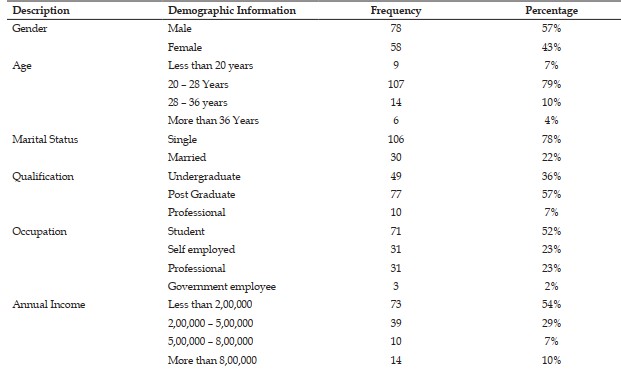
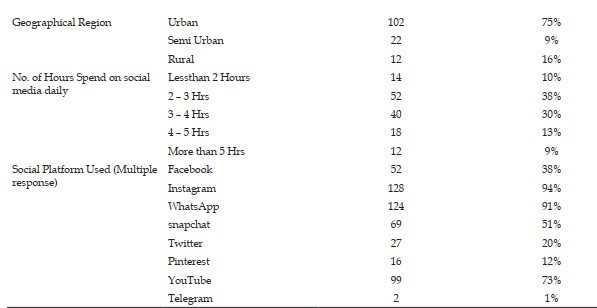
In the past few centuries, social media usage increased among the public due to advancements in information technology. Social media advertisements provoked the interest, leading to “impulsive temptations” to buy the product. So, the present research attempts to find the influence of social media in impulsive consumer buying behaviour. The researcher carried out the descriptive study using convenience sampling with a sample size of 136. The sample unit for the study are the general public using social media. Sample area for the study is Chennai city. The research instrument used for the study is structured questionnaire, the required primary data for the study collected through this structured questionnaire and secondary data for the study are collected from the books, journals and from websites. The researcher has conducted a pilot study by collecting 20 samples based on the results of the questionnaire for final data collection. The data collected for the study are analysed with percentage analysis and statistical tools like anova, chi-square test and t-test are also used to test the hypothesis. The study finds reveals that majority of respondents 57% using the social media are male, between the age group of twenty to twenty eight years of age and 68% of the respondents spends daily 2 to 3 hrs in social media, more than 91% of the respondents using Instagram and WhatsApp as a preferred social media. offer is the most important attribute which stimulates impulsive buying behaviour among the consumersAccording to the findings, social marketing has an important influence in customer purchasing behaviour, and digital marketing will soon become the backbone of any organisation.
References
- 1. Liu, P., He, J., & Li, A. (2019). Upward social comparison on social network sites and impulse buying: A moderated mediation model of negative affect and rumination. Computers in Human Behavior, 96, 133–140.
- 2. Oberst, U., Wegmann, E., Stodt, B., Brand, M., & Chamarro, A. (2017). Negative consequences from heavy social networking in adolescents: The mediating role of Fear of missing out. Journal of Adolescence, 55, 51–60.
- 3. Alzyoud, Mohammad. (2018). Does social media marketing enhance impulse purchasing among female customers case study of Jordanian female shoppers. Journal of Business & Retail Management Research. 13. 10.24052/JBRMR/V13IS02/ ART-13.
- 4. Ozuem, Wilson & Naeem, Muhammad. (2021). The role of social media in internet banking transition during COVID-19 pandemic: Using multiple methods and sources in qualitative research. Journal of Retailing and Consumer Services. 60. 10.1016/j.jretconser.2021.102483.
- 5. Ahmed, R. R., Streimikiene, D., Rolle, J-A, & Duc, P. A. (2020). The COVID-19 Pandemic and the Antecedants for the Impulse Buying Behavior of US Citizens. Journal of Competitiveness, 12(3), 5–27.
- 6. Sibel (2021) Mobile technologies for education attitudes to social media, European Journal of Foreign Language Teaching,Volume 5, Issue 3, 2021
- 7. Nuri Handayani, The Relationship between Product Browsing on Instagram and Shopping Motivation, and its Effects on Purchase Intention, Word-of-mouth Intention and Impulse Buying,Volume 10, Issue 1, January-2019
Data Sharing Statement
There are no additional data available. All raw data and code are available upon request.
Funding
This research received no funding.
Author Contributions
All authors contributed significantly to the work and approve its publication.
Ethics Declaration
This article does not involve any human or animal subjects, and therefore does not require ethics approval.
Acknowledgements
We would like to express our gratitude to the patients, their families, and all those who have contributed to this study.
Conflicts of Interest
No conflicts of interest in this work.
About this article

Cite this article
S G Balaji, Ahamed Aashiq Ali/Influence of Social Media in Impulsive Consumer Behavior/J Soc Welfare Manag. 2022;14(3(Part-I):83–88
Licence:
Attribution-Non-commercial 4.0 International (CC BY-NC 4.0)This license enables reusers to distribute, remix, adapt, and build upon the material in any medium or format for noncommercial purposes only, and only so long as attribution is given to the creator.
| Received | Accepted | Published |
|---|---|---|
| July 14, 2022 | August 01, 2022 | December 25, 2022 |
DOI: https://doi.org/10.21088/jswm.0975.0231.14322.7
Keywords
Social mediaImpulsive BuyingBuying behaviourSocial media MarketingSearch for Similar Articles
Similar Articles
- Electronic Publishing: A Powerful Tool in Academic Environment
- Natural Farming & the Concept of Recycle, Reuse through Case Studies
- From Home to the Gig: Empowering Women in Thoothukudi District of Tamil Nadu sta...
- Determinants of FinTech Adoption: An Analysis of Perceptual and Behavioural Infl...
- The Illusion of Prestige: Pay-and-Take Awards and the Glorified Profile Culture...
Article Level Metrics
Last UpdatedWednesday 23 September 2026, 04:11:50 (IST)
2804
Accesses
7
294
00
Citations
NA
NA
NA
Download citation
Article Keywords
Keyword Highlighting
Highlight selected keywords in the article text.
Timeline
| Received | July 14, 2022 |
| Accepted | August 01, 2022 |
| Published | December 25, 2022 |
licence
Attribution-Non-commercial 4.0 International (CC BY-NC 4.0)
This license enables reusers to distribute, remix, adapt, and build upon the material in any medium or format for noncommercial purposes only, and only so long as attribution is given to the creator.