Full Text (PDF)
Indian Journal of Agriculture Business 11(2):p 67-72, July-December 2025. | DOI: https://doi.org/10. 21088/ijab.2454.7964.11225.1
Original Article
Identification of Priority Traits for Selection in Sahiwal Cattle Using Linear Type Scoring
Ajay Kumar, Mamta null, Rajneesh Sirohi, Yajuvendra Singh, Chandan Kumar, Rashmi null, Jaswant Kumar Regar
Author Information
Licence:
Attribution-Non-commercial 4.0 International (CC BY-NC 4.0)This license enables reusers to distribute, remix, adapt, and build upon the material in any medium or format for noncommercial purposes only, and only so long as attribution is given to the creator.
Indian Journal of Agriculture Business 11(2):p 67-72, July-December 2025. | DOI: https://doi.org/10. 21088/ijab.2454.7964.11225.1
How Cite This Article:
Kumar A, Mamta, Sirohi R, et al. Identification of Priority Traits for Selection in Sahiwal Cattle Using Linear Type Scoring. J Agri Busi 2025; 11(2): 67–72.Timeline
Received : August 18, 2025
Accepted : October 22, 2025
Published : December 24, 2025
Abstract
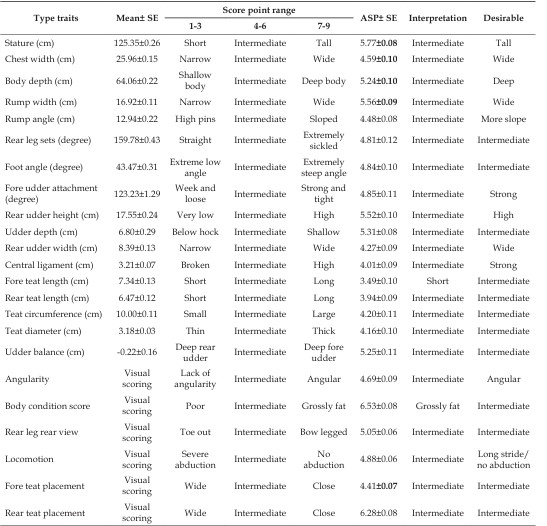
Linear type scoring is an important tool in herd decision-making, as it aids in selecting animals with superior productive potential based on body conformation. The present study was conducted on 150 lactating Sahiwal cattle, with measurements for linear type traits recorded before the evening milking at three different stages of lactation. The mean scores (±SE, cm) for objective linear type traits were as follows: stature 5.77±0.08; chest width 4.59±0.10; body depth 5.24±0.10; rump width 5.56±0.09; rump angle 4.48±0.08; rear legs sets 4.81±0.12; foot angle 4.84±0.10; fore udder attachment 4.85±0.11; rear udder height 5.52±0.10; udder depth 5.31±0.08; rear udder width 4.27±0.09; central ligament 4.01±0.09; fore teat length 3.49±0.10; rear teat length 3.94±0.09; teat circumference 4.20±0.11; teat diameter 4.16±0.10 and udder balance 5.25±0.11. For subjective linear type traits (1–9 scale), the mean scores were angularity 4.69±0.09; rear leg rear view 5.05±0.06; body condition score 6.53±0.08; locomotion 4.88±0.06; fore teat placement 4.41±0.07 and rear teat placement 6.28±0.08. Based on these findings, dairy cattle may be prioritized for selection with emphasis on improving rump height, body depth, chest width, rear udder width, fore udder attachment, and central ligament strength to enhance overall productivity and longevity.
References
- 1. Atkins, G. and Shannon, J., 2002. Minimizing lameness through genetic selection. Advanced Dairy Technology, 14: 93.
- 2. Atkins, G., Shannon, J. and Muir, B., 2008. Using conformational anatomy to identify functionality and economic of dairy cows. Advanced Dairy Technology, 20: 279-295.
- 3. Berry, D.P., Buckley, F., Dillon, P., Evans, R.D. and Veerkamp, R.F., 2004. Genetic relationships among linear type traits, milk yield, body weight, fertility and somatic cell count in primiparous dairy cows. Irish Journal of Agricultural and Food Research, 43(2): 161 176.
- 4. Berry, D.P., 2007. Evaluation and optimal utilization of international linear type classification schemes project No. 5238. Dairy production research Centre, Moorepark, Fermany, Co.Cork.
- 5. Boettcher, P.J., Hansen, L.B., Chester-Jones, H. and Young, C.W., 1993. Responses of yield and conformation to selection for milk in a designed experiment with a control population. Journal of Dairy Science, 76: 267-273.
- 6. Campos, R.V., Cobuci, J.A., Kern, E.L., Costa, C.N. and McManus, C.M., 2015. Genetic parameter for linear type traits and milk, fat and protein production in Holstein cows in Brazil. Asian Australian Journal of Animal Science, 28(4): 476-484.
- 7. Cruickshank, J., Weigel, K.A., Dentine, M.R. and Kirkpatrick, B.W., 2002. Indirect prediction of herd life in Guernsey dairy cattle. Journal of Dairy Science, 85: 1307-1313.
- 8. Dubey, A., 2010. Studies on linear type traits in Sahiwal. M.V.Sc. thesis, Indira Gandhi Agricultural University, Raipur, India.
- 9. Dubey, A., Mishra, S. and Khune, M., 2014. Appraisal of linear type traits in Sahiwal cattle. Indian Journal of Animal Research, 48 (3): 258 261.
- 10. Godara, A.S., Tomar, A.K.S., Patel, M., Godara, R.S., Showkat, A. Bhat, S.A. and Bharati, P., 2015. Body conformation in Tharparkar cattle as a tool of selection. Journal of Animal Research, 5(3): 423-430.
- 11. Harris, B.L., Freeman, A.E. and Metzger. E., 1992. Genetic and phenotypic parameters for type and production in Guernsey dairy cows. Journal of Dairy Science, 75: 1147-1153.
- 12. Huxley, J.N., 2013. Impact of lameness and claw lesions in cows on health and production. Livestock Science, 156: 64-70.
- 13. ICAR, 2018. Conformation recording of dairy cattle. Guidelines approved by the general assembly, Rome, Italy. www.icar.org/ Documents/Guidelines/Guidelines 2018.pdf.
- 14. Khan, M.A. and Khan, M.S., 2015. Development of linear score system for Sahiwal cows. Journal of Animal Health and Production, 3(3): 59-63.
- 15. Miglior, F., Muir, B.L. and Van-Doormall, B.J., 2005. Selection indices in Holstein cattle of various countries. Journal of Dairy Science, 88: 1255- 63.
- 16. Murrill, F.D., 1974. What we need to know about conformational traits: The commercial dairyman. Journal of Dairy Science, 57: 1282-1285.
- 17. Penev, T., Marinov, I., Gergovska, Z., Mitev, J., Miteva, T., Dimov, D. and Binev, R., 2017. Linear type traits for feet and legs, their relation to health traits connected with them and with productive traits in dairy cow. Bulgarian Journal of Agricultural Science, 23(3): 467-475.
- 18. Ramos, A.A., 2008. Judgment course buffaloes for milk and meat exterior, type breed and judgment system. 1st National meeting of buffalo breeder, Monteria, Colombia.
- 19. Snedecor, G.W. and Cochran, W.G. (1994) Statistical method (7thed). Iowa State University
- 20. Van Dorp, T.E., Dekkers, J.C.M. Martin, S.W. and Noordhuizen, J.P.T.M., 1998. Genetic parameter of health disorders, relations with 305 day milk yield and conformation traits of registered Holstein cows. Journal of Dairy Science, 83: 2629-2639.
- 21. Zink, V., Zavadilova, L., Lassen, J., Stipkova, M., Vacek, M. and Stolc, L. 2014. Analyses of genetic relationships between linear type traits, fat-to-protein ratio, milk production traits and somatic cell count in first-parity Czech Holstein cows. Czech Journal Animal of Science, 59 (12): 539–547.
Data Sharing Statement
There are no additional data available.
Funding
This research received no funding.
Author Contributions
All authors contributed significantly to the work and approve its publication.
Ethics Declaration
None
Acknowledgements
Inoformation Not Provided
About this article

Cite this article
Kumar A, Mamta, Sirohi R, et al. Identification of Priority Traits for Selection in Sahiwal Cattle Using Linear Type Scoring. J Agri Busi 2025; 11(2): 67–72.
Licence:
Attribution-Non-commercial 4.0 International (CC BY-NC 4.0)This license enables reusers to distribute, remix, adapt, and build upon the material in any medium or format for noncommercial purposes only, and only so long as attribution is given to the creator.
| Received | Accepted | Published |
|---|---|---|
| August 18, 2025 | October 22, 2025 | December 24, 2025 |
DOI: https://doi.org/10. 21088/ijab.2454.7964.11225.1
Keywords
10. 21088/ijab.2454.7964.11225.1Sahiwal cattle • Linear type traits • Body conformation • Dairy cattle selection • Udder morphology • Genetic improvement • Phenotypic assessmentSahiwal cattleLinear type traitsBody conformationDairy cattle selectionUdder morphologGenetic improvementPhenotypic assessmentSearch for Similar Articles
Similar Articles
- Studies on Bee and Pollination is Changing Environment: A Review
- Importance of Need Assessment for Development of Prog. for Rural Community
- Assessment of Sperm Damage with use of Unconventional Practices for Freeze Thawi...
- Diseases of Pulse Crops and their Management in India
- Expression of Natural Behaviour in Domestic Goats (Capra hircus): Implications f...
Article Level Metrics
Last UpdatedThursday 01 October 2026, 04:37:38 (IST)
3130
Accesses
28
430
00
Citations
NA
NA
NA
Download citation
Article Keywords
Keyword Highlighting
Highlight selected keywords in the article text.
Timeline
| Received | August 18, 2025 |
| Accepted | October 22, 2025 |
| Published | December 24, 2025 |
licence
Attribution-Non-commercial 4.0 International (CC BY-NC 4.0)
This license enables reusers to distribute, remix, adapt, and build upon the material in any medium or format for noncommercial purposes only, and only so long as attribution is given to the creator.