Full Text (PDF)
Journal of Global Public Health 4(2):p 75-80, July-December 2022. | DOI: NA
Review Article
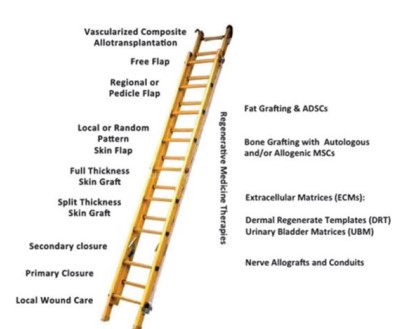
Hybrid Reconstruction Ladder
Ravi Kumar Chittoria, Jacob Antony Chakiath
Author Information
Licence:
Attribution-Non-commercial 4.0 International (CC BY-NC 4.0)This license enables reusers to distribute, remix, adapt, and build upon the material in any medium or format for noncommercial purposes only, and only so long as attribution is given to the creator.
Journal of Global Public Health 4(2):p 75-80, July-December 2022. | DOI: NA
How Cite This Article:
Jacob Antony Chakiath, Ravi Kumar Chittoria/Hybrid Reconstruction Ladder/Journal of Global Public Health. 2022; 4(2):75–80.Timeline
Received : July 21, 2022
Accepted : August 23, 2022
Published : December 25, 2022
Abstract
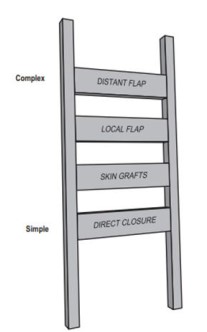
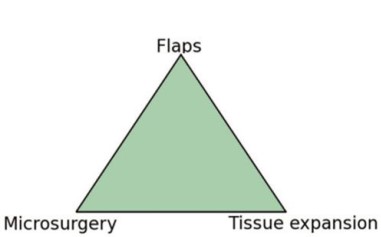
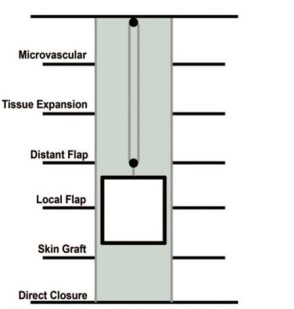
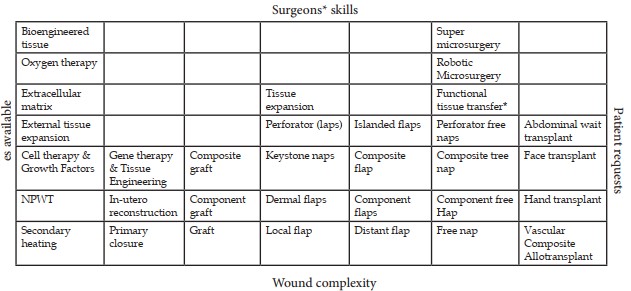
Combat operations expose military service members and civilians to the devastating effects of high-energy munitions that often lead to a complex pattern of injury. This complex injury pattern has initiated efforts to create new and innovative techniques in tissue regeneration. Multidisciplinary team has effectively adapted advanced reconstructive techniques merged with regenerative medicine modalities to improve outcomes in combat casualties. These treatments combine traditional reconstruction measures with regenerative medicine applications and has been termed ‘hybrid reconstructions’. This review article gives an overview about hybrid reconstruction ladder.
References
- 1. Fleming ME, Bharmal H, Valerio I. Regenerative medicine applications in combat casualty care. Regen Med 2014;9:179–190.
- 2. Mathes SJ, Nahai F. Reconstructive Surgery: Principles, Anatomy & Technique. Vol. 2. New York: Churchill Livingstone; St. Louis: Quality Medical; 1997.
- 3. Gottlieb LJ, Krieger LM. From the reconstructive ladder to the reconstructive elevator. PlastReconstr Surg. 1994;93:1503– 1504.
- 4. Wong CJ, Niranjan N. Reconstructive stages as an alternative to the reconstructive ladder. PlastReconstr Surg. 2008;121: 362e–363e.
- 5. Erba P, Ogawa R, Vyas R, Orgill D. The reconstructive matrix: A new paradigm in reconstructive plastic surgery. PlastReconstr Surg. 2010;126:492–298.
- 6. Mohapatra, Devi Prasad M.Ch.;Thiruvoth, FrijiMeethale M.Ch. Reconstruction 2.0: Restructuring the Reconstructive Ladder, Plastic and Reconstructive Surgery: March 2021 - Volume 147 - Issue 3 - p 572e-573e.
- 7. Vedder NB. Wei FC, Mardini S, eds. Problem analysis in reconstructive surgery: Reconstructive ladders, elevators, and surgical judgment. In: Flaps and Reconstructive Surgery. 2017:2nd ed. Toronto: Elsevier; 1–5.
- 8. Bernstein JL, Cohen BP, Lin A, Harper A, Bonassar LJ, Spector JA. Tissue engineering auricular cartilage using late passage human auricular chondrocytes. Ann Plast Surg. 2018;80(Suppl 4):S168–S173.
- 9. Roh DS, Li EB, Liao EC. CRISPR craft: DNA editing the reconstructive ladder. PlastReconstr Surg. 2018;142:1355–1364.
- 10. Owens BD, Kragh JF Jr, Macaitis J, Svoboda SJ, Wenke JC. Characterization of extremity wounds in Operation Iraqi Freedom and Operation Enduring Freedom. J. Orthop. Trauma 21(4), 254–257 (2007).
- 11. Fleming M, Waterman S, Dunne J, D’Alleyrand JC, Andersen RC. Dismounted complex blast injuries: patterns of injuries and resource utilization associated with the multiple extremity amputee. J. Surg. Orthop. Adv. 21(1), 32–37 (2012).
- 12. Masini BD, Waterman SM, Wenke JC, Owens BD, Hsu JR, Ficke JR. Resource utilization and disability outcome assessment of combat casualties from Operation Iraqi Freedom and Operation Enduring Freedom. J. Orthop. Trauma 23(4), 261–266 (2009).
- 13. Belmont PJ Jr, Thomas D, Goodman GP et al. Combat musculoskeletal wounds in a US Army Brigade Combat Team during operation Iraqi Freedom. J. Trauma 71(1), e1–e7 (2011).
- 14. Deal DN, Griffin JW, Hogan MV. Nerve conduits for nerve repair or reconstruction. J. Am. Acad. Orthop. Surg. 20(2), 63–68 (2012).
- 15. Hudson TW, Zawko S, Deister C et al. Optimized acellular nerve graft is immunologically tolerated and supports regeneration. Tissue Eng. 10(11–12), 1641–1651 (2004).
- 16. Whitlock EL, Tuffaha SH, Luciano JP et al. Processed allografts and type I collagen conduits for repair of peripheral nerve gaps. Muscle Nerve 39(6), 787–799 (2009).
- 17. Mackinnon SE, Doolabh VB, Novak CB, Trulock EP. Clinical outcome following nerve allograft transplantation. Plast. Reconstr. Surg. 107(6), 1419– 1429 (2001).
- 18. Ficke JR, Obremskey WT, Gaines RJ et al. Reprioritization of research for combat casualty care. J. Am. Acad. Orthop. Surg. 20 (Suppl. 1), S99–S102 (2012). • Discusses the research gaps and the need for reprioritization of research in combat casualty care.
- 19. Turner NJ, Badylak SF. Biologic scaffolds for musculotendinous tissue repair. Eur. Cell Mater. 25, 130–143 (2013).
- 20. Siemionow M, Uygur S, Ozturk C, Siemionow K. Techniques and materials for enhancement of peripheral nerve regeneration: a literature review. Microsurgery 33(4), 318–328 (2013).
- 21. Tenenhaus M, Rennekampff HO. Surgical advances in burn and reconstructive plastic surgery: new and emerging technologies. Clin. Plast. Surg. 39(4), 435– 443 (2012).
- 22. Kokemueller H, Spalthoff S, Nolff M et al. Prefabrication of vascularized bioartificial bone grafts in vivo for segmental mandibular reconstruction: experimental pilot study in sheep and first clinical application. Int. J. Oral Maxillofac. Surg. 39(4), 379–387 (2010).
- 23. Kneser U, Polykandriotis E, Ohnolz J et al. Engineering of vascularized transplantable bone tissues: induction of axial vascularization in an osteoconductive matrix using an arteriovenous loop. Tissue Eng. 12(7), 1721–1731 (2006).
- 24. Murphy BD, Zuker RM, Borschel GH. Vascularized composite allotransplantation: an update on medical and surgical progress and remaining challenges. J. Plast. Reconstr. Aesthet. Surg. 66(11), 1449–1455 (2013).
- 25. Erkin UR, Kerem M, Tug M, Orbay H, Sensöz O. Prefabrication of a conjoint flap containing xenogenic tissues: a preliminary report on an experimental model. J. Craniofac. Surg. 18(6), 1451– 1456 (2007).
Data Sharing Statement
There are no additional data available. All raw data and code are available upon request.
Funding
This research received no funding.
Author Contributions
All authors contributed significantly to the work and approve its publication.
Ethics Declaration
This article does not involve any human or animal subjects, and therefore does not require ethics approval.
Acknowledgements
We would like to express our gratitude to the patients, their families, and all those who have contributed to this study.
Conflicts of Interest
No conflicts of interest in this work.
About this article

Cite this article
Jacob Antony Chakiath, Ravi Kumar Chittoria/Hybrid Reconstruction Ladder/Journal of Global Public Health. 2022; 4(2):75–80.
Licence:
Attribution-Non-commercial 4.0 International (CC BY-NC 4.0)This license enables reusers to distribute, remix, adapt, and build upon the material in any medium or format for noncommercial purposes only, and only so long as attribution is given to the creator.
| Received | Accepted | Published |
|---|---|---|
| July 21, 2022 | August 23, 2022 | December 25, 2022 |
DOI: NA
Keywords
Reconstruction ladderWoundHybridSearch for Similar Articles
Similar Articles
- Cluster System to be Implemented in Telangana State
- Back Massage in Labour in First Phase of Delivery: Benefits and Techniques
- Management of a COVID Positive Electrical Burn Patient: Challenges and Our Exper...
- Factors Influencing Help-seeking to One-stop Crisis Centers: Unveiling the Wound...
- Assessment of Quality of Life in Oral Squamous Cell Carcinoma Patients of Centra...
Article Level Metrics
Last UpdatedSaturday 05 September 2026, 10:55:18 (IST)
763
Accesses
2
101
00
Citations
NA
NA
NA
Download citation
Article Keywords
Keyword Highlighting
Highlight selected keywords in the article text.
Timeline
| Received | July 21, 2022 |
| Accepted | August 23, 2022 |
| Published | December 25, 2022 |
licence
Attribution-Non-commercial 4.0 International (CC BY-NC 4.0)
This license enables reusers to distribute, remix, adapt, and build upon the material in any medium or format for noncommercial purposes only, and only so long as attribution is given to the creator.