Full Text (PDF)
Journal of Global Public Health 4(2):p 65-71, July-December 2022. | DOI: NA
Original Article
Factors Influencing Help-seeking to One-stop Crisis Centers: Unveiling the Wounds of Violence Against Women
Shuvashis Saha, Mohammad Kabir Uddin, Shajib Kumar Hazari
Author Information
Licence:
Attribution-Non-commercial 4.0 International (CC BY-NC 4.0)This license enables reusers to distribute, remix, adapt, and build upon the material in any medium or format for noncommercial purposes only, and only so long as attribution is given to the creator.
Journal of Global Public Health 4(2):p 65-71, July-December 2022. | DOI: NA
How Cite This Article:
Shuvashis Saha, Mohammad Kabir Uddin, Shajib Kumar Hazari/Factors Influencing Help-seeking to One-stop Crisis Centers: Unveiling the Wounds of Violence Against Women/Journal of Global Public Health. 2022; 4(2):65–71.Timeline
Received : July 12, 2022
Accepted : August 15, 2022
Published : December 25, 2022
Abstract
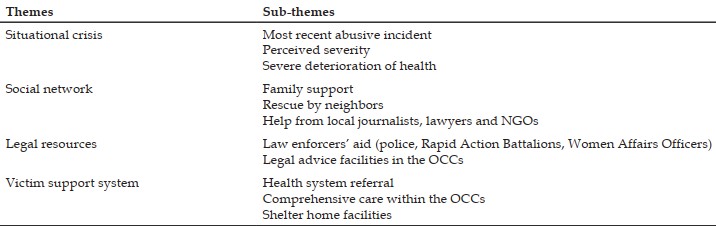
Objective: This study aims to explore the factors that influenced help-seeking to the One-stop Crisis Centers (OCCs) by the victims of violence against women (VAW) in Bangladesh. Methods: A qualitative document analysis of 146 case studies of victims from OCCs of different tertiary hospitals was done. Data were retrieved from the official Newsletters published between 2008 to 2018. Result: Four distinct themes emerged which influenced victims' help-seeking to OCCs: i) situational crisis, ii) social network, iii) legal resources, and iv) victims support system. Conclusion: Recognizing the influencing factors of help-seeking to OCCs by the victims of VAW might help the policymakers to identify the most important gatekeepers and channels to OCCs. Greater disclosure and helpseeking can be achieved through greater community indulgence.
References
- 1. WHO. Global and regional estimates of violence against women: prevalence and health effects of intimate partner violence and non-partner sexual violence. World Health Organization, 2013.[Cited 2020 December 11]. Available from: https://apps.who.int/iris/bitstream/ handle/10665/85239/9789241564625_eng.pdf.
- 2. WHO. Responding to intimate partner violence and sexual violence against women: WHO clinical and policy guidelines.World Health Organization, 2013.
- 3. WHO. Violence against women- key facts.World Health Organization, 2017, November 29. [Cited 2020 December 11]. Available from: https://www. who.int/news-room/fact-sheets/detail/violenceagainst-women.
- 4. WHO. WHO multi-country study on women's health and domestic violence against women: Initial results on prevalence, health outcomes and women's responses. World Health Organization, 2005. [Cited 2020 December 11]. Available from: https://apps.who.int/iris/bitstream/ handle/10665/43309/924159358X_eng.pdf.
- 5. ChowdhuryMAK, Rahman, AE, MoriumS, Hasan MM, Bhuiyan A, Arifeen SE. Domestic violence against women in urban slums of Bangladesh: a crosssectional survey. J Interpersonal violence.August 2018. https://doi.org/10.1177/0886260518791235.
- 6. Hasnat MA. We can’t talk about rape. Dhaka Tribune. 2017; May 14.pp. 2.. [Cited 2020 December 12]. Available from: https://www.yumpu.com/ en/document/view/58484191/e-paper-sundaymay-14-2017.
- 7. Islam R. Rights situation remains alarming. The Daily Star. 2018, January 1. [Cited 2020 December 12] Available from: https://www.thedailystar. n e t / f r o n t p a g e / r i g h t s - s i t u a t i o n - r e m a i n s - alarming-1513159.
- 8. WahedT, Bhuiya A. Battered bodies & shattered minds: Violence against women in Bangladesh. Indian J Medical Research 2007; 126(4): 341.[Cited 2020 December 15] Available from:https://search. proquest.com/openview/79daff7f5dbc0b1dae5ee d534ea7a9a2/1?pq-origsite=gscholar&cbl=37533; 2020.
- 9. Kamimura A, Bybee D, Yoshihama M. Factors Affecting Initial Intimate Partner Violence–Specific Health Care Seeking in the Tokyo Metropolitan Area, Japan. J Interpersonal Violence, 2014; 29(13): 2378- 2393. https://doi.org/10.1177/0886260513518842.
- 10. Bui HN. Help-Seeking Behavior Among Abused Immigrant Women: A Case of Vietnamese American Women. Violence Against Women 2003; 9(2):207- 239. https://doi.org/10.1177/1077801202239006.
- 11. Estrellado AF, Loh J. Factors associated with battered Filipino women’s decision to stay in or leave an abusive relationship. J Interpersonal Violence 2014; 29(4): 575-592. https://doi. org/10.1177/0886260513505709.
- 12. Hodges TA, Cabanilla AS.Factors that impact helpseeking among battered Black women: application of critical and survivor theories.J Cultural diversity 2011; 18(4).
- 13. Kim JY, Lee JH. Factors influencing helpseeking behavior among battered Korean women in intimate relationships. J Interpersonal Violence 2011; 26(15): 2991-3012.https://doi. org/10.1177/0886260510390946.
- 14. Taherkhani S, Negarandeh R, Simbar M, Ahmadi F. Barriers to seeking help among abused Iranian women. J Adult Protection 2017; 19(5): 261-273. https://doi.org/10.1108/JAP-03-2017-0007.
- 15. Colombini M, Mayhew S, Watts C. Health-sector responses to intimate partner violence in low-and middle-income settings: a review of current models, challenges and opportunities. Bulletin of the World health Organization 2008; 86: 635-642.
- 16. Multi-Sectoral Program on violence Against Women (MSPVAW). Ministry of Women and Children Affairs,Government of Bangladesh, 2021. [Cited 2020 December 17] Available from: http:// mspvaw.gov.bd/contain/29.
- 17. CDC. The Social-Ecological Model: A Framework for Prevention.CCD; 2020 January 28. [Cited 2020 December 23] Available from: https://www.cdc. gov/violenceprevention/publichealthissue/socialecologicalmodel.html.
- 18. Bowen GA. Document Analysis as a Qualitative Research Method. Qualitative Research J 2009; 9 (2): 27-40. https://doi.org/10.3316/QRJ0902027.
- 19. Braun V, Clarke V. Using thematic analysis in psychology. Qual Res Psychol 2006; 3(2): 77e101.
- 20. Ahmad F, Driver N, McNally MJ, Stewart DE.
- 21. Fanslow JL, Robinson EM. Help-seeking behaviors and reasons for help seeking reported by a representative sample of women victims of intimate partner violence in New Zealand. J Interpersonal Violence 2010: 25(5): 929-951. https://doi. org/10.1177/0886260509336963.
- 22. Parvin K, Sultana N, Naved RT. Disclosure and help seeking behavior of women exposed to physical spousal violence in Dhaka slums. BMC public health 2016; 16(1): 383. DOI: 10.1186/s12889-016- 3060-7.
- 23. Zaman H. Violence against women in Bangladesh: issues and responses. In Women's Studies International Forum 1999; 22(1): 37-48. https://doi. org/10.1016/S0277 5395(98)00093-4.
- 24. Naved RT, Azim S, Bhuiya A, Persson LA. Physical violence by husbands: magnitude, disclosure and help-seeking behavior of women in Bangladesh. Social science & medicine 2006; 62(12): 2917–2929. https://doi.org/10.1016/j.socscimed.2005.12.001.
- 25. Naved RT, Persson LA. Dowry and spousal physical violence against women in Bangladesh. J Family Issues 2010; 31(6): 830-856. https://DOI: 10.1177/0192513X09357554.
- 26. Das TK, Alam MF, Bhattacharyya R, Pervin A. Causes and contexts of domestic violence: Tales of help-seeking married women in Sylhet, Bangladesh. Asian Social Work and Policy Review 2015; 9(2): 163-176.https://doi.org/10.1111/aswp.12055.
- 27. Macy RJ, RizoCF, Ermentrout DM. Characteristics, needs, and help seeking of partner violence victims mandated to community services by courts and child protective services. Am J Orthopsychiatry 2013; 83(4): 588-599. https://doi.org/10.1111/ ajop.12049.
- 28. Grossman SF, Lundy M, George CC, CrabtreeNelson S. Shelter and service receipt for victims of domestic violence in Illinois. J Interpersonal violence 2010; 25(11): 2077-2093. https://doi. org/10.1177/0886260509354505.
- 29. World Health Organization.Primary health care systems (PRIMASYS): case study from Bangladesh, abridged version. World Health Organization,Geneva; 2017. License: CC BY-NC-SA 3.0 IGO.
Data Sharing Statement
There are no additional data available. All raw data and code are available upon request.
Funding
This research received no funding.
Author Contributions
All authors contributed significantly to the work and approve its publication.
Ethics Declaration
This article does not involve any human or animal subjects, and therefore does not require ethics approval.
Acknowledgements
We would like to express our gratitude to the patients, their families, and all those who have contributed to this study.
Conflicts of Interest
No conflicts of interest in this work.
About this article

Cite this article
Shuvashis Saha, Mohammad Kabir Uddin, Shajib Kumar Hazari/Factors Influencing Help-seeking to One-stop Crisis Centers: Unveiling the Wounds of Violence Against Women/Journal of Global Public Health. 2022; 4(2):65–71.
Licence:
Attribution-Non-commercial 4.0 International (CC BY-NC 4.0)This license enables reusers to distribute, remix, adapt, and build upon the material in any medium or format for noncommercial purposes only, and only so long as attribution is given to the creator.
| Received | Accepted | Published |
|---|---|---|
| July 12, 2022 | August 15, 2022 | December 25, 2022 |
DOI: NA
Keywords
Violence against womenOne-stop Crisis CentersComprehensive care;Comprehensive careHelp-seekingSexual violenceSpousal violenceVictims support systemSearch for Similar Articles
Similar Articles
- Cluster System to be Implemented in Telangana State
- Back Massage in Labour in First Phase of Delivery: Benefits and Techniques
- Management of a COVID Positive Electrical Burn Patient: Challenges and Our Exper...
- Hybrid Reconstruction Ladder
- Assessment of Quality of Life in Oral Squamous Cell Carcinoma Patients of Centra...
Article Level Metrics
Last UpdatedSaturday 05 September 2026, 10:54:20 (IST)
763
Accesses
4
101
00
Citations
NA
NA
NA
Download citation
Article Keywords
Keyword Highlighting
Highlight selected keywords in the article text.
Timeline
| Received | July 12, 2022 |
| Accepted | August 15, 2022 |
| Published | December 25, 2022 |
licence
Attribution-Non-commercial 4.0 International (CC BY-NC 4.0)
This license enables reusers to distribute, remix, adapt, and build upon the material in any medium or format for noncommercial purposes only, and only so long as attribution is given to the creator.