Full Text (PDF)
Indian Journal of Genetics and Molecular Research 11(2):p 69-77, july-december 2022. | DOI: https://doi.org/10.21088/ijgmr.2319.4782.11222.4
Review Article
Genetic Insight into Familial and Sporadic Alzheimer’s Disease
Author Information
Licence:
Attribution-Non-commercial 4.0 International (CC BY-NC 4.0)This license enables reusers to distribute, remix, adapt, and build upon the material in any medium or format for noncommercial purposes only, and only so long as attribution is given to the creator.
Indian Journal of Genetics and Molecular Research 11(2):p 69-77, july-december 2022. | DOI: https://doi.org/10.21088/ijgmr.2319.4782.11222.4
How Cite This Article:
Bibhas Kar, Ireen Femeela/Genetic Insight into Familial and Sporadic Alzheimer’s Disease/Indian J Genet Mol Res. 2022; 11(2):69–77.Timeline
Received : April 16, 2022
Accepted : May 25, 2022
Published : December 30, 2022
Abstract
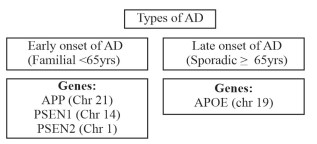
Alzheimer’s disease (AD) is a neurodegenerative disorder and common form of dementia in elderly patients, accounting for 60 to 80 percent of cases worldwide. The hallmark of AD is deposition of neurofibrillary tangles and amyloid plaques in the brain that lead to neurotoxicity and irreversible loss of neurons in the hippocampus and cortex. Based on the onset of age, AD can be classified into early onset (<65 years) and late-onset (≥ 65 years) groups. Genetic factors such as gene mutation as well as environmental factors both can trigger the disease pathogenesis. The preliminary diagnosis can be performed based on the specific clinical symptoms and genetic analysis can help in establishing the familial cases. Treatments are suggested according to the stages of AD, such as mild, moderate, and severe, based on the clinical symptoms and the diagnosis of the patients.This review focuses on overall AD.
References
- 1. Zou Z, Liu C, Che C, Huang H. Clinical genetics of Alzheimer’s disease. Biomed Res Int. 2014;2014:291862.
- 2. Korolev IO. Alzheimer ’s disease : A clinical and basic science review. Medical Student Research Journal. 2014;4(Fall):24–33.
- 3. Defina PA, Moser RS, Glenn M, Lichtenstein JD, Fellus J. Alzheimer’s disease clinical and research update for health care practitioners. J Aging Res. 2013;2013:207178.
- 4. Van Giau V, Bagyinszky E, Yang YS, Youn YC, An SSA, Kim SY. Genetic analyses of earlyonset Alzheimer’s disease using next generation sequencing. Sci Rep. 2019;9(1):8368.
- 5. Giri M, Zhang M, Lü Y. Genes associated with Alzheimer’s disease: An overview and current status. Clin Interv Aging. 2016;11:665–681.
- 6. Meraz-Ríos MA, Franco-Bocanegra D, Toral Rios D, Campos-Peña V. Early onset Alzheimer’s disease and oxidative stress. Oxid Med Cell Longev. 2014;2014:375968.
- 7. Rabinovici GD. Late-onset Alzheimer's disease. Continuum (Minneap Minn). 2019;25(1):14–33. 8. Bekris LM, Yu C-E, Bird TD, Tsuang DW. Genetics of Alzheimer disease. J Geriatr Psychiatry Neurol. 2010;23(4):213–227.
- 9. Cedazo-Mínguez A. Apolipoprotein E and Alzheimer’s disease: Molecular mechanisms and therapeutic opportunities. J Cell Mol Med. 2007;11(6):1227–1238.
- 10. Kumar A, Singh A, Ekavali. A review on Alzheimer’s disease pathophysiology and its management: An update. Pharmacol Rep. 2015;67(2):195–203.
- 11. Alzheimer's Association. Alzheimers disease facts and figures. Alzheimers Dement. 2021;17(3):327- 406.
- 12. DeTure MA, Dickson DW. The neuropathological diagnosis of Alzheimer’s disease. Mol Neurodegener. 2019;14(1):32. .
- 13. Galimberti D, Scarpini E. Treatment of Alzheimer’s disease: Symptomatic and disease-modifying approaches. Curr Aging Sci. 2010;3(1):46–56.
- 14. Sanabria-Castro A, Alvarado-Echeverría I, MongeBonilla C. Molecular pathogenesis of Alzheimer’s disease: An update. Ann Neurosci. 2017;24(1):46–54.
- 15. Dai M-H, Zheng H, Zeng L-D, Zhang Y. The genes associated with early-onset Alzheimer’s disease. Oncotarget. 2018;9(19):15132–15143.
- 16. Chen X-Q, Mobley WC. Alzheimer's disease pathogenesis: Insights from molecular and cellular biology studies of oligomeric Aβ and tau species. Front Neurosci. 2019;13:659.
- 17. Bi C, Bi S, Li B. Processing of mutant β-amyloid precursor protein and the clinicopathological features of familial Alzheimer’s disease. Aging Dis. 2019;10(2):383. .
- 18. Tcw J, Goate AM. Genetics of β-amyloid precursor protein in Alzheimer's disease. Cold Spring Harb Perspect Med. 2017;7(6):a024539.
- 19. Swerdlow RH. Pathogenesis of Alzheimer's disease. Clin Interv Aging. 2007;2(3):347-359.
- 20. Head E, Phelan M, Doran E, Kim R, Poon W, Schmitt F, Lott I. Cerebrovascular pathology in Down syndrome and Alzheimer's disease. Acta Neuropathol Commun. 2017;5(1):93.
- 21. Portelius E, Soininen H, Andreasson U, Zetterberg H, Persson R, Karlsson G, Blennow K, Herukka S, Mattsson N. Exploring Alzheimer molecular pathology in Down syndrome cerebrospinal fluid. Neurodegener Dis. 2014;14(2):98-106.
- 22. Cipriani G, Danti S, Carlesi C, Di Fiorino M. Aging with Down syndrome: The dual diagnosis: Alzheimers disease and Down syndrome. Am J Alzheimers Dis Other Dement. 2018;33(4):253-262.
- 23. An S, Cai Y, Kim S. Mutations in presenilin 2 and its implications in Alzheimer’s disease and other dementia-associated disorders. Clinical Interv Aging. 2015; 10: 1163.1172.
- 24. Van Cauwenberghe C, Van Broeckhoven C, Sleegers K. The genetic landscape of Alzheimer disease: clinical implications and perspectives. Genet Med. 2016;18(5):421-430.
- 25. Dai MH, Zheng H, Zeng LD, Zhang Y. The genes associated with early-onset Alzheimer's disease. Oncotarget. 2017;9(19):15132-15143.
- 26. Lanoiselée H, Nicolas G, Wallon D, Rovelet-Lecrux A, Lacour M, Rousseau S, et al., APP, PSEN1, and PSEN2 mutations in early-onset Alzheimer's disease: A genetic screening study of familial and sporadic cases. PLoS Med. 2017;14(3):e1002270.
- 27. Sonntag K, Ryu W, Amirault K, Healy R, Siegel A, McPhie D, Forester B, Cohen B. Late-onset Alzheimer’s disease is associated with inherent changes in bioenergetics profiles. Sci Rep. 2017;7(1): 14038.
- 28. Kim J, Basak J, Holtzman D. The role of apolipoprotein E in Alzheimer's disease. Neuron. 2009;63(3):287-303.
- 29. Dong S, Duan Y, Hu Y, Zhao Z. Advances in the pathogenesis of Alzheimer’s disease: A reevaluation of amyloid cascade hypothesis. Trans Neurodegener. 2012;1:18.
- 30. Lahiri D, Sambamurti K, Bennett D. Apolipoprotein gene and its interaction with the environmentally driven risk factors: Molecular, genetic and epidemiological studies of Alzheimer’s disease. Neurobiol Aging. 2004;25(5):651-660.
- 31. Olgiati P, Politis A, Papadimitriou G, De Ronchi D, Serretti A. Genetics of late-onset Alzheimer's disease: Update from the Alzgene Database and Analysis of Shared Pathways. Int J Alzheimers Dis 2011;2011:832379.
- 32. Khanahmadi M, Farhud DD, Malmir M, Orang S. Some biochemical Markers in patients with Alzheimer's disease. Iran J Public Health. 2016;45(10):1355-1358.
- 33. Holtzman D, Herz J, Bu G. Apolipoprotein E and Apolipoprotein E receptors: Normal biology and roles in Alzheimer's disease. Cold Spring Harb Perspect Med. 2012;2(3):a006312-a006312. 34. Mendez M. Early-onset Alzheimer's disease and its variants. Continuum (Minneap Minn). 2019;25(1):34-51.
- 35. Isik A. Late onset Alzheimer’s disease in older people. Clini Interv Aging. 2010;5:307-311.
- 36. Turner RS. Alzheimer's disease. Semin Neurol. 2006;26(5):499-506.
- 37. Cummings J, Tong G, Ballard C. Treatment combinations for Alzheimer’s disease: Current and future pharmacotherapy options. J Alzheimers Dis. 2019;67(3):779-794.
- 38. Neugroschl J, Wang S. Alzheimer's disease: diagnosis and treatment across the spectrum of disease severity. Mt Sinai J Med. 2011;78(4):596-612.
- 39. Bird T. Genetic aspects of Alzheimer's disease. Genet Med. 2008;10(4):231-239.
- 40. Baldwin S, Farias S. Neuropsychological assessment in the diagnosis of Alzheimer's disease. Curr Proto. Neurosc. 2009; 0.10:10.3.
- 41. DeFina P, Moser R, Glenn M, Lichtenstein J, Fellus J. Alzheimer's disease clinical and research update for health care practitioners. J Aging Res. 2013;2013: 207178.
- 42. Schachter A, Davis K. Alzheimer’s disease. Curr Treat Options Neurol. 2000;2(1):51-60.
- 43. Tellechea P, Pujol N, Esteve-Belloch P, Echeveste B, García-Eulate MR, Arbizu J, Riverol M. Early- and late-onset Alzheimer disease: Are they the same entity? Neurologia. 2018;33(4):244-253.
- 44. Bondi M, Edmonds E, Salmon D. Alzheimer’s disease: Past, present, and future. J Int Neuropsychol Soc. 2017;23(9-10):818-831.
- 45. Yiannopoulou KG, Papageorgiou SG. Current and future treatments for Alzheimer's disease. Ther Adv Neurol Disord. 2013;6(1):19-33.
- 46. Liu P, Xie Y, Meng X, Kang J. History and progress of hypotheses and clinical trials for Alzheimer’s disease. Signal Transduct Target Therapy. 2019;4:29.
- 47. Weller J, Budson A. Current understanding of Alzheimer's disease diagnosis and treatment. 2018; 7 : F 1000 Faculty Rev-1161.
Data Sharing Statement
There are no additional data available. All raw data and code are available upon request.
Funding
This research received no funding.
Author Contributions
All authors contributed significantly to the work and approve its publication.
Ethics Declaration
This article does not involve any human or animal subjects, and therefore does not require ethics approval.
Acknowledgements
We would like to express our gratitude to the patients, their families, and all those who have contributed to this study.
Conflicts of Interest
No conflicts of interest in this work.
About this article

Cite this article
Bibhas Kar, Ireen Femeela/Genetic Insight into Familial and Sporadic Alzheimer’s Disease/Indian J Genet Mol Res. 2022; 11(2):69–77.
Licence:
Attribution-Non-commercial 4.0 International (CC BY-NC 4.0)This license enables reusers to distribute, remix, adapt, and build upon the material in any medium or format for noncommercial purposes only, and only so long as attribution is given to the creator.
| Received | Accepted | Published |
|---|---|---|
| April 16, 2022 | May 25, 2022 | December 30, 2022 |
DOI: https://doi.org/10.21088/ijgmr.2319.4782.11222.4
Keywords
Early onsetLate onsetNeurofibrillary tanglesTau proteinSearch for Similar Articles
Similar Articles
- Success After Unexplained Multiple Miscarriages using PGT-A and PGT-M for RELN G...
- A Translational Strategy to Overcome Platinum Resistance in Ovarian Cancer via...
- Bridging Classic Cytogenetics with Modern Chromosomics: A Historical and Scienti...
- Mitochondrial D-Loop and HBB Gene Profiling in Antenatal Hemoglobinopathy Carrie...
- Histopathologic Features of High Grade Serous Ovarian Carcinomas Associated with...
Article Level Metrics
Last UpdatedTuesday 20 October 2026, 08:31:45 (IST)
2261
Accesses
41
325
00
Citations
NA
NA
NA
Download citation
Article Keywords
Keyword Highlighting
Highlight selected keywords in the article text.
Timeline
| Received | April 16, 2022 |
| Accepted | May 25, 2022 |
| Published | December 30, 2022 |
licence
Attribution-Non-commercial 4.0 International (CC BY-NC 4.0)
This license enables reusers to distribute, remix, adapt, and build upon the material in any medium or format for noncommercial purposes only, and only so long as attribution is given to the creator.