Full Text (PDF)
Indian Journal of Agriculture Business 10(1):p 49-53, January - June 2024. | DOI: https://doi.org/10.21088/ijab.2454.7964.10124.7
Case Report
Farmer Producer Company: A Case Study of Coimbatore Coconut Producer Company Limited, Coimbatore, Tamil Nadu
K. Kalidas, S. Nandhitha, K. Sandhya, T. Selvanivethini, V. Vanathi
Author Information
Licence:
Attribution-Non-commercial 4.0 International (CC BY-NC 4.0)This license enables reusers to distribute, remix, adapt, and build upon the material in any medium or format for noncommercial purposes only, and only so long as attribution is given to the creator.
Indian Journal of Agriculture Business 10(1):p 49-53, January - June 2024. | DOI: https://doi.org/10.21088/ijab.2454.7964.10124.7
How Cite This Article:
Kalidas K, Nandhitha S, Sandhya K, Selvanivethini T, Vanathi V. Farmer Producer Company: A Case Study of Coimbatore Coconut Producer Company Limited, Coimbatore, Tamil Nadu. Indian J Agri Busi. 2024;10(1):49-53.Timeline
Received : February 26, 2024
Accepted : March 30, 2024
Published : June 30, 2024
Abstract
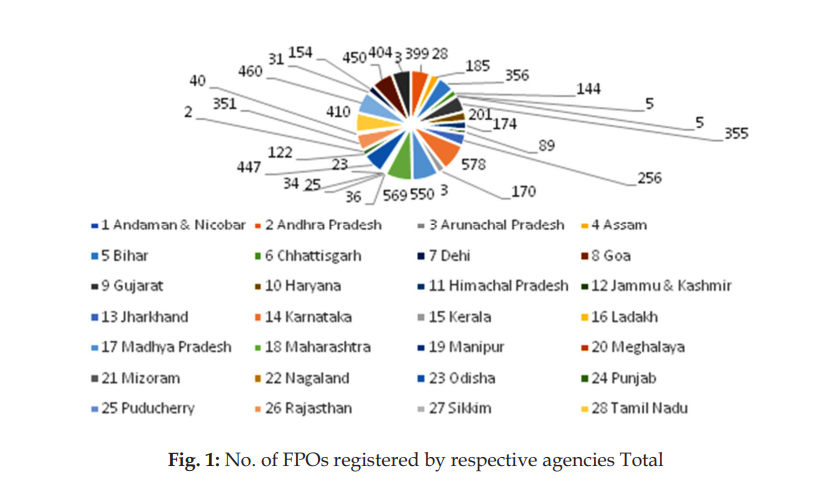
Agriculture, as the primary sector of the Indian economy, employs about two-thirds of the Indian people and contributes approximately 20. 19% of the nation's GDP; thus, agriculture is proudly referred to as India's backbone. The number of farms has more than doubled since the first agriculture census 45 years ago, from 70 million in 1970 to 145 million in 2015 and counting. This means a larger population in an ever-shrinking landholding, resulting in growing population pressure and widespread underemployment. Farmers are frequently harmed by inefficiencies in the transportation system. This makes them reliant on middlemen, reducing any profit (Business World, 2022). In India, Farmer Producer Organisations (FPOs) have arisen as a new type of aggregation model. The Central Sector Scheme for "Formation and Promotion of 10,000 Farmer Producer Organisations (FPOs)" has been approved and launched by the Government of India. Initially, one FPO is assigned to each block. So far, 7059 new FPOs produce clusters have been assigned and formed. This study analyses the status of farmer producer companies promoted by various agencies in India and in particular, a case study about the FPC promoted in Coimbatore district of Tamil Nadu.
References
- 1. Ayoob, CP, and Aboobacker Siddeeq Kakkattuchali. 2020.
- 2. Kalidas, K, S Jiji, and M Sureka. 2014.
- 3. Padmaja, Subash Surendran, Jaya K Ohja, Arathy Ashok, and Vinayak Ramesh Nikam.
- 4. Panda, Asish Kumar, and JeevanArakal.
- 5. PIB. 2023. Highlights of 2022-23. New Delhi: Government of India.
Data Sharing Statement
There are no additional data available.
Funding
This research received no funding.
Author Contributions
All authors contributed significantly to the work and approve its publication.
Ethics Declaration
This article does not involve any human or animal subjects, and therefore does not require ethics approval.
Acknowledgements
Information not provided.
Conflicts of Interest
The authors report no conflicts of interest in this work.
About this article

Cite this article
Kalidas K, Nandhitha S, Sandhya K, Selvanivethini T, Vanathi V. Farmer Producer Company: A Case Study of Coimbatore Coconut Producer Company Limited, Coimbatore, Tamil Nadu. Indian J Agri Busi. 2024;10(1):49-53.
Licence:
Attribution-Non-commercial 4.0 International (CC BY-NC 4.0)This license enables reusers to distribute, remix, adapt, and build upon the material in any medium or format for noncommercial purposes only, and only so long as attribution is given to the creator.
| Received | Accepted | Published |
|---|---|---|
| February 26, 2024 | March 30, 2024 | June 30, 2024 |
DOI: https://doi.org/10.21088/ijab.2454.7964.10124.7
Keywords
AggregationLand FragmentationFarmerProducer CompaniesSearch for Similar Articles
Similar Articles
- Studies on Bee and Pollination is Changing Environment: A Review
- Importance of Need Assessment for Development of Prog. for Rural Community
- Assessment of Sperm Damage with use of Unconventional Practices for Freeze Thawi...
- Diseases of Pulse Crops and their Management in India
- Expression of Natural Behaviour in Domestic Goats (Capra hircus): Implications f...
Article Level Metrics
Last UpdatedThursday 10 September 2026, 21:41:57 (IST)
2959
Accesses
17
418
00
Citations
NA
NA
NA
Download citation
Article Keywords
Keyword Highlighting
Highlight selected keywords in the article text.
Timeline
| Received | February 26, 2024 |
| Accepted | March 30, 2024 |
| Published | June 30, 2024 |
licence
Attribution-Non-commercial 4.0 International (CC BY-NC 4.0)
This license enables reusers to distribute, remix, adapt, and build upon the material in any medium or format for noncommercial purposes only, and only so long as attribution is given to the creator.