Full Text (PDF)
Journal of Biochemistry and Biophysics 7(1):p 21-28, January-June 2022. | DOI: https://doi.org/10.21088/rfpjbb.2582-3558.7122.3
Original Article
Extraction of Anthocyanins from Seasonal Flowers and Biological Activities of its Phytochemicals
Author Information
Licence:
Attribution-Non-commercial 4.0 International (CC BY-NC 4.0)This license enables reusers to distribute, remix, adapt, and build upon the material in any medium or format for noncommercial purposes only, and only so long as attribution is given to the creator.
Journal of Biochemistry and Biophysics 7(1):p 21-28, January-June 2022. | DOI: https://doi.org/10.21088/rfpjbb.2582-3558.7122.3
How Cite This Article:
Madhusudhan MC, S Lokesh / Extraction of Anthocyanins from Seasonal Flowers and Biological Activities of its Phytochemicals / JBB Journal of Biochemistry and Biophysics. 2022;7(1):21–28.Timeline
Received : March 02, 2022
Accepted : May 21, 2022
Published : June 26, 2022
Abstract
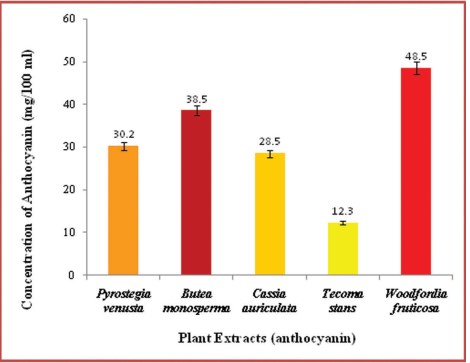
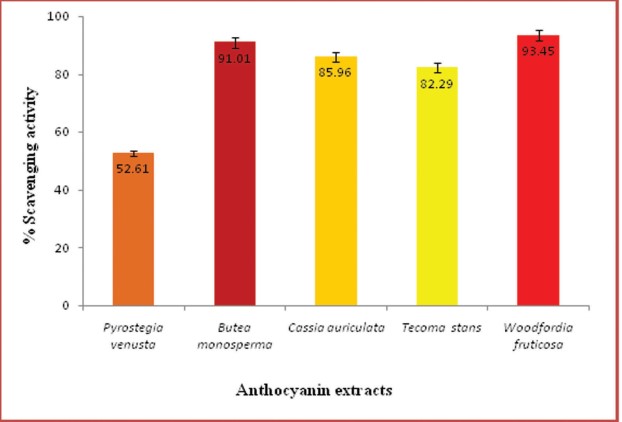
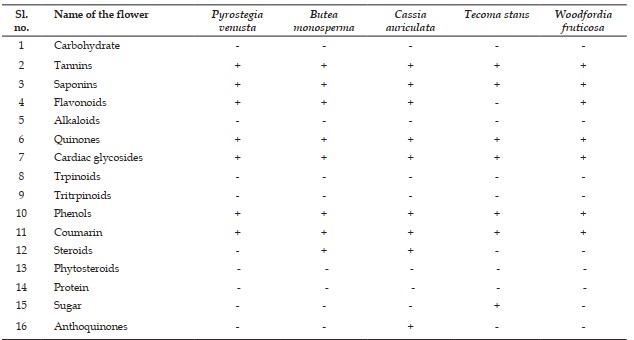
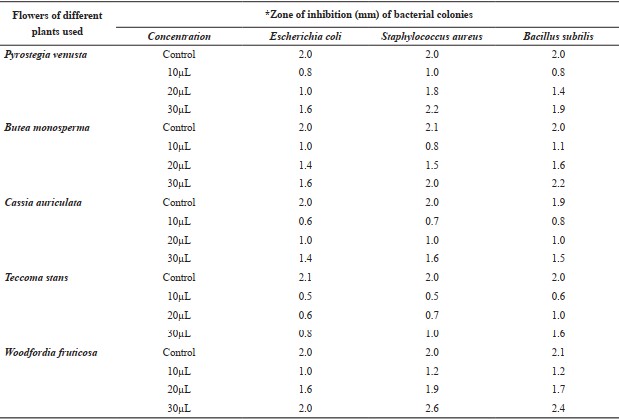
Anthocyanins are water soluble vacuolar pigments that, depending on their pH, may appear red, purple, or blue found in plants. In the current study anthocyanin colors were extracted from locally available flowers of the Pyrostegia venusta, Butea monosperma, Cassia auriculata, Tecoma stans and Woodfordia fruticosa using acidified methanol as a solvent. Obtained extracts were evaluated for their phytochemicals and assessed for its bioactivity such as antimicrobial (E coli, Staphylococcus aeries and Bacillus subtilis) and antioxidant properties. This flower extracts has shown considerably significant activities along with their coloring property. The results show the potential usage of these natural colorants in various coloring applications including food coloration, alternative to synthetic colors. The study also explores the utilization of easily available sources and value addition to waste products.
References
- 1. Chethana S, Chetan AN, Raghavarao KSMS. Aqueous two phase extraction for purification and concentration of betalains. J. Food Eng. 2007; 81: 679–687.
- 2. Chethana S, Chetan AN,Madhusudhan MC, Raghavarao KSMS.Single step aqueous twophase extraction for downstream processing of C-phycocyanin from Spirulina platensis.J. Food Sci. Technol.2015; 52(4): 2415-21.
- 3. Patil G, Madhusudhan MC, Ravindra B. Raghavarao KSMS.Extraction, dealcoholisation and concentration of anthocyanin from red radish peels. Chem. Eng. Process.2009; 1(48): 364–369.
- 4. Francis FJ. Food colourants: anthocyanins. Crit. Rev. Food Sci. Nutr.1989; 4(28): 273–314.
- 5. Liu X, Xiao G, Chen W, Xu Y, Wu J. Quantification and purification of mulberry anthocyanins with macroporous resins. J. Biomed. Biotechnol.2004; 5: 326–331
- 6. Jing P. GiustiMM. Effects of Extraction Conditions on Improving the Yield and Quality of an Anthocyanin-Rich Purple Corn (Zea mays L.) Color Extract. J. Food Sci.2007; 72(7): 363-368.
- 7. Chandrasekhar J, Madhusudhan MC, Raghavarao KSMS. Extraction of anthocyanins from red cabbage and purification using adsorption. Food Bioprod. Process.2012; 90(4): 615-623
- 8. Sujithra S, Manikkandan TR.Extraction of Anthocyanin from Banana (Musa paradisiaca) Flower Bract and Analysis of Phytochemicals, Antioxidant Activities and Anthocyanin Content.J. Chem. Pharm. Sci.2019; 12(3): 102-104
- 9. Jeyaraj EJ, Lim YY, Choo WS. Extraction methods of butterfly pea (Clitoria ternatea) flower and biological activities of its phytochemicals, J. Food Sci. Technol. 2021; 58(6): 2054–2067.
- 10. Mazza G, Francis FJ. Anthocyanins in grapes and grape products. Crit. Rev. Food Sci. Nutr.1995; 35(4): 341–371.
- 11. Wang LS, Hecht SS, Carmella SG et al. Anthocyanins in black raspberries prevent esophageal tumors in rats. Cancer Prev. Res. 2009;2(1): 84–93.
- 12. Faria A, Pestana D, Teixeira D et al. Blueberry anthocyanins and pyruvic acid adducts: anticancer properties in breast cancer cell lines. Phytother. Res.2010; 24(12): 1862–1869.
- 13. Cisowska A, Wojnicz D, Hendrich AB. Anthocyanins as antimicrobial agents of natural plant origin. Nat. Prod. Commun.2011; 6(1): 149–156.
- 14. Roewer N, Broscheit J. Delphinidin complex as an antiphlogistic or immunosuppressive active ingredient. U.S. Patent Application No. 14/443,166;2013.
- 15. Chen XY, Zhou J, Luo LP et al. Black rice anthocyanins suppress metastasis of breast cancer cells by targeting RAS/RAF/MAPK pathway. BioMed Res. Int. 2015; 2015: 414250.
- 16. Genskowsky E, Puente LA, Perez-Alvarez JA et al. Determination of polyphenolic profile, antioxidant activity and antibacterial properties of maqui [Aristotelia chilensis (Molina) Stuntz] a Chilean blackberry. J. Sci. Food Agric.2016; 96(12): 4235–4242.
- 17. Khoo HE, Azlan A, Tang ST, Lim SM. Anthocyanidins and anthocyanins: colored pigments as food, pharmaceutical ingredients, and the potential health benefits.Food Nutr. Res.2017; 61(1): 1361779.
- 18. Giusti M, Wrolstad RE. Acylated anthocyanins from edible sources and their applications in food systems. Biochem. Eng. J.2003; 14(3): 217–225.
- 19. Ugochukwu SC, Uche A, Ifeanyi O. Preliminary phytochemical screening of different solvent extracts of stem bark and roots of Dennettia tripetala G. Baker. Asian J. Plant Sci. Res.2013; 3:10-13.
- 20. Gonelimali FD, Lin J, Miao W, Xuan J, Charles F, Chen M, Hatab SR. Antimicrobial Properties and Mechanism of Action of Some Plant Extracts Against Food Pathogens and Spoilage Microorganisms. Front. Microbiol.2018; 9: 1639.
- 21. Williams WB, Cuvelier ME, Berset C. Use of a free radical method to evaluate antioxidant activity. LWT - Food Sci. Technol.1995; 28(1): 25-30.
Data Sharing Statement
There are no additional data available. All raw data and code are available upon request.
Funding
This research received no funding.
Author Contributions
All authors contributed significantly to the work and approve its publication.
Ethics Declaration
This article does not involve any human or animal subjects, and therefore does not require ethics approval.
Acknowledgements
We would like to express our gratitude to the patients, their families, and all those who have contributed to this study.
Conflicts of Interest
No conflicts of interest in this work.
About this article

Cite this article
Madhusudhan MC, S Lokesh / Extraction of Anthocyanins from Seasonal Flowers and Biological Activities of its Phytochemicals / JBB Journal of Biochemistry and Biophysics. 2022;7(1):21–28.
Licence:
Attribution-Non-commercial 4.0 International (CC BY-NC 4.0)This license enables reusers to distribute, remix, adapt, and build upon the material in any medium or format for noncommercial purposes only, and only so long as attribution is given to the creator.
| Received | Accepted | Published |
|---|---|---|
| March 02, 2022 | May 21, 2022 | June 26, 2022 |
DOI: https://doi.org/10.21088/rfpjbb.2582-3558.7122.3
Keywords
AnthocyaninNatural colorantMedicinal plantsAntioxidantsAntimicrobialsSearch for Similar Articles
Similar Articles
- Emergent Quantum Phenomena in Topological and Moiré Condensed Matter Systems: Re...
- The Molecular Architecture of Fragility: A Biophysical and Biochemical Dissectio...
- Silent Carcinogens at Home: Understanding Cancer Risks in Indian Kitchens
- Beyond Tone and Tissue: A Biochemical and Biophysical Perspective on Post-partum...
- GLP-1 Therapies as Essential Medicines: Opportunities and Barriers for Diabetes...
Article Level Metrics
Last UpdatedMonday 27 July 2026, 16:20:58 (IST)
862
Accesses
14
221
00
Citations
NA
NA
NA
Download citation
Article Keywords
Keyword Highlighting
Highlight selected keywords in the article text.
Timeline
| Received | March 02, 2022 |
| Accepted | May 21, 2022 |
| Published | June 26, 2022 |
licence
Attribution-Non-commercial 4.0 International (CC BY-NC 4.0)
This license enables reusers to distribute, remix, adapt, and build upon the material in any medium or format for noncommercial purposes only, and only so long as attribution is given to the creator.