Full Text (PDF)
Journal of Biochemistry and Biophysics 11(1):p 21-25, January 2026. | DOI: https://doi.org/10.21088/rfpjbb.2582-3558.11126.3
Review Article
Silent Carcinogens at Home: Understanding Cancer Risks in Indian Kitchens
Sachin C Narwadiya, Neha Suthar
Author Information
Licence:
Attribution-Non-commercial 4.0 International (CC BY-NC 4.0)This license
enables reusers to distribute, remix, adapt, and build upon the material in any
medium or format for noncommercial purposes only, and only so long as
attribution is given to the creator.
Journal of Biochemistry and Biophysics 11(1):p 21-25, January 2026. | DOI: https://doi.org/10.21088/rfpjbb.2582-3558.11126.3
How Cite This Article:
Sachin C Narwadiya, Neha Suthar. Silent Carcinogens at Home: Understanding Cancer Risks in Indian Kitchens. RFP Jour. of Bio. and Biophy. 2026; 11(1): 21–25.Timeline
Received : April 15, 2022
Accepted : May 20, 2026
Published : June 25, 2026
Abstract
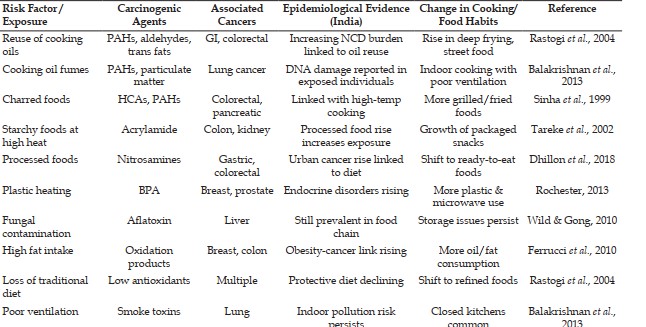
There is a growing concern that latent exposure to carcinogens in the home kitchen may lead to an increase in cancer risk. In the Indian context, the interaction of traditional and modern cooking methods adds complexity to the issue. While there are many ways to prepare food, this paper reviews only certain cooking methods such as deep frying, grilling, roasting, and the repeated use of cooking oils, and points out that during those methods of preparation, harmful molecules or compounds i.e., nitrosamines (NOC) /polycyclic aromatic hydrocarbons (PAHs) and numerous other forms of carcinogens are produced. In addition, other risk factors such as using biomass fuels for cooking, cooking in poorly ventilated homes, and the increasing dependency on processed, high-temperature food products compound household exposure to carcinogens. Over time, these factors may contribute to the cumulative carcinogenic burden of the person/citizen and the prevalence of diet-related cancers. The second aim of the article is to examine the possible protective role of millets in the diet in relation to the risk factors previously described. Millets such as ragi, bajra, jowar, and other varieties of millet contain excessive amounts of dietary fibre, polyphenols, and antioxidants, as well as essential nutrients that have the potential to provide protection against cancer via their anti-carcinogenic, anti-inflammatory, and detoxification properties. Thus, consuming millets may facilitate reducing oxidative stress and lessening the impacts of food-related carcinogens. The review indicates the need for additional awareness and dietary diversity, as well as public health efforts, to reduce the hidden carcinogenic exposures in Indian homes.
References
- 1. Choe, E., & Min, D. B. (2007). Chemistry of deep-fat frying oils. Journal of Food Science, 72(5), R77–R86. [https://doi.org/10.1111/j.1750-3841.2007.00352.x](https://doi.org/10.1111/j.1750-3841.2007.00352.x)
- 2. Skog, K., Johansson, M. A. E., & Jägerstad, M. (1998). Carcinogenic heterocyclic amines in cooked foods. Food and Chemical Toxicology,
- 3. Sinha, R., Rothman, N., Brown, E. D., Mark, S. D., Hoover, R. N., & Caporaso, N. E. (1995). High concentrations of the carcinogen PhIP in
- 4. Tareke, E., Rydberg, P., Karlsson, P., Eriksson, S., & Törnqvist, M. (2002). Analysis of acrylamide in heated foodstuffs. Journal of
- 5. Steenland, K., Fletcher, T., & Savitz, D. A. (2010). Epidemiologic evidence on the health effects of perfluorooctanoic acid (PFOA).
- 6. Mirvish, S. S. (1995). Role of N-nitroso compounds in cancer etiology. Toxicology and Applied Pharmacology, 31(3), 325–351.
- 7. IARC Working Group. (2010). Household use of solid fuels and high-temperature frying. IARC Monographs on the Evaluation of Carcinogenic Risks to Humans, 95. International Agency for Research on Cancer.
- 8. Rochester, J. R. (2013). Bisphenol A and human health: A review of the literature. Reproductive Toxicology, 42, 132–155. [https://doi.org/10.1016/j.reprotox.2013.08.008](https://doi.org/10.1016/j.reprotox.2013.08.008).
- 9. Wild, C. P., & Gong, Y. Y. (2010). Mycotoxins and human disease: A largely ignored global health issue. Carcinogenesis, 31(1), 71–82.
- 10. Exley, C. (2013). Human exposure to aluminium. Environmental Science: Processes & Impacts, 15(10), 1807–1816. [https://doi.
- 11. Rastogi, T., Reddy, K. S., Vaz, M., Spiegelman, D., Prabhakaran, D., Willett, W. C., & Ascherio, A. (2004).Diet and risk of ischemic heart
- 12. Balakrishnan, K., Cohen, A., & Smith, K. R. (2014).Addressing the burden of disease attributable to air pollution in India: The need to integrate across household and ambient air pollution exposures. The Lancet, 383(9927), 134–136.[https://doi.org/10.1016/S0140-
- 13. Sinha, R., Rothman, N., Brown, E. D., Mark, S. D., Hoover, R. N., Caporaso, N. E., Levander, O. A., & Knize, M. G. (1999).High concentrations of the carcinogen 2-amino-1-methyl-6- phenylimidazo[4,5-b]pyridine (PhIP) occur in chicken but are dependent on the cooking method. Cancer Research, 59(17), 4329–4333.
- 14. Tareke, E., Rydberg, P., Karlsson, P., Eriksson, S., & Törnqvist, M. (2002).Analysis of acrylamide, a carcinogen formed in heated foodstuffs. Journal of Agricultural and Food Chemistry, 50(17), 4998–5006.[https://doi.org/10.1021/
- 15. Dhillon, P. K., Mathur, P., Nandakumar, A., Fitzmaurice, C., Kumar, G. A., Mehrotra, R., & Dandona, L. (2018).The burden of cancers and their variations across the states of India: The Global Burden of Disease Study 1990–2016. The Lancet Oncology, 19(10), 1289–1306.[https://doi.org/10.1016/S1470-2045(18)30447-9](https://doi.org/10.1016/ S1470-045%2818%2930447-9).
- 16. Rochester, J. R. (2013).Bisphenol A and human health: A review of the literature. Reproductive T o x i c o l o g y , 4 2 , 1 3 2 – 1 5 5 . [ h t t p s : / / d o i .org/10.1016/j.reprotox.2013.08.008](https:// doi.org/10.1016/j.reprotox.2013.08.008).
- 17. Wild, C. P., & Gong, Y. Y. (2010).Mycotoxins and human disease: A largely ignored global health issue. Carcinogenesis, 31(1), 71–82.
- 18. Ferrucci, L. M., Sinha, R., Graubard, B. I., Mayne, S. T., Ma, X., Schatzkin, A., Cross, A. J. (2010). Dietary meat intake in relation to colorectal cancer in a prospective study. Asian Pacific Journal of Cancer Prevention, 11(1), 63–70.
- 19. Devi, P. B., Vijayabharathi, R., Sathyabama, S., Malleshi, N. G., & Priyadarisini, V. B. (2014). Health benefits of finger millet (Eleusine
- 20. Saleh, A. S. M., Zhang, Q., Chen, J., & Shen, Q. (2013). Millet grains: Nutritional quality, processing, and potential health benefits.
- 21. Anitha, S., Kane-Potaka, J., Tsusaka, T. W., Botha, R., & Rajendran, A. (2021). Can millet consumption help manage lifestyle diseases?
- 22. National Institute of Nutrition. (2020). Dietary guidelines for Indians – A manual. Hyderabad: ICMR-NIN.
- 23. Chandrasekara, A., & Shahidi, F. (2011). Antioxidant phenolics of millet control oxidative stress. Journal of Functional Foods,
- 24. Awika, J. M., & Rooney, L. W. (2004). Sorghum phytochemicals and their potential health effects. Phytochemistry, 65(9), 1199–1221.
- 25. Hegde, P. S., Rajasekaran, N. S., & Chandra, T. S. (2005). Effects of antioxidant properties of millet extracts on cell health. Plant Foods for Human Nutrition, 60(2), 97–102.
- 26. Ministry of Agriculture & Farmers Welfare, Government of India. (2023). Millets: Nutritional and health benefits report. New Delhi.
Data Sharing Statement
There are no additional data available. All raw data and code are available upon request.
Funding
This research received no funding.
Author Contributions
All authors contributed significantly to the work and approve its publication.
Ethics Declaration
Provide information related to the Ethics Committee approval with approval number OR write, This article does not involve any human or animal subjects, and therefore does not require ethics approval.
Acknowledgements
We would like to express our gratitude to the patients, their families, and all those who have contributed to this study.
Conflicts of Interest
The authors report no conflicts of interest in this work.
About this article

Cite this article
Sachin C Narwadiya, Neha Suthar. Silent Carcinogens at Home: Understanding Cancer Risks in Indian Kitchens. RFP Jour. of Bio. and Biophy. 2026; 11(1): 21–25.
Licence:
Attribution-Non-commercial 4.0 International (CC BY-NC 4.0)This license
enables reusers to distribute, remix, adapt, and build upon the material in any
medium or format for noncommercial purposes only, and only so long as
attribution is given to the creator.
| Received | Accepted | Published |
|---|---|---|
| April 15, 2022 | May 20, 2026 | June 25, 2026 |
DOI: https://doi.org/10.21088/rfpjbb.2582-3558.11126.3
Keywords
CarcinogensNitrosaminesNitrosamines (NOC)Polycyclic Aromatic Hydrocarbons (PAHs)Article Level Metrics
Last UpdatedFriday 23 October 2026, 08:03:50 (IST)
1688
Accesses
38
290
00
Citations
NA
NA
NA
Download citation
Article Keywords
Keyword Highlighting
Highlight selected keywords in the article text.
Timeline
| Received | April 15, 2022 |
| Accepted | May 20, 2026 |
| Published | June 25, 2026 |
licence
Attribution-Non-commercial 4.0 International (CC BY-NC 4.0)
This license
enables reusers to distribute, remix, adapt, and build upon the material in any
medium or format for noncommercial purposes only, and only so long as
attribution is given to the creator.