Full Text (PDF)
Journal of Biochemistry and Biophysics 11(1):p 13-19, January 2026. | DOI: https://doi.org/10.21088/rfpjbb.2582-3558.11126.2
Original Article
Beyond Tone and Tissue: A Biochemical and Biophysical Perspective on Post-partum Haemorrhage Mortality
Author Information
Licence:
Attribution-Non-commercial 4.0 International (CC BY-NC 4.0)This license
enables reusers to distribute, remix, adapt, and build upon the material in any
medium or format for noncommercial purposes only, and only so long as
attribution is given to the creator.
Journal of Biochemistry and Biophysics 11(1):p 13-19, January 2026. | DOI: https://doi.org/10.21088/rfpjbb.2582-3558.11126.2
How Cite This Article:
Alpana Saha, Pragati. Beyond Tone and Tissue: A Biochemical and Biophysical Perspective on Post-partum Haemorrhage Mortality. RFP Jour. of Bio. and Biophy. 2026; 11(1): 13–19Timeline
Received : April 09, 2026
Accepted : May 10, 2026
Published : June 25, 2026
Abstract
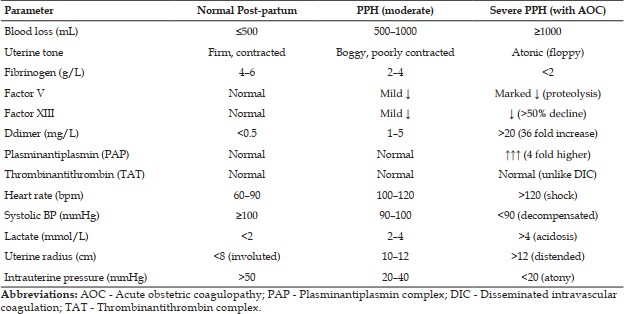
Background: Post-partum haemorrhage (PPH) remains the leading cause of maternal mortality worldwide, yet the pathophysiological processes that transform normal Post-partum bleeding into a lifethreatening coagulopathic state are incompletely understood. This review integrates biochemical and biophysical perspectives on PPHrelated mortality, focusing on molecular coagulopathy, uterine biomechanics, and hemodynamic collapse. Methods: We conducted a narrative synthesis of peerreviewed literature from PubMed, Scopus, and WHO databases (2015–2025), emphasizing mechanistic studies, clinical trials, and global burden data. Key outcomes included prevalence of PPH, coagulopathy biomarkers, hemodynamic parameters, and mortality reduction strategies. Results: Globally, PPH affects 9.97% of deliveries (95% CI: 6.90–13.04%), with severe PPH in 4.52% (95% CI: 2.47–6.57%). Biochemically, acute obstetric coagulopathy (AOC) is driven by dysregulated plasmin generation causing hyperfibrinolysis, leading to fibrinogen and factor V cleavage. Biophysical mechanisms center on uterine atony responsible for 70–80% of PPH where failure of myometrial contraction prevents mechanical compression of spiral arteries. Hemodynamic derangements include a 36fold increase in Ddimer and rapid depletion of factor XIII. Tranexamic acid, administered within three hours, reduces bleedingrelated mortality by onethird. Conclusions: PPH mortality is a consequence of interacting biochemical coagulopathy and biophysical uterine failure. Early detection using objective blood loss measurement and prompt implementation of the MOTIVE bundle (massage, oxytocin, tranexamic acid, intravenous fluids, vaginal examination, escalation) are critical. Future research should focus on pointofcare viscoelastic testing and genotypeguided prophylaxis.
References
- 1. World Association of Trainees in Obstetrics and Gynecology (WATOG). Post-partum hemorrhage: Findings of a global survey. Int J Gynecol Obstet. 2025;171(2):593600. doi:10.1002/ijgo.70512.
- 2. Global burden, disparities, and determinants of Post-partum haemorrhage among women who gave birth: an umbrella review of systematic reviews and metaanalyses. Front Reprod Health. 2025; Sec Reproductive Epidemiology. doi:10.3389/frph.2025.1721550.
- 3. Definition, management strategies, and risk assessment of obstetric hemorrhage: a narrative review. Ann Obstet Gynecol. 2025. doi:10.21037/aob2445.
- 4. Collins PW, et al. Acute obstetric coagulopathy is associated with excess plasmin generation and proteolysis of fibrinogen and factor V. Blood Adv. 2025;9(11):27512762. doi:10.1182/ bloodadvances.2024015514.
- 5. Haemostatic agents in the management of obstetric haemorrhage. Br J Anaesth Educ. 2024;24(11):426432. doi:10.1016/j.bjae.2024.06.005.
- 6. Uterine Atony. In: StatPearls [Internet]. Treasure Island (FL): StatPearls Publishing; 2026 Jan.
- 7. Cianci V, et al. Uterine atony and Postpartum haemorrhage: predisposing genetic factors and postmortem findings. Clin Ter. 2025;176(4):e217e224. PMID: 40728334.
- 8. Korte W, Bürgi J, Haslinger C. Post Partum Haemorrhage (PPH): Time to Change Perception of Pathophysiology and Approach to Therapy? Blood. 2024;144(Supplement 1):557. doi:10.1182/blood2024207971.
- 9. Ray HC, et al. Assessing The Efficacy of Tranexamic Acid in Adjunct to Oxytocin in Reducing Blood Loss During Cesarean Deliveries: A Scoping Review. Doctor of Nursing Practice Projects. 2025; Paper 112.
- 10. Rohwer C, Rohwer A, Cluver C, Ker K, Hofmeyr GJ. Tranexamic acid for preventing Post-partum haemorrhage after caesarean section. Cochrane Database Syst Rev. 2024;11:CD016278. doi:10.1002/14651858.
- 11. World Health Organization. Consolidated guidelines for the prevention, diagnosis and treatment of Post-partum haemorrhage. Geneva: WHO; 2025. ISBN 9789240115637.
- 12. Global health agencies issue new recommendations to help end deaths from Post-partum haemorrhage. WHO News Release, 5 October 2025.
- 13. Korte W, Bürgi J, Haslinger C. Post Partum Haemorrhage: prepartum plasmin and thrombin generation is similar in women with and without PPH. Hamostaseologie. 2025;45(S01):S5. doi:10.1055/s00441801544.
- 14. Pai H. Tackling the challenge of Postpartum Hemorrhage. Express Healthcare. 2025. Available from: https://www. expresshealthcare.in[reference:50]
- 15. Sahoo G. Post-partum Hemorrhage—The Present Scenario, How Far We have Succeeded and Way Forward. In: Recent Advances in Obstetrics and Gynaecology. Jaypee Digital; 2018.
Data Sharing Statement
There are no additional data available. All raw data and code are available upon request.
Funding
This research received no funding.
Author Contributions
All authors contributed significantly to the work and approve its publication.
Ethics Declaration
Provide information related to the Ethics Committee approval with approval number OR write, This article does not involve any human or animal subjects, and therefore does not require ethics approval.
Acknowledgements
We would like to express our gratitude to the patients, their families, and all those who have contributed to this study.
Conflicts of Interest
The authors report no conflicts of interest in this work.
About this article

Cite this article
Alpana Saha, Pragati. Beyond Tone and Tissue: A Biochemical and Biophysical Perspective on Post-partum Haemorrhage Mortality. RFP Jour. of Bio. and Biophy. 2026; 11(1): 13–19
Licence:
Attribution-Non-commercial 4.0 International (CC BY-NC 4.0)This license
enables reusers to distribute, remix, adapt, and build upon the material in any
medium or format for noncommercial purposes only, and only so long as
attribution is given to the creator.
| Received | Accepted | Published |
|---|---|---|
| April 09, 2026 | May 10, 2026 | June 25, 2026 |
DOI: https://doi.org/10.21088/rfpjbb.2582-3558.11126.2
Keywords
Post-Partum HaemorrhageMaternal MortalityAcute Obstetric CoagulopathyUterine AtonyHyperfibrinolysisTranexamic AcidHemodynamicsMotive BundleArticle Level Metrics
Last UpdatedSunday 18 October 2026, 12:31:31 (IST)
1624
Accesses
43
290
00
Citations
NA
NA
NA
Download citation
Article Keywords
Keyword Highlighting
Highlight selected keywords in the article text.
Timeline
| Received | April 09, 2026 |
| Accepted | May 10, 2026 |
| Published | June 25, 2026 |
licence
Attribution-Non-commercial 4.0 International (CC BY-NC 4.0)
This license
enables reusers to distribute, remix, adapt, and build upon the material in any
medium or format for noncommercial purposes only, and only so long as
attribution is given to the creator.