Full Text (PDF)
International Journal of Food, Nutrition & Dietetics 10(3):p 95-99, September-December 2022. | DOI: https://doi.org/10.21088/ijfnd.2322.0775.10322.3
Original Article
Evaluation of in Vitro Antioxidant & Antidiabetic Effects of Garden Cress Seed (Lepidium Sativum)
Minaxi R Prajapati, K B Kamaliya
Author Information
Licence:
Attribution-Non-commercial 4.0 International (CC BY-NC 4.0)This license enables reusers to distribute, remix, adapt, and build upon the material in any medium or format for noncommercial purposes only, and only so long as attribution is given to the creator.
International Journal of Food, Nutrition & Dietetics 10(3):p 95-99, September-December 2022. | DOI: https://doi.org/10.21088/ijfnd.2322.0775.10322.3
How Cite This Article:
Minaxi R Prajapati, K B Kamaliya/Evaluation of in Vitro Antioxidant & Antidiabetic Effects of Garden Cress Seed (Lepidium Sativum)/Int J Food Nutr Diet. 2022;10(3):95–99.Timeline
Received : July 26, 2022
Accepted : August 28, 2022
Published : December 30, 2022
Abstract
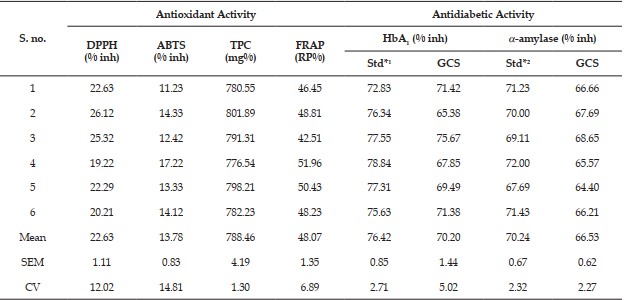
Foods rich in antioxidants have gained much attention due to their health promoting activities. These foods are also referred as a neutraceuticals as they prevent many of degenerative diseases like diabetes mellitus, cancer, blood pressure and heart diseases. Garden cress seed have been used in India since ancient time. It possesses numerous health benefits such as antianaemic effect, Antimicrobial Activity, Antidiabetic and Anti-oxidant effect. In the present study, Garden cress seed was evaluated for its in vitro antioxidant and antidiabetic activities. Antioxidants activities of Garden cress seed was studies by DPPH and ABTS method. Whole seed showed 22.63% DPPH radical inhibition and 13.78% ABTS radical inhibition. Antidiabetic activity was studies by using Non enzymatic Glycosylation of hemoglobin (NEGH) and a amylase inhibition activity. Non enzymatic Glycosylation of hemoglobin inhibition was 71.42% and a amylase inhibition was 66.53%. Results suggest potential health benefiting activities of Garden cress seed. These benefits must be utilized by incorporating seed in daily diet.
References
- 1. Abdullah H., Abdullah J. (2007). The effects of Lepidium sativum seed on Fracture – Induced Healing in Rabbits. Med Gen Med., 9(2), 23-29.
- 2. Amawi K., Aljamal A. (2012). Effects of Lepidium sativum on Lipid profiles and Blood Glucose in Rats. J Phys & Pharm Adv., 2(8), 277- 281.
- 3. Anonymous. Ayurvedic Pharmacopaeia of India, Part-1, 1st ed, The drug controller of India, Government of India, Ministry of health and family welfare development of Indian system of medicine and homeopathy, New Delhi civil lines, Delhi. 2001; 1:26.
- 4. Bhakare HA, Kulkarni, Khotpal RR. (1993). Lipid composition of some seed of Central India., Journal of Food Science and Technology. 30:54-55.
- 5. Bran- Williams M. Cuvelier and Berset C. (1995). Use of free radical method to evaluate antioxidant activity. Lebensmittel Wissenschaft and Technology., 28: 25-30.
- 6. Hossan S.J., El-Sayed M., Aoshima H. (2009). Antioxidative and anti a-amylase activities of four wild plants consumed by nomads in Egypt., Orient Pharm Exp Med: 217-224.
- 7. Kirtkar KM, Basu BD.( 2005). Indian medicinal plants., I:174.
- 8. Onyeneho SN, Hettiarachchy NS. (1992). J Agric Food Chem., 40: 1496–1500.
- 9. Paranjape, AN., Mehta, AA. (2006). Iranian Journal of Pharmacology & Therapeutics., 5(1): 55-59.
- 10. Re N., Pellegrini A., Proteggente A., Pannala M., Yang and Rice Evans. (1999). Antioxidnat activity applying an improved ABTS radical cation decolorization assay. Free Radical Biology., 26:1231-1237.
- 11. Sawsan Hassan Mahassni and Roaa Mahdi AlReemi. (2013). Cytotoxic effect of an aqueous extract of Lepidium SativumL.seed on human breast cancer cells, Indian Journal of Traditional Knowlwdge., 2(4): 605-614.
- 12. Suganya G, Sampath Kumar P. Dheeba B, Sivakumar R. (2014). In vitro Antidiabetic, Antioxidnat and Anti-Inflamatory Activity of Clitoria Ternatea L. International Journal of Pharmacy and Pharmaceutical Sciences., 6(7): 342-347.
- 13. Sumangala S. Gokavi, Nagappa G., Malleshi, Mingruo Guo. (2004). Chemical Composition of Garden Cress (Lepidium sativum) Seeds and Its Fractions and use of Bran as a Functional Ingredient, Journal of Plant Foods for Human Nutrition., 59: 105–111.
Data Sharing Statement
There are no additional data available. All raw data and code are available upon request.
Funding
This research received no funding.
Author Contributions
All authors contributed significantly to the work and approve its publication.
Ethics Declaration
This article does not involve any human or animal subjects, and therefore does not require ethics approval.
Acknowledgements
We would like to express our gratitude to the patients, their families, and all those who have contributed to this study.
Conflicts of Interest
No conflicts of interest in this work.
About this article

Cite this article
Minaxi R Prajapati, K B Kamaliya/Evaluation of in Vitro Antioxidant & Antidiabetic Effects of Garden Cress Seed (Lepidium Sativum)/Int J Food Nutr Diet. 2022;10(3):95–99.
Licence:
Attribution-Non-commercial 4.0 International (CC BY-NC 4.0)This license enables reusers to distribute, remix, adapt, and build upon the material in any medium or format for noncommercial purposes only, and only so long as attribution is given to the creator.
| Received | Accepted | Published |
|---|---|---|
| July 26, 2022 | August 28, 2022 | December 30, 2022 |
DOI: https://doi.org/10.21088/ijfnd.2322.0775.10322.3
Keywords
AntioxidantsAntidiabeticDegenerative diseasesInhibitionSearch for Similar Articles
Similar Articles
- Smart and Sustainable Packaging Approaches for Reducing Heavy Metal Contaminatio...
- Traditional Rhythms for Modern Health: Seed Cycling in the Management of Women’s...
- School-Based Nutrition Education Improves Knowledge and Consumption of Omega-3-R...
- Nutrition as Precision Therapy in Rare Genetic Diseases: Moving beyond Supportiv...
- A Review on Health Risks Associated with the Repetitive use of Cooking Oil and D...
Article Level Metrics
Last UpdatedMonday 07 September 2026, 02:46:22 (IST)
1797
Accesses
6
247
00
Citations
NA
NA
NA
Download citation
Article Keywords
Keyword Highlighting
Highlight selected keywords in the article text.
Timeline
| Received | July 26, 2022 |
| Accepted | August 28, 2022 |
| Published | December 30, 2022 |
licence
Attribution-Non-commercial 4.0 International (CC BY-NC 4.0)
This license enables reusers to distribute, remix, adapt, and build upon the material in any medium or format for noncommercial purposes only, and only so long as attribution is given to the creator.