Full Text (PDF)
Physiotherapy and Occupational Therapy Journal 16(3):p 9-19, July-September 2023. | DOI: http://dx.doi.org/10.21088/potj.0974.5777.16323.1
Original Article
Efficency of Motor Imagery with Conventional Therapy in Gait Training of Stroke Patient
Author Information
Licence:
Attribution-Non-commercial 4.0 International (CC BY-NC 4.0)This license enables reusers to distribute, remix, adapt, and build upon the material in any medium or format for noncommercial purposes only, and only so long as attribution is given to the creator.
Physiotherapy and Occupational Therapy Journal 16(3):p 9-19, July-September 2023. | DOI: http://dx.doi.org/10.21088/potj.0974.5777.16323.1
How Cite This Article:
Aslam M. Efficiency of motor imagery with conventional therapy in gait training of stroke patient. Physiother Occup Ther J. 2023;16(3):111-121.Timeline
Received : May 24, 2023
Accepted : June 30, 2023
Published : September 29, 2023
Abstract
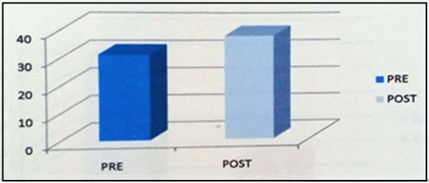
Total 30 participants including both male and female who were previously diagnosed by neurologist as having was recruited for the study. Subjects will be selected as per convenient sampling and assigned into two groups i.e. group-A (Experimental group) and Group–B (Control Group). In Group-A subjects were given motor imagery and conventional therapy both; in group-B subjects were given conventional therapy alone. Group A got 13 subjects with (mean age = 65.46±7.55) and Group-B got 13 subjects with (mean age = 65.69±5.58). Both programs were concluded in the respective participants home and hospital environment. None of the subjects attended physiotherapy for lower limb anywere else during the study. Baseline measurements was taken at the start of treatment program, using gait variables as outcome measures i.e. stride length, step length, Gait velocity & Cadence. Results of post reading in both groups (for stride length (p=0,928) and post stride (p=0.592), for pre step length (p=0.777) and post step length 9p=0.631), for pre gait velocity (p=0.4590 and post gait velocity (p=0.959), for pre cadence (p=0.986) and post cadence (p=0.844) show significance improvement, but improvement in Group-A was more than in Group-B. As per the results of the present study, Motor imagery program is found to be effective when given with conventional therapy in improving gait in stroke subjects. Moveover it can be done easily by the patient as it takes effort and motivates the subject for performing the desired task. It also does not fatigue the patient. Thus, it is a feasible method and can be applied in conjunction with conventional therapy while treating stroke patients with gait issue.
References
- 1. J. Donald Easton, Jeffrey L. Saver Gregory W. Albers, Mark J. Albers, Semant Chaturvedi, Edward Feldmann, et.al Definition and Evaluation of Transient Ischemic Attack, Journal of the Americans heart association, 2009 May; 40: 2276-2293.
- 2. Christian Weimar, Tobias Kurth, Klaus Kaywinkel, Markus Wagner, Otto Busse, Roman LudwieHabert, et.al, assessment of functioning and disability after ischemic stroke, journal of American heart associstion, 2002 May: 33: 2053-2059.
- 3. O’ Sullivan SB, SchnitzT J.physical Rehabilitation, 5th ed. New Delhi (India): Jaypee Brothers; 2007:705-722.
- 4. Ruth Dickstein, Ayelet Dunsky, Emanuel Marcovitz, Motor Imagery for Gait Rehabilitation in Post-Stroke Hemiperesis, Physical Therapy, 2004 Dec:84(24):1167-1177.
- 5. Lidmina Svetlana, M. Calayan,, J Margarita, R.Dizon, Asystemic review on the effective of mental practice with motor imagery in the neurologic rehabilitation of stroke patients, The internet Journal of Applied Health Sciences and Practices, 2009:7(2) :1-11.
- 6. S. corina, B jenny, A. Brian, K.Udo, E. Thierry, comparsion of embedded and added motor imagery training in patients afyer stroke: study protocol of randomized controlled pilot trail using a moxed methods approach, Trails journal, 2009: 10(97):1186-1745.
- 7. Yahagi S, Shimura K, Kasai T, An increase incortical excitability with no change inspinal excitability during motor imagery, Hiroshima Shudo Universiry Japan, 1996 Aug:83(1) :288-90.
- 8. F. Luciano, B. Giovanni, C Laila, F. Leonardo, G.vittorio, P.Giovanni, corticospinal excitability is apecifically modulated by motor imagery: a magnetic stimulation study, sciences Direct, 1999Jan; 37(2) :147-158.
- 9. H C Dijkerman, Mletswaart, M Johnston, R S Mac Walter, does motor imagery training improve hand function in chronic stroke patients? A pilot study, Clinical Rehabilitation, 2004:18(5) :538-549.
- 10. Zimmermann-Schlatter A, Schuster C, Puhan MA, Siekierka E, Steurer J, efficacy of motor imagery in post-stroke rehabilitation :a systematic review, journal Neuroengineerinng Rehabilitation, 2008 Mar:14:5:8.
- 11. Sujin Hwang, Hye-SeonJeon, H Y Chung, Oh-yun Kwon, Sang-hyun Cho, Sung-hyun You, locomotor imagery training improves gait performance in people with chronic hemiparetic stroke: a controlled clinical trial, Department of physical Therapy, College of Health Sciences, Yonsei University, 2010 June (6):514 522.
- 12. Kay Cerny, A Clinical Method of Quantitative Gait Analysis, Physical Therapy, 1983:1123-1126.
- 13. Stephen J Page, Peter Levine, Sue Ann Sisto and Mark v Johnston, A randomized efficacy and feasibility study of imagery in acute stroke, KMRREC, 2001: 15; 233-230.
- 14. Craig R .Hall , Wendy M. Rodgers and Kathryan A. B arr, The Use of Imagery By Atheletes in Selected Sports, Sports Psycology, 1990:4: 1-1.0.
- 15. Susain L Morris, Karen J Dodd, Meg E Morris, outcomes of progressive resistance strengthening training following stroke: a systematic review, clinical Rehabilitation, 2004 Jan:18 (1):27-39.
- 16. Catherine M. Dean, Carol L. Richards, Francine Malouin, Task–Related Circuit Training Improves Performance of Lomotor Tasks in Chronic Stroke: A Randomized, Controlled Pilot Trail, The American Academy of Physical Medicine and Rehabilitation, 2000:81:409-417.
- 17. Th. Mulder, Motor imagery and action observation: cognitive tools for rehabilitation, J Neural Transm, 2007 :114: 1265-1278.
- 18. Sullivan K, Klassen T, Mulory S, Combined task-specific training and strengthening effects on locomotor recovery post- stroke : a case study, Journal of Physical Therapy, 2006sep:30(3) :130-141.
- 19. Lewek, Mechael D. he Value of Overground Gait Taining for Improving Locomotion in Individuals with Chronic Stroke, Journal of Neurologic Physical Therapy, 2009Dec:33(4):187 188.
- 20. Teixeira-Salmela LF, Olney SJ, Nadeau SJ, Nadeau S, Brouwer B, Muscles strengthening and Physical conditioning to reduce impairement and disability in chronic stroke survivors Arch Phys Med Rehabi,. 1999 Oct; 80 (10) :1211-1218.
- 21. Joe Vaga, Stroke Rehabilitation is a Critical Part Stroke Recovery, 2009 Sept.
- 22. Auri Bruno-Petrina, motor recovery in stroke, Physical therapy and rehabilitation, 2010 Sept.
- 23. Jain Jun Yu, Yong Shan YU, Yi hu, Wen Hua Chen, YuLianzhu, Xiao Cui, et.al, the effects of community–based rehabilitation on stroke patients in china a single–blind randomized controlled multicenter trial, clinical rehabilitation, 2009 April:23(5): 408-417.
Data Sharing Statement
There are no additional data available.
Funding
This research received no funding.
Author Contributions
All authors contributed significantly to the work and approve its publication.
Ethics Declaration
This article does not involve any human or animal subjects, and therefore does not require ethics approval
Acknowledgements
Information Not Provided
Conflicts of Interest
No conflicts of interest in this work.
About this article

Cite this article
Aslam M. Efficiency of motor imagery with conventional therapy in gait training of stroke patient. Physiother Occup Ther J. 2023;16(3):111-121.
Licence:
Attribution-Non-commercial 4.0 International (CC BY-NC 4.0)This license enables reusers to distribute, remix, adapt, and build upon the material in any medium or format for noncommercial purposes only, and only so long as attribution is given to the creator.
| Received | Accepted | Published |
|---|---|---|
| May 24, 2023 | June 30, 2023 | September 29, 2023 |
DOI: http://dx.doi.org/10.21088/potj.0974.5777.16323.1
Keywords
Motor imageryGait velocityCadenceStroke.Gait velocityCadenceStroke.Search for Similar Articles
Similar Articles
- Cross-Cultural Adaptation, Reliability, and Validity of the Gujarati Version of...
- Physiotherapy Management of Multiple Sclerosis: An Overview of Recent Technologi...
- Converging Technologies in Cardiopulmonary Physiotherapy: A Review of VR, AR, AI...
- Cross-Cultural Adaptation, Reliability, and Validity of the Gujarati Version of...
- Effects of Kinesiotaping in Lateral Epicondylitis: A Narrative Review
Article Level Metrics
Last UpdatedWednesday 29 July 2026, 20:47:32 (IST)
1979
Accesses
4
429
00
Citations
NA
NA
NA
Download citation
Article Keywords
Keyword Highlighting
Highlight selected keywords in the article text.
Timeline
| Received | May 24, 2023 |
| Accepted | June 30, 2023 |
| Published | September 29, 2023 |
licence
Attribution-Non-commercial 4.0 International (CC BY-NC 4.0)
This license enables reusers to distribute, remix, adapt, and build upon the material in any medium or format for noncommercial purposes only, and only so long as attribution is given to the creator.