Full Text (PDF)
Physiotherapy and Occupational Therapy Journal 17(1):p 57-65, January - March 2024. | DOI: http://dx.doi.org/10.21088/potj.0974.5777.17124.6
Original Article
Effect of Q-angle on Static and Dynamic Balance in Older Population
Purnima Singh, Pratibha Shetkar, Komal K. B., Anee Joshvina K. V.
Author Information
Licence:
Attribution-Non-commercial 4.0 International (CC BY-NC 4.0)This license enables reusers to distribute, remix, adapt, and build upon the material in any medium or format for noncommercial purposes only, and only so long as attribution is given to the creator.
Physiotherapy and Occupational Therapy Journal 17(1):p 57-65, January - March 2024. | DOI: http://dx.doi.org/10.21088/potj.0974.5777.17124.6
How Cite This Article:
Shetkar P, Komal KB, Joshvina KV, et al. Effect of Q-angle on static and dynamic balance in older population. Physio Ther Occup Ther J. 2024;17(1):57-65.Timeline
Received : March 23, 2024
Accepted : April 18, 2024
Published : March 25, 2024
Abstract
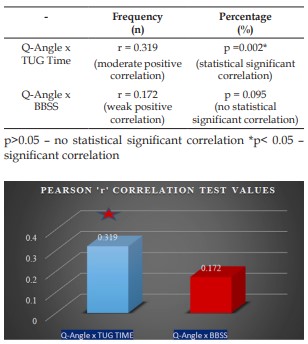
Background and Objectives: Lower extremity injuries are commonly due to impaired balance. The best to assess lower extremity alignment is the Quadriceps angle (QA), it says the important variable and because it represents quadriceps muscles vector direction in frontal plane. The purpose of this study is to find a correlation between quadriceps angle on static and dynamic balance measures. Methodology: Ethical clearance was obtained from institutional ethical committee. Subjects fulfilling the inclusion and exclusion criteria were included. Informed consent form was taken from each of the subject prior to the treatment. A sample of 95 subjects recruited between 60 years and above. These participants were recruited using purposive sampling. This Correlation analytical study consists of Timed Up and Go Test And Berg Balance Scale for assessing functional mobility and Balance(Static and Dynamic) respectively and data was analysed using the statistical package SPSS 22.0 (SPSS Inc.., Chicago, IL) at p<0.05. Result: The result of research suggests that there is a Statistically significant with moderate positive correlation (p=0.002*) observed between Q-angle with TUG (which measure dynamic balance). There is significantly weak positive (p=0.095) correlation observed between Q-angle with BBSS values (which measures both static and dynamic balance). Conclusion: In this study, the effect of Q angle has moderately positive correlation with dynamic balance. A Q angle is weakly correlated with the static balance. That means quadriceps angle plays an important role in predicting injuries of lower extremity. This makes an important diagnostic tool during assessment of an individual, especially in Geriatric population.
References
- 1. Dunsky A, Zeev A, Netz Y. Balance Performance Is Task Specific in Older Adults. Biomed Res Int. 2017; 2017:6987017. doi: 10.1155/2017/6987017. Epub 2017 Sep 5.PMID: 29018817; PMCID: PMC5605868.
- 2. Census Data of Bangalore.
- 3. Ayelet Dunsky, Aviva Zeev, and Yael Netz. Balance Performance Is Task Specific in Older Adults. 2017 Sep 5.
- 4. Cheitlin MD. Cardiovascular physiology — changes with aging. The Americanjournal of geriatric cardiology. 2003 Jan;12(1):9-13.
- 5. Lord S. R., Ward J. A., Williams P., Anstey K. J. Physiological factors associated with falls in older community-dwelling women. Journal of the American Geriatrics Society. 1994; 42(10):1110–1117.doi: 10.1111/j.1532-5415.1994. tb06218.x. [PubMed] [Cross Ref] [Google Scholar]
- 6. Brattström H. Shape of the Intercondylar Groove Normally and in Recurrent Dislocation of Patella: A Clinical and X-Ray Anatomical Investigation. Acta Orthop Scand. 1964;35:1 148. 10.3109/ort.1964.35.suppl-68.01 [PubMed] [CrossRef] [Google Scholar]
- 7. T.R. Malone, A.L. Pfeifle, Chapter 69 -Patellofemoral Disorders, Editor (s): Jeffrey D. Placzek, David A. Boyce, Orthopaedic Physical Therapy Secrets (Third Edition), Elsevier,2017
- 8. Nguyen A-D, Boling MC, Levine B, Shultz SJ. Relationships between lower extremity alignment and the quadriceps angle. Clin J Sport Med Off J Can Acad Sport Med.2009;19: 201–206. 10.1097/JSM.0b013e3181a38fb1 [PMC free article] [PubMed] [Cross Ref] [Google Scholar] [Ref list]
- 9. Jaiyesimi AO, Jegede OO. Influence of gender and leg dominance on Q-angle among Adult Nigerians. Afr J Phys and Reh Sci. 2009;1:18–23. [Google Scholar] [Ref list].
- 10. Antinolfi P, Bartoli M, Placella G, et al. Acute patello femoral instability in children and adolescents. Joints. 2016;4:47–51. [PMC free article] [PubMed] [Google Scholar] [Reflist]
- 11. Denizoglu Kulli H, Yeldan I, Yildirim NU. Influence of quadriceps angle on static and dynamic balance in young adults. J Back Musculoskelet Rehabil. 2019;32:857–62. [PubMed] [Google Scholar] [Ref list]
- 12. Lathinghouse LH, Trimble MH. Effects of isometric quadriceps activation on the Qanglein women before and after quadriceps exercise. J Orthop Sports Phys Ther. 2000; 30:211–6. [PubMed] [Google Scholar] [Ref list]
- 13. Venus Pagare, Andeela Hafeez, Abdallah Ahmed Mohamed, Ehtisham Panhwar, Laura Ritchie, Ben Kasehagen, WikiSysop, Nikhil Benhur Abburi, Admin, Kim Jackson. Q angle : [physiopedia]
- 14. Edson J. Ascencio, Gustavo D. Cieza-Gomez, et all,. Timed up and go test predictsmortality in older adults in Peru. Ascencio et al. BMC Geriatrics (2022)22:61
- 15. Teo I, Thompson J, Neo YN, Lundie S, Munnoch DA. Lower limb dominance and volume in healthy individuals. Lymphology. 2017;50(4):197-202. PMID: 30248724.
- 16. Schorderet C, Hilfiker R, Allet L. The role of the dominant leg while assessing balanceperformance. A systematic review and meta-analysis. Gait Posture. 2021 Feb;84:66-78. doi: 10.1016/j.gaitpost.2020.11.008. Epub 2020 Nov 19. PMID: 33278778.
- 17. Khasawneh RR, Allouh MZ, Abu-El-Rub E. Measurement of the quadriceps (Q) anglewith respect to various body parameters in young Arab population. PLoS One. 2019 Jun13; 14(6):e0218387. doi: 10.1371/journal. pone.0218387. PMID: 31194851; PMCID: PMC6564690.
- 18. Woodland LH, Francis RS. Parameters and comparisons of the quadriceps angleof college aged men and women in the supine and standing positions. The Americanjournal of sports medicine. 1992Mar;20(2):208-11
- 19. Russell AK, Zerr MC, Rinehart TG, Norris BM, Perkuhn NK. The relationship betweenlower extremity musculature strength, q-angle, and single-leg balance.2014
- 20. Shultz SJ, Carcia CR, Gansneder BM, Perrin DH. The independent and interactiveeffects of navicular drop and quadriceps angle on neuromuscular responses to a weight bearing perturbation. J Athl Train. 2006; 41: 251–259. [PMC freearticle] [PubMed] [Google Scholar] [Ref list]
- 21. Griffin L, Agel J, Albohm M, Arendt E, Dick R, Garrett W, et al. Noncontact Anterior Cruciate Ligament Injuries: Risk Factors and Prevention Strategies. J Am Acad OrthopSurg. 2000;8: 141 150. [PubMed] [Google Scholar] [Ref list]
- 22. Horton MG, Hall TL. Quadriceps femoris muscle angle: normal values and relationships with gender and selected skeletal measures. Phys Ther. 1989 Nov; 69(11):897-901. doi:10.1093/ptj/69.11.897. PMID: 2813517.
- 23. Bogle Thorbahn LD, Newton RA. Use of the Berg Balance Test to predict falls in elderlypersons. Phys Ther. 1996 Jun;76(6):576 83; discussion 584-5. doi: 10.1093/ptj/76.6.576. PMID: 8650273.
- 24. Earl JE, Hertel J. Lower-extremity muscle activation during the Star Excursion Balance Tests. Journal of Sport Rehabilitation. 2001 May1;10(2):93-104.
- 25. Daneshmandi H, Saki F, Shahheidari S, Khoori A. Lower extremity Malalignment andits linear relation with Q angle in female athletes. Procedia-Social and Behavioral Sciences. 2011 Jan1;15:3349-54
- 26. Tsakoniti AE, Stoupis CA, Athanasopoulos SI. Quadriceps cross-sectional area changesin young healthy men with different magnitude of Q angle. Journal of applied physiology. 2008 Sep;105(3):800-4
- 27. Robbins S, Waked E, McClaran J. Proprioception and stability: foot position awarenessas a function of age and footwear. Age Ageing 1995;24(1):67–72. [PubMed] [GoogleScholar]
- 28. Patel M, Magnusson M, Kristinsdottir E, Fransson PA. The contribution of mechanoreceptive sensation on stability and adaptation in the young and elderly. Eur JAppl Physiol 2009; 105(2):167–173. [PubMed] [Google Scholar]
- 29. Hsieh LC, Lin HC, Lee GS. Aging of vestibular function evaluated using correlational vestibular autorotation test. Clin Interv Aging 2014;9:1463–1469. [PMC freearticle] [PubMed] [Google Scholar]
- 30. Judge JO, King MB, Whipple R, Clive J, Wolfson LI. Dynamic balance in olderpersons: effects of reduced visual and proprioceptive input. J Gerontol A Biol Sci MedSci 1995;50(5):M263 270. [PubMed] [Google Scholar]
Data Sharing Statement
There are no additional data available.
Funding
This research received no funding
Author Contributions
All authors contributed significantly to the work and approve its publication.
Ethics Declaration
This article does not involve any human or animal subjects, and therefore does not require ethics approval
Acknowledgements
Information Not Provided
Conflicts of Interest
No conflicts of interest in this work.
About this article

Cite this article
Shetkar P, Komal KB, Joshvina KV, et al. Effect of Q-angle on static and dynamic balance in older population. Physio Ther Occup Ther J. 2024;17(1):57-65.
Licence:
Attribution-Non-commercial 4.0 International (CC BY-NC 4.0)This license enables reusers to distribute, remix, adapt, and build upon the material in any medium or format for noncommercial purposes only, and only so long as attribution is given to the creator.
| Received | Accepted | Published |
|---|---|---|
| March 23, 2024 | April 18, 2024 | March 25, 2024 |
DOI: http://dx.doi.org/10.21088/potj.0974.5777.17124.6
Keywords
Q-angleStatic BalanceDynamic BalanceL/E injuriesElderlySearch for Similar Articles
Similar Articles
- Leadership in Physiotherapy: A Narrative Review
- Effectiveness of Low Level Laser Theapy in the Management of Temporomandibular J...
- The Impact of Air Pollution on Cardiopulmonary Health: Molecular Mechanisms, Pre...
- Efectiveness of Physiotherapy in Postpartum Women with Diastasis Recti: A Review
- Pain Neuroscience Education: Transforming Physiotherapy Practice
Article Level Metrics
Last UpdatedSaturday 24 October 2026, 18:12:50 (IST)
4390
Accesses
16
739
00
Citations
NA
NA
NA
Download citation
Article Keywords
Keyword Highlighting
Highlight selected keywords in the article text.
Timeline
| Received | March 23, 2024 |
| Accepted | April 18, 2024 |
| Published | March 25, 2024 |
licence
Attribution-Non-commercial 4.0 International (CC BY-NC 4.0)
This license enables reusers to distribute, remix, adapt, and build upon the material in any medium or format for noncommercial purposes only, and only so long as attribution is given to the creator.