Full Text (PDF)
Physiotherapy and Occupational Therapy Journal 17(1):p 67-76, January - March 2024. | DOI: http://dx.doi.org/10.21088/potj.0974.5777.17124.7
Original Article
A Study on Effectiveness of Mirror Therapy on Grip and Release Function of Hand in Sub acute Stroke Patients
Purnima Singh, Anee Joshvina K. V.
Author Information
Licence:
Attribution-Non-commercial 4.0 International (CC BY-NC 4.0)This license enables reusers to distribute, remix, adapt, and build upon the material in any medium or format for noncommercial purposes only, and only so long as attribution is given to the creator.
Physiotherapy and Occupational Therapy Journal 17(1):p 67-76, January - March 2024. | DOI: http://dx.doi.org/10.21088/potj.0974.5777.17124.7
How Cite This Article:
Joshvina KV, Singh P. A study on effectiveness of mirror therapy on grip and release function of hand in sub acute stroke patients. Physio Ther Occup Ther J. 2024;17(1):67-76.Timeline
Received : March 23, 2024
Accepted : April 18, 2024
Published : March 25, 2024
Abstract
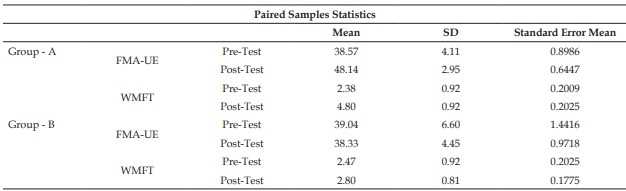
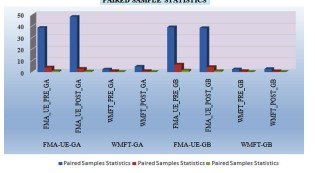
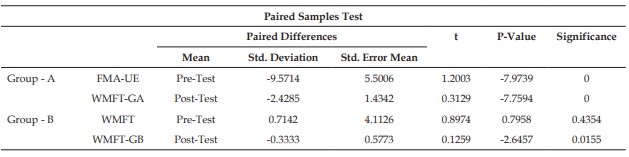
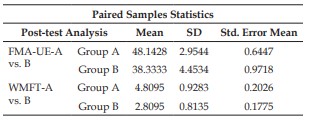
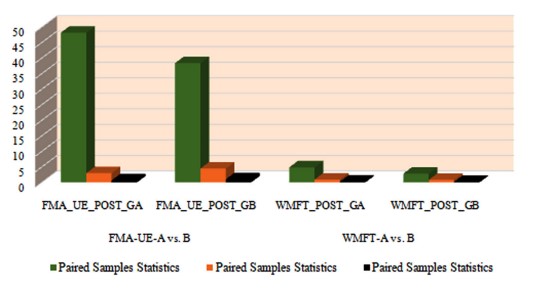
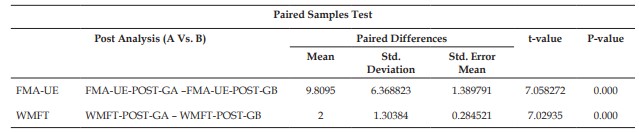
Background and Purpose: The impairment of hand function is one of the most significant hurdles to independence after a stroke, necessitating the use of novel procedures and tactics aimed at boosting the functional recovery of motor skills after a stroke. A newer technique known as "mirror therapy" is said to alter neuroplasticity and is simple to implement. As a result, the purpose of this study is to see how well mirror therapy improves hand function in persons who have had subacute stroke. Methodology: Ethical clearance was obtained from institutional ethical committee. Subjects fulfilling the inclusion and exclusion criteria were included and informed consent form was taken from each prior to the treatment. A sample of 42 subjects within the age group of 40-60 years with sub-acute stroke were recruited in the study and were treated with Mirror therapy and conventional therapy. Pre and post intervention tests were assessed for Grip and release function of hand using Fugl-Meyer Assessment of the Upper Extremity (FMA-UE) and Wolf Motor Function Test (WMFT) measures. Results: The study of pre and post intervention data revealed that the Mirror group improved significantly in hand function. At the post-test, participants demonstrated considerable improvement in FMA-WH and WFMT-WH. FMA-UE rose from 38.57 to 48.14 (p=0.000), while WMFT from 2.38 to 4.8 (p=0.000). Conclusion: The preliminary data indicate that Mirror therapy can be a valuable intervention to enhance patient rehabilitation; it provides a simple and cost-efficient therapy for wrist and hand motor recovery and improves grip and release function in subacute stroke patients.
References
- 1. Kuriakose D, Xiao Z. Pathophysiology and Treatment of Stroke: Present Status and Future Perspectives. Int J Mol Sci. 2020 Oct 15;21(20):7609. doi: 10.3390/ijms21207609.
- 2. PMID: 33076218; PMCID: PMC7589849. Shakir R. The struggle for stroke reclassification. Nat Rev Neurol. 2018 Aug;14(8):447-448. doi: 10.1038/s41582-018-0036-5. PMID: 29959393.
- 3. Chang JC. Stroke Classification: Critical Role of Unusually Large von Willebrand Factor Multimers and Tissue Factor on Clinical Phenotypes Based on Novel “Two-Path Unifying Theory” of Hemostasis. Clin Appl Thromb Hemost. 2020 JanDec;26 :1076029620913634. doi: 10.1177/1076029620913634. PMID: 32584600; PMCID: PMC7427029.
- 4. Wu, Ping1,#; Zeng, Fang1,#; Li, Yong-xin2; Yu, Bai-li3; Qiu, Li-hua4; Qin, Wei5; Li, Ji3; Zhou, Yu-mei1; Liang, Fan-rong1,*. Changes of resting cerebral activities in subacute ischemic stroke patients. Neural Regeneration Research 10(5):p 760-765, May 2015. | DOI: 10.4103/1673 5374.156977
- 5. Dalal, Praful; Bhattacharjee, Madhumita; Vairale, Jaee; Bhat, Priya. UN millennium development goals: Can we halt the stroke epidemic in India? Annals of Indian Academy of Neurology 10(3): p 130-136, Jul–Sep 2007. | DOI: 10.4103/0972-2327.34791
- 6. Jones SP, Baqai K, Clegg A, Georgiou R, Harris C, Holland EJ, Kalkonde Y, Lightbody CE, Maulik PK, Srivastava PM, Pandian JD, Kulsum P, Sylaja PN, Watkins CL, Hackett ML. Stroke in India: A systematic review of the incidence, prevalence, and case fatality. Int J Stroke. 2022 Feb;17(2):132-140. doi: 10.1177/17474930211027834. Epub 2021 Jul 2. PMID: 34114912; PMCID: PMC8821978. Basmajian JV. The Winter of Our Discontent: breaking intolerable time locks for stroke survivors. The 38th annual John Stanley Coulter lecture. Arch Phys Med Rehabil. 1989; 70:92–94
- 7. Gourie-Devi M. Epidemiology of neurological disorders in India: review of background, prevalence and incidence of epilepsy, stroke, Parkinson’s disease and tremors. Neurol India. 2014 Nov-Dec;62(6):588-98. doi: 10.4103/0028 3886.149365. Erratum in: Neurol India. 2016 Sep-Oct;64(5):1110-1. PMID: 25591669.
- 8. Parry R, Macias Soria S, Pradat-Diehl P, Marchand-Pauvert V, Jarrassé N, Roby-Brami A. Effects of Hand Configuration on the Grasping, Holding, and Placement of an Instrumented Object in Patients With Hemiparesis. Front Neurol. 2019 Mar 19;10:240. doi: 10.3389/ fneur.2019.00240. PMID: 30941091; PMCID: PMC6433942.
- 9. Duncan PW, Goldstein LB, Horner RD, Landsman PB, Samsa GP, Matchar DB. Similar motor recovery of upper and lower extremities after stroke. Stroke. 1994 Jun;25(6):1181-8. doi: 10.1161/01.str.25.6.1181. PMID: 8202977.
- 10. Hand Function in Stroke Hand Function, 2019 ISBN : 978-3-030-16999-2 Osman Hakan Gündüz, Canan Şanal Toprak
- 11. Beer RF, Dewald JP, Rymer WZ. Deficits in the coordination of multijoint arm movements in patients with hemiparesis: evidence for disturbed control of limb dynamics. Exp Brain Res. 2000 Apr;131(3):305-19. doi: 10.1007/ s002219900275. PMID: 10789946.
- 12. Stevens JA, Stoykov ME. Using motor imagery in the rehabilitation of hemiparesis. Arch Phys Med Rehabil. 2003 Jul;84(7):1090-2. doi: 10.1016/s0003-9993(03)00042-x. PMID: 12881842.
- 13. Najiha, Aishath & Alagesan, Jagatheesan & Rathod, Vandana & Paranthaman, Poongundran. (2015). Mirror Therapy: A Review of Evidences. International Journal of Physiotherapy and Research. 3. 1086-90. 10.16965/ijpr.2015.148.
- 14. Underlying neural mechanisms of mirror therapy: Implications for motor rehabilitation in strokehttps://www.neurologyindia.com/ article.asp?issn=0028-3886;year=2016;volume= 64;issue=1;spage=38;epage=44;aulast=Arya
- 15. Fugl-Meyer AR, Jääskö L, Leyman I, Olsson S SS. The post-stroke hemiplegic patient. 1. a method for evaluation of physical performance. Scand J Rehabil Med 1975; 7: 13–31.
- 16. Bushnell C, Bettger JP, Cockroft KM, et al. Chronic stroke outcome measures for motor function intervention trials: Expert panel recommendations. Circ Cardiovasc Qual Outcomes 2015; 8: S163–S169.
- 17. Page SJ, Fulk GD, Boyne P. Clinically Important Differences for the Upper-Extremity FuglMeyer Scale in People with Minimal to Moderate Impairment Due to Chronic Stroke. Phys Ther 2012; 92: 791–798.
- 18. See J, Dodakian L, Chou C, et al. A Standardized Approach to the Fugl-Meyer Assessment and Its Implications for Clinical Trials. Neurorehabil Neural Repair 2013; 27: 732–741.
- 19. Wolf SL, Thompson PA, Winstein CJ, et al. The EXCITE stroke trial: comparing early and delayed constraint-induced movement therapy. Stroke 2010; 41: 2309–15
- 20. Wolf SL, Winstein CJ, Miller JP, et al. Effect of constraint-induced movement therapy on upper extremity function 3 to 9 months after stroke: the EXCITE randomized clinical trial. JAMA 2006; 296: 2095–104.
- 21. Bai Z, Zhang J, Zhang Z, Shu T, Niu W. Comparison Between Movement-Based and Task-Based Mirror Therapies on Improving Upper Limb Functions in Patients with Stroke: A Pilot Randomized Controlled Trial. Front Neurol. 2019 Mar 26; 10:288. doi: 10.3389/ fneur.2019.00288. PMID: 30972016; PMCID: PMC6443927.
- 22. Altschuler EL, Wisdom SB, Stone L, Foster C, Galasko D, Llewellyn DM, et al. Rehabilitation of hemiparesis after stroke with a mirror. Lancet. 1999; 353:2035–2036.
- 23. Funase K, Tabira T, Higashi T, Liang N, Kasai T. Increased corticospinal excitability during direct observation of self-movement and indirect observation with a mirror box. Neurosci Lett. 2007; 419:108–112.
- 24. Yavuzer G, Selles R, Sezer N, Sütbeyaz S, Bussmann JB, Köseoğlu F, Atay MB, Stam HJ. Mirror therapy improves hand function in subacute stroke: a randomized controlled trial. Arch Phys Med Rehabil. 2008 Mar;89(3):393 8. doi: 10.1016/j.apmr.2007.08.162. PMID: 18295613.
- 25. Cattaneo L, Rizzolatti G. The mirror neuron system. Arch Neurol. 2009 May;66(5):557 60. doi: 10.1001/archneurol.2009.41. PMID: 19433654.
- 26. Seitz RJ (1998) Role of the premotor cortex in recovery from middle cerebral artery infarction. Arch Neurol 55: 1081-1088.
- 27. Stevens JA, Stoykov ME. Using motor imagery in the rehabilitation of hemiparesis. Arch Phys Med Rehabil. 2003; 84:1090–1092.
- 28. Fadiga L, Craighero L. Electrophysiology of action representation. J Clin Neurophysiol. 2004; 21:157–169.
- 29. Summers JJ, Kagerer FA, Garry MI, Hiraga CY, Loftus A, Cauraugh JH. Bilateral and unilateral movement training on upper limb function in chronic stroke patients: a TMS study. J Neurol Sci. 2007; 252:76–82.
- 30. Cauraugh JH, Summers JJ. Neural plasticity and bilateral movements: a rehabilitation approach for chronic stroke. Prog Neurobiol. 2005; 75:309–320.
- 31. Grefkes, C., Fink, G.R. Recovery from stroke: current concepts and future perspectives. Neurol. Res. Pract. 2, 17 (2020). https://doi. org/10.1186/s42466-020-00060-6
- 32. Shepherd RB. Exercise and training to optimize functional motor performance in stroke: driving neural reorganization? Neural Plast. 2001;8:121–129.
Data Sharing Statement
There are no additional data available.
Funding
This research received no funding.
Ethics Declaration
This article does not involve any human or animal subjects, and therefore does not require ethics approval.
Acknowledgements
Information Not Provided
Conflicts of Interest
No conflicts of interest in this work.
About this article

Cite this article
Joshvina KV, Singh P. A study on effectiveness of mirror therapy on grip and release function of hand in sub acute stroke patients. Physio Ther Occup Ther J. 2024;17(1):67-76.
Licence:
Attribution-Non-commercial 4.0 International (CC BY-NC 4.0)This license enables reusers to distribute, remix, adapt, and build upon the material in any medium or format for noncommercial purposes only, and only so long as attribution is given to the creator.
| Received | Accepted | Published |
|---|---|---|
| March 23, 2024 | April 18, 2024 | March 25, 2024 |
DOI: http://dx.doi.org/10.21088/potj.0974.5777.17124.7
Keywords
StrokeFMA-UEWMFTMirror therapySearch for Similar Articles
Similar Articles
- Leadership in Physiotherapy: A Narrative Review
- Effectiveness of Low Level Laser Theapy in the Management of Temporomandibular J...
- The Impact of Air Pollution on Cardiopulmonary Health: Molecular Mechanisms, Pre...
- Efectiveness of Physiotherapy in Postpartum Women with Diastasis Recti: A Review
- Pain Neuroscience Education: Transforming Physiotherapy Practice
Article Level Metrics
Last UpdatedSaturday 24 October 2026, 18:15:37 (IST)
4390
Accesses
14
739
00
Citations
NA
NA
NA
Download citation
Article Keywords
Keyword Highlighting
Highlight selected keywords in the article text.
Timeline
| Received | March 23, 2024 |
| Accepted | April 18, 2024 |
| Published | March 25, 2024 |
licence
Attribution-Non-commercial 4.0 International (CC BY-NC 4.0)
This license enables reusers to distribute, remix, adapt, and build upon the material in any medium or format for noncommercial purposes only, and only so long as attribution is given to the creator.