Full Text (PDF)
Physiotherapy and Occupational Therapy Journal 15(1):p 33-36, January-March 2022. | DOI: https://doi.org/10.21088/potj.0974.5777.15122.4
Case Report
Effect of Instrument Assisted Soft Tissue Mobilisation for the Management of Acute Shin Splints: A Case Report
Author Information
Licence:
Attribution-Non-commercial 4.0 International (CC BY-NC 4.0)This license enables reusers to distribute, remix, adapt, and build upon the material in any medium or format for noncommercial purposes only, and only so long as attribution is given to the creator.
Physiotherapy and Occupational Therapy Journal 15(1):p 33-36, January-March 2022. | DOI: https://doi.org/10.21088/potj.0974.5777.15122.4
How Cite This Article:
Manisha Uttam/Effect of Instrument Assisted Soft Tissue Mobilisation for the Management of Acute Shin Splints: A Case Report, Physiotherapy and Occupational Therapy Journal. 2022;15(1):33-36.Timeline
Received : January 21, 2022
Accepted : February 24, 2022
Published : March 30, 2022
Abstract
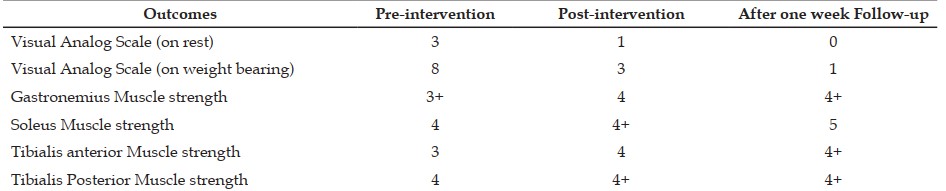
Shin Splints is characterized by lower leg pain and tenderness in the middle or lower third of the medial edge of the shinbone. Objective: The purpose of this case report is to evaluate the effect of Instrument Assisted Soft tissue Mobilisation (IASTM) along with conventional rehabilitation programme for the management of Acute Shin Splints. Clinical Features: A 63 year old male patient complains of pain in his left lower leg since one week. On palpation, tenderness was present on anterior, medial and posterior side of tibia. Initially symptoms were mild during walking but later his pain gets severe even with weight bearing. The patient underwent treatment of Instrument Assisted Soft tissue Mobilisation and conventional rehabilitation for one week. Intervention and Outcome: The recovery of pain was monitored by visual analogue scale and muscle strength by manual muscle testing. On Visual Analog Scale (VAS), Pain on rest was 3 while on weight bearing it was 8 out of 10. Left lower extremity muscle strength was grade 4 measured by manual muscle testing. After one week, a significant reduction of pain in his left lower leg, VAS gets reduced to 1 on weight bearing and 0 at rest. Lower extremity muscle strength also increased to grade 5. After one week follow up, his symptoms completely resolve. Conclusion: The study concluded that IASTM showed a promising result in managing the Acute Shin Splints. It should be used as an addition to conventional rehabilitation program.
References
- 1. Krenner BJ. Comprehensive management of medial tibial stress syndrome. J Chiropr Med. 2002; 1(3): 122-4.
- 2. Wilder RP, Sethi S. Overuse injuries: tendinopathies, stress fractures, compartment syndrome, and shin splints. Clin Sports Med. 2004; 23(1): 55-81.
- 3. Jovicic M, Jovicic V, Hrkovic M, Lazovic M. Medial tibial stress syndrome: case report. Med Pregl. 2014; 67(7-8): 247-51.
- 4. Griebert MC, Needle AR, McConnell J, Kaminski TW. Lower-leg Kinesio tape reduces rate of loading in participants with medial tibial stress syndrome. Phys Ther Sport. 2016; 18: 62-67.
- 5. Beck BR. Tibial stress injuries. An aetiological review for the purposes of guiding management. Sports Med. 1998; 26(4): 265-79.
- 6. Gulick D. Instrument-assisted soft tissue mobilization increases myofascial trigger point pain threshold. J Bodyw Mov Ther. 2018; 22: 341-345.
- 7. Kortebein PM, Kaufman KR, Basford JR, Stuart MJ. Medial tibial stress syndrome. Med Sci Sports Exerc. 2000; 32 Suppl 3: 278-33.
- 8. Moen MH, Tol JL, Weir A, Steunebrink M, De Winter TC. Medial tibial stress syndrome. Sports Med. 2009; 39(7): 523-46.
- 9. El-hafez HM, Hamdy HA, Takla MK, Ahmed SEB, Genedy AF, Abd EL-Azeim ASS. Instrument-assisted soft tissue mobilizations versus stripping massage for upper trapezius myofascial trigger points. J Taibah Univ Med Sc. 2020; 15(2): 1-7
Data Sharing Statement
There are no additional data available. All raw data and code are available upon request.
Funding
This research received no funding.
Author Contributions
All authors contributed significantly to the work and approve its publication.
Ethics Declaration
This article does not involve any human or animal subjects, and therefore does not require ethics approval.
Acknowledgements
We would like to express our gratitude to the patients, their families, and all those who have contributed to this study.
Conflicts of Interest
No conflicts of interest in this work.
About this article

Cite this article
Manisha Uttam/Effect of Instrument Assisted Soft Tissue Mobilisation for the Management of Acute Shin Splints: A Case Report, Physiotherapy and Occupational Therapy Journal. 2022;15(1):33-36.
Licence:
Attribution-Non-commercial 4.0 International (CC BY-NC 4.0)This license enables reusers to distribute, remix, adapt, and build upon the material in any medium or format for noncommercial purposes only, and only so long as attribution is given to the creator.
| Received | Accepted | Published |
|---|---|---|
| January 21, 2022 | February 24, 2022 | March 30, 2022 |
DOI: https://doi.org/10.21088/potj.0974.5777.15122.4
Keywords
Medial Tibial Stress SyndromeSoft tissue mobilizationAcute painRehabilitationLower leg painSearch for Similar Articles
Similar Articles
- Leadership in Physiotherapy: A Narrative Review
- Effectiveness of Low Level Laser Theapy in the Management of Temporomandibular J...
- The Impact of Air Pollution on Cardiopulmonary Health: Molecular Mechanisms, Pre...
- Efectiveness of Physiotherapy in Postpartum Women with Diastasis Recti: A Review
- Pain Neuroscience Education: Transforming Physiotherapy Practice
Article Level Metrics
Last UpdatedFriday 23 October 2026, 15:23:13 (IST)
4358
Accesses
30
739
00
Citations
NA
NA
NA
Download citation
Article Keywords
Keyword Highlighting
Highlight selected keywords in the article text.
Timeline
| Received | January 21, 2022 |
| Accepted | February 24, 2022 |
| Published | March 30, 2022 |
licence
Attribution-Non-commercial 4.0 International (CC BY-NC 4.0)
This license enables reusers to distribute, remix, adapt, and build upon the material in any medium or format for noncommercial purposes only, and only so long as attribution is given to the creator.