Full Text (PDF)
Indian Journal of Maternal-Fetal & Neonatal Medicine 11(2):p 39-43, July-December 2024. | DOI: https://doi.org/10.21088/ijmfnm.2347.999X.11224.1
Original Article
Effect of Early and Prophylactic Surfactant Therapy in Preterm Neonates in a Tertiary Care Setting: A Clinical Study
Swapnil Kajale, Umesh Kawalkar, Amar Mankar, Nilesh Jadhao, Anshu Singh
Author Information
Licence:
Attribution-Non-commercial 4.0 International (CC BY-NC 4.0)This license enables reusers to distribute, remix, adapt, and build upon the material in any medium or format for noncommercial purposes only, and only so long as attribution is given to the creator.
Indian Journal of Maternal-Fetal & Neonatal Medicine 11(2):p 39-43, July-December 2024. | DOI: https://doi.org/10.21088/ijmfnm.2347.999X.11224.1
How Cite This Article:
Swapnil Kajale, Umesh Kawalkar, Amar Mankar, et al. Effect of Early and Prophylactic Surfactant Therapy in Preterm Neonates in a Tertiary Care Setting: A Clinical Study in Selected Hospital, Surat. Ind J of Matern-Fetal & Neonatal Med 2024;11(2):39–43.Timeline
Received : August 20, 2024
Accepted : October 05, 2024
Published : December 30, 2024
Abstract
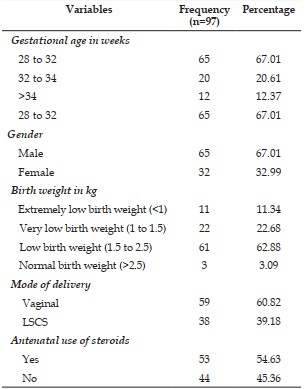
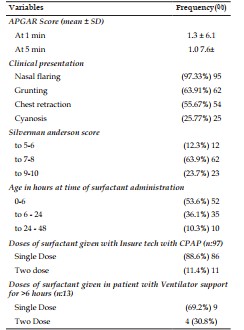
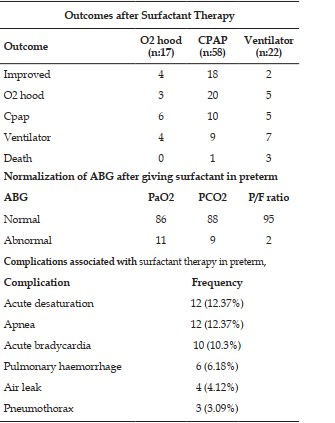
Context: Respiratory Distress Syndrome (RDS) is a significant cause of morbidity and mortality in preterm neonates due to pulmonary immaturity and lack of endogenous surfactant. This study evaluates the effect of early and prophylactic surfactant therapy in preterm neonates in a tertiary care setting. Aims: To assess the clinical outcomes of early and prophylactic surfactant therapy in preterm neonates. Settings and Design: A prospective observational clinical trial conducted over 24 months at the Neonatal Intensive Care Unit (NICU) of VMGMC Solapur. Methods and Material: The study included preterm neonates up to 28 days old who received surfactant therapy. Neonates with severe congenital anomalies were excluded. Surfactant was administered using the Intubation-surfactant-Extubation (InSurE) technique without sedation. Bovine lipid extract surfactant (NEOSURF) was administered, followed by non-invasive positive pressure ventilation (NIPPV). Data was collected using a pre-designed questionnaire and analysed using IBM SPSS version 21.0. Statistical analysis used: Descriptive statistics was used to describe the data. Chisquare test was applied for qualitative data, and Student's t-test for quantitative data. A pvalue of <0.05 was considered statistically significant. Results: Out of 97 neonates, 67.01% had a gestational age of 28-32 weeks, and 62.88% had low birth weight. Clinical presentations included nasal flaring (97.93%) and grunting (63.91%). The majority of surfactant administrations occurred within the first 6 hours (53.6%). Postsurfactant, arterial blood gas normalization was achieved in 88% of the cases. Complications included acute desaturation (12.37%) and apnea (12.37%). Mortality was 10.67%, with the majority being discharged after an average NICU stay of 17.6 days. Conclusions: Early and prophylactic surfactant therapy significantly improved clinical outcomes in preterm neonates, reducing morbidity and mortality with manageable complications.
References
- 1. Nkadi PO, Merritt TA, Pillers DAM. An overview of pulmonary surfactant in the neonate: genetics, metabolism, and the role of surfactant in health and disease. Mol Genet Metab. 2009;97(2):95–101.
- 2. Nugent K, Dobbe L, Rahman R, Elmassry M, Paz P. Lung morphology and surfactant function in cardiogenic pulmonary edema: a narrative review. J Thorac Dis. 2019;11(9):4031.
- 3. Sardesai S, Biniwale M, Wertheimer F, Garingo A, Ramanathan R. Evolution of surfactant therapy for respiratory distress syndrome: past, present, and future. Pediatric Research 2017 81:1. 2016 Oct 5;81(1):240–8.
- 4. De Luca D. Personalising care of acute respiratory distress syndrome according to patients’ age. Lancet Respir Med. 2019 Feb 1;7(2):100–1.
- 5. Aggarwal NR, King LS, D’Alessio FR. Diverse macrophage populations mediate acute lung inflammation and resolution. Am J Physiol Lung Cell Mol Physiol. 2014 Apr15 ;306(8):709–25.
- 6. Kotta S, Aldawsari HM, Badr-Eldin SM, Binmahfouz LS, Bakhaidar RB, Sreeharsha N, et al. Aerosol delivery of surfactant liposomes for management of pulmonary fibrosis: An approach supporting pulmonary mechanics. Pharmaceutics. 2021 Nov 1;13(11):1851.
- 7. De Luca D. Personalising care of acute respiratory distress syndrome according to patients’ age. Lancet Respir Med. 2019;7(2):100–1.
- 8. Szczapa T, Hożejowski R, Krajewski P. Implementation of less invasive surfactant administration in clinical practice—Experience of a mid-sized country. PLoS One. 2020 Jul 1
- 9. Enezi FA, Mohan S, Fuad Alghamdi K, Mubarak Alenzi AD, Ahmed Alrashidi K, Abdulaziz Almajed AA, et al. Incidence and Outcome of Surfactant Therapy in Premature Neonates in ICU of KAMC. IntJCurrMicrobiolAppSci. 2018 ;7(4):1548–58.
- 10. Singh D, Rana KS, Mathai S. Role of prophylactic surfactant in preterm infants. Med J Armed Forces India. 2011 Apr 1;67(2):138–41.
- 11. Wiswell TE, Knight GR, Finer NN, Donn SM, Desai H, Walsh WF, et al. A Multicenter, Randomized, Controlled Trial Comparing Surfaxin (Lucinactant) Lavage With Standard Care for Treatment of Meconium Aspiration Syndrome. Pediatrics. 2002 Jun 1 ;109(6):1081–7.
- 12. Da Costa DE, Nair AK, Pai MG, Al Khusaiby SM. Steroids in full term infants with respiratory failure and pulmonary hypertension due to meconium aspiration syndrome. Eur J Pediatr. 2001;160(3):150–3.
- 13. Natarajan CK, Sankar MJ, Jain K, Agarwal R, Paul VK. Surfactant therapy and antibiotics in neonates with meconium aspiration syndrome: a systematic review and meta-analysis. Journal of Perinatology 2016 36:1. 2016 Apr 25;36(1): S49–54.
- 14. Donn SM, Dalton J. Surfactant Replacement Therapy in the Neonate: Beyond Respiratory Distress Syndrome. Respir Care. 2009;54(9).
Data Sharing Statement
There are no additional data available. All raw data and code are available upon request.
Funding
This research received no funding.
Author Contributions
All authors contributed significantly to the work and approve its publication.
Ethics Declaration
This article does not involve any human or animal subjects, and therefore does not require ethics approval.
Acknowledgements
We would like to express our gratitude to the patients, their families, and all those who have contributed to this study.
Conflicts of Interest
No conflicts of interest in this work.
About this article

Cite this article
Swapnil Kajale, Umesh Kawalkar, Amar Mankar, et al. Effect of Early and Prophylactic Surfactant Therapy in Preterm Neonates in a Tertiary Care Setting: A Clinical Study in Selected Hospital, Surat. Ind J of Matern-Fetal & Neonatal Med 2024;11(2):39–43.
Licence:
Attribution-Non-commercial 4.0 International (CC BY-NC 4.0)This license enables reusers to distribute, remix, adapt, and build upon the material in any medium or format for noncommercial purposes only, and only so long as attribution is given to the creator.
| Received | Accepted | Published |
|---|---|---|
| August 20, 2024 | October 05, 2024 | December 30, 2024 |
DOI: https://doi.org/10.21088/ijmfnm.2347.999X.11224.1
Keywords
Preterm neonatesRespiratory Distress SyndromeSurfactant therapyInsure techniqueNICU.Respiratory Distress SyndromeSurfactant therapyInsure techniqueNICU.Search for Similar Articles
Similar Articles
- Maternal Mental-Health During Pregnancy and Postpartum Period: A Review of Recen...
- Prenatal Diagnosis of Costello Syndrome: A Case Report
- Innovations in Obstetric Hemorrhage Management: The Evolution of Transvaginal Ba...
- Maternal Plasma Cytokines and the Subsequent Risk of Uterine Atony and Postpartu...
- Amniotic Band Syndrome
Article Level Metrics
Last UpdatedSaturday 17 October 2026, 15:02:41 (IST)
1730
Accesses
14
189
00
Citations
NA
NA
NA
Download citation
Article Keywords
Keyword Highlighting
Highlight selected keywords in the article text.
Timeline
| Received | August 20, 2024 |
| Accepted | October 05, 2024 |
| Published | December 30, 2024 |
licence
Attribution-Non-commercial 4.0 International (CC BY-NC 4.0)
This license enables reusers to distribute, remix, adapt, and build upon the material in any medium or format for noncommercial purposes only, and only so long as attribution is given to the creator.