Full Text (PDF)
Indian Journal of Agriculture Business 12(1):p 45-53, January 2026. | DOI: https://doi.org/10.21088/ijab.2454.7964.12126.6
Original Article
Direct administration of high CLA producing Butyrivibrio fibrisolvens along with dietary oil on CLA profile of muscles and fat tissue of crossbred kids
Nilufar Haque, Sheikh Asraf Hossain, Amrish K. Tyagi
Author Information
Licence:
Attribution-Non-commercial 4.0 International (CC BY-NC 4.0)This license enables reusers to distribute, remix, adapt, and build upon the material in any medium or format for noncommercial purposes only, and only so long as attribution is given to the creator.
Indian Journal of Agriculture Business 12(1):p 45-53, January 2026. | DOI: https://doi.org/10.21088/ijab.2454.7964.12126.6
How Cite This Article:
Sheikh Asraf Hossain, Nilufar Haque, Amrish K. Tyagi. Direct administration of high CLA producing Butyrivibrio fibrisolvens along with dietary oil on CLA profile of muscles and fat tissue of crossbred kids. J Agri Busi 2026; 12(1): 45–53.Timeline
Received : January 31, 2026
Accepted : March 02, 2026
Published : June 20, 2026
Abstract
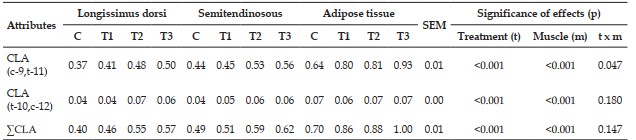
Conjugated linoleic acid (CLA), found in ruminant-derived food products such as meat is one of the functional food components. Manipulating rumen microbial population might be a strategy to develop the value added goat meat. In present experiment, the effect of high CLA producing Butyrivibrio fibrisolvens strain 4a (bf4a) administration along with dietary oil contained linoleic acid (LA) was investigated on CLA content in meat of crossbred kids of four different groups (n=20): Control (C; basal diet); T1 (C + LA source @200 mg/L of rumen fluid), T2 (C+suspension of bf4a, 109 CFU head-1) and T3 (T1+suspension of bf4a, 109 CFU head-1). Total CLA content was enhanced by 30.0, 19.1 and 30.0%, respectively, in Longissimus dorsi, Semitendinosus muscle and adipose tissue thereby improving the desaturation index in bf4a along with dietary oil administered group as compared to the control. Administration of B. fibrisolvens 4a along with linoleic acid enriched dietary oil is a useful strategy to increase beneficial CLA levels in ruminant’s meat by altering the ruminal biohydrogenation pattern.
References
- 1. AOAC. (2005). Official Methods of Analysis, Association of Official Analytical Chemists, Washington DC, USA.
- 2. Asanuma, N., Kawato, M., & Hino, T. (2001). Presence of Butyrivibrio fibrisolvens in the digestive tract of dogs and cats, and its contribution to butyrate production. Journal of General and Applied Microbiology, 47, 313–319.
- 3. Baghurst, K. (2004). Dietary fats, marbling and human health. Australian Journal of Experimental Agriculture, 44, 635–644.
- 4. Das, K., & Qin, W. (2012). Isolation and characterization of superior rumen bacteria of cattle (Bos taurus) and potential application in animal feedstuff. Open Journal of Animal Sciences, 2, 224-228.
- 5. Elwood, P.C., Pickering, J.E., Givens, D.I., & Gallacher, J.E. (2010). The consumption of milk and dairy foods and the incidence of vascular disease and diabetes: an overview of the evidence. Lipids, 45, 925–939.
- 6. Fukuda, S., Furuya, H., Suzuki, Y., Asanuma, N., & Hino, T. (2005). A new strain of Butyrivibrio fibrisolvens that has high ability to isomerize linoleic acid to conjugated linoleic acid. Journal of General and Applied Microbiology, 51, 105–113.
- 7. Givens, D. I. (2005). The role of animal nutrition in improving the nutritive value of animal-derived foods in relation to chronic disease. Proceedings of the Nutrition Society, 64, 395–402.
- 8. Griinari, J.M., & Bauman, D.E. (1999). Biosynthesis of conjugated linoleic acid and its incorporation into meat and milk in ruminants. In: Yurawecz MP, Mossoba MM, Kramer JKG, Pariza MW, Nelson GJ (eds) Advances in Conjugated Linoleic Acid Research AOCS, Illinois, Champaign, pp 180-200.
- 9. Griinari, J.M., Corl, B.A., Lacy, S.H., Chouinard, P.Y., & Nurmela, K.V.V. (2000). Conjuated linoleic acid is synthesized endogenously in lactating dairy by delta-9-desaturase. Journal of Nutrition, 130, 2285-2291.
- 10. Hussain, S.A., Srivastav, A., Tyagi, A., Shandilya, U.K., Kumar, A., Kumar, S., & Tyagi, A.K. (2016). Characterization of CLAproducing Butyrivibrio spp. reveals strainspecific variations. 3 Biotech, 6, 90.
- 11. Koba, K., & Yanagita, T. (2014). Health benefits of conjugated linoleic acid (CLA). Obesity Research and Clinical Practice, 8, 525-532.
- 12. Kramer, J.K., Fellner, V., Dugan, M.E., Sauer, F.D., Mossoba, M.M., & Yurawecz, M.P. (1997). Evaluating acid and base catalyst in the methylation of milk and rumen fatty acids with special emphasis on conjugated dienes and total trans fatty acids. Lipids, 32, 1219– 1228.
- 13. Lee, H.J., Kannan, G., & Kouakou, B. (2006). Concentration and distribution of conjugated linoleic acid and trans- fatty acids in small ruminant milk and meat lipids. Journal of Food Lipids, 13, 100-111.
- 14. Mahgoub, O., Khan, A.J., Al-Maqbaly, R.S., Al-Sabahi, J.N., Annamalai, K., & Al-Sakry, N.M. 2002. Fatty acid composition of muscle and fat tissues of Omani Jebel Akhdar goats of different sexes and weights. Meat Science, 61, 381-387.
- 15. Mills, S., Ross, R.P., Hill, C., Fitzgerald, G.F., & Stanton, C. (2011). Milk intelligence: mining milk for bioactive substances associated with human health. International Dairy Journal, 7, 377-401.
- 16. Muka, T., Kraja, B., Ruiter, R., Keyser, C.E., Hofman, A., Stricker, B.H.,,,, & Franco, O.H. (2016). Dietary polyunsaturated fatty acids intake modifies the positive association between serum total cholesterol and colorectal cancer risk: the Rotterdam study. Journal of Epidemiology and Community Health, 70, 881-887.
- 17. NRC. (1981). Nutrient Requirement of Goats: Angora Dairy and Meat Goats in temperate and tropical countries. National Acad. Press, Washington, DC.
- 18. O’Fallon, J.V., Busboom, J.R., Nelson, M.L., & Gaskins, C.T. (2007). A direct method for fatty acid methyl ester synthesis: Application to wet meat tissues, oils and feedstuffs. Journal of Animal Science, 85, 1511-1521.
- 19. Ogawa, J., Kishino, S., Ando, A., Sugimoto, S., Nishara, K., & Shimizu, S. (2005). Production of conjugated linoleic acid by lactic acid bacteria. Journal of Bioscience and Bioengineering, 100,
- 20. Or-Rashid, M.M., Wright, T.C., & McBride, B.W. (2009). Microbial fatty acid conversion within the rumen and the subsequent utilization of these fatty acids to improve the healthfulness of ruminant food products. Appllied Microbiology and Biotechnology, 84, 1033– 1043.
- 21. Punia, A.K., Chaitianya, S., Tyagi, A.K., De, S., & Singh, K. (2008). Conjugated linoleic acid producing potential of Lactobacilli isolated from rumen of cattle. Journal of Industrial Microbiology and Biotechnology, 35, 1223-1228.
- 22. Radunz, Z.E., Wickersham, L.A., Loerch, S.C., Fluharty, F.L., Reynolds, C.K., & Zerby, H.N. (2009). Effects of dietary polyunsaturated fatty acid supplementation on fatty acid composition in muscle and subcutaneous adipose tissue of lambs. Journal of Animal Science, 87, 4082-4091.
- 23. Raes, K., De Smet, S., & Demeyer, D. (2004). Effect of dietary fatty acids on incorporation of long chain polyunsaturated fatty acids and conjugated linoleic acid in lamb, beef and pork meat: a review. Animal Feed Science and Technology, 113, 199–221.
- 24. Smet, D.S., Raes, K., & Demeyer, D. (2004). Meat fatty acid composition as affected by fatness and genetic factors: a review. Animal Research, 53, 81-98.
- 25. Talpur, F.N., Bhanger, M.I., & Khuhawar, M.Y. (2007). Intramuscular fatty acid profile of Longissimus dorsi and Semitendinosus muscle from Kundi steers fed pasture with cotton seed cake supplement. International Journal of Food Science and Technology, 42, 1007-1011.
- 26. Talpur, F.N., Bhanger, M.I., & Sharazi, S.T.H. (2008). Intramuscular fatty acid profile of longissimus of dorsi and semitendinosus muscle from Pateri goats fed under traditional feeding system of Sindh, Pakistan. Meat Science, 80, 819-822.
- 27. Todaro, M., Carrao, A., Barone, C.M.A., Alicata, M.L., Schinelli, R., & Giaccone, P. (2006). Use of weaning concentrate in the feeding of suckling kids: Effects on meat quality. Small Ruminant Research, 66, 44-50.
- 28. Zhu, Z., Hang, S., Mao, S., & Zhu, W. (2014). Diversity of Butyrivibrio Group bacteria in the rumen of goats and its response to the supplementation of garlic oil. AsianAustralasian Journal of Animal Sciences, 27,179–186.
Data Sharing Statement
There are no additional data available. All raw data and code are available upon request.
Funding
This research received no funding.
Author Contributions
All authors contributed significantly to the work and approve its publication.
Ethics Declaration
This article does not involve any human or animal subjects, and therefore does not require ethics approval.
Acknowledgements
We would like to express our gratitude to the patients, their families, and all those who have contributed to this study.
Conflicts of Interest
No conflicts of interest in this work.
About this article

Cite this article
Sheikh Asraf Hossain, Nilufar Haque, Amrish K. Tyagi. Direct administration of high CLA producing Butyrivibrio fibrisolvens along with dietary oil on CLA profile of muscles and fat tissue of crossbred kids. J Agri Busi 2026; 12(1): 45–53.
Licence:
Attribution-Non-commercial 4.0 International (CC BY-NC 4.0)This license enables reusers to distribute, remix, adapt, and build upon the material in any medium or format for noncommercial purposes only, and only so long as attribution is given to the creator.
| Received | Accepted | Published |
|---|---|---|
| January 31, 2026 | March 02, 2026 | June 20, 2026 |
DOI: https://doi.org/10.21088/ijab.2454.7964.12126.6
Keywords
Butyrivibrio FibrisolvensFatty AcidConjugated Linoleic AcidMuscleAdipose TissueGoat KidsSearch for Similar Articles
Similar Articles
- Studies on Bee and Pollination is Changing Environment: A Review
- Cultivating Rosemary: A Guide to its Medicinal and Therapeutic Wonders
- Active Biodegradable Edible Packaging System: An Affluent Predisposition Towards...
- Routine Management Practices for Sustainable Dairy Production
- Diagnosis and Management of Diseases Caused by Abiotic and Biotic Stress in Vege...
Article Level Metrics
Last UpdatedThursday 22 October 2026, 10:52:52 (IST)
3516
Accesses
13
498
00
Citations
NA
NA
NA
Download citation
Article Keywords
Keyword Highlighting
Highlight selected keywords in the article text.
Timeline
| Received | January 31, 2026 |
| Accepted | March 02, 2026 |
| Published | June 20, 2026 |
licence
Attribution-Non-commercial 4.0 International (CC BY-NC 4.0)
This license enables reusers to distribute, remix, adapt, and build upon the material in any medium or format for noncommercial purposes only, and only so long as attribution is given to the creator.