Full Text (PDF)
Indian Journal of Agriculture Business 12(1):p 40-44, January 2026. | DOI: https://doi.org/10.21088/ijab.2454.7964.12126.6
Original Article
Economic Feasibility of Dual-Axis tracking Fresnel Lens-assisted Solar Dryer Integrated with Nano-Enhanced Phase Change Material (NEPCM) Thermal Storage System
Aniket V. Deshmukh, Sanjay M. Kherde, Sneha D. Deshmukh
Author Information
Licence:
Attribution-Non-commercial 4.0 International (CC BY-NC 4.0)This license enables reusers to distribute, remix, adapt, and build upon the material in any medium or format for noncommercial purposes only, and only so long as attribution is given to the creator.
Indian Journal of Agriculture Business 12(1):p 40-44, January 2026. | DOI: https://doi.org/10.21088/ijab.2454.7964.12126.6
How Cite This Article:
Aniket V. Deshmukh, Sanjay M. Kherde, Sneha D. Deshmukh. Economic Feasibility of Dual-Axis tracking Fresnel lens-assisted solar dryer integrated with Nano-Enhanced Phase Change Material (NEPCM) thermal storage system. J Agri Busi 2026; 12(1): 40–44.Timeline
Received : August 28, 2025
Accepted : November 14, 2025
Published : June 20, 2026
Abstract
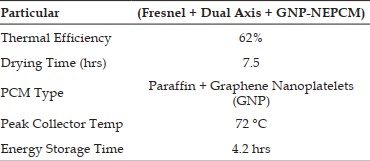
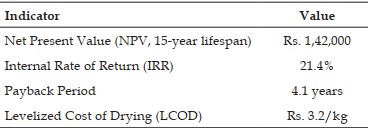
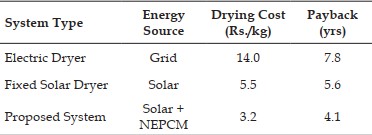
Background: Traditional solar dryers suffer from inconsistent solar availability and low energy density, which limit their efficiency and reliability. Rural agroprocessing units require sustainable, low-cost, and energy-efficient drying methods to reduce post-harvest losses and dependency on fossil fuels. Aims: To evaluate the technical and economic feasibility of a dual-axis tracking Fresnel lens solar dryer integrated with nano-enhanced phase change material (NEPCM) thermal storage for agricultural applications. Material and Methods: A techno-economic model was developed using five years of meteorological data for Indian climatic conditions. The system comprised a dual-axis Fresnel lens concentrator, drying chamber, and NEPCM thermal storage unit based on paraffin wax enhanced with graphene nanoplatelets. Economic evaluation included Net Present Value (NPV), Internal Rate of Return (IRR), payback period, and Levelized Cost of Drying (LCOD). Results: The integrated system achieved a thermal efficiency of 62%, reducing drying time for crops (chili, turmeric, amla) by 25–35% compared to conventional dryers. NEPCM storage enabled 4.2 hours of extended drying after sunset. The payback period was 4.1 years, with an IRR of 21.4% and LCOD of Rs. 3.2/ kg, representing ~60% savings compared to electric dryers. Sensitivity analysis highlighted the influence of PCM cost and solar irradiance on economic viability. Conclusion: The dual-axis Fresnel lens solar dryer with NEPCM storage is technically effective and economically viable. It enhances drying efficiency, reduces energy dependence, and improves product quality, making it suitable for rural agro-processing. Key Message: Integration of solar concentration with nano-enhanced PCM storage offers a sustainable pathway for reducing post-harvest losses. Wider adoption could empower small-scale farmers, lower drying costs, and contribute to lowcarbon agricultural practices.
References
- 1. Asrori, Asrori, and SugengHadiSusilo. “The Development of Fresnel Lens Concentrators for Solar Water Heaters: A Case Study in Tropical Climates.” EUREKA Physics and Engineering, no. 3, May 2022, pp. 3–10. https://doi.org/10.21303/2461-4262.2022.002441.
- 2. Babu, S., et al. “Solar Energy Simulation of Fresnel Lens Concentrated System for Thermal Electric Generator.” Lecture notes in mechanical engineering, 2021, pp. 833–39. https://doi.org/10.1007/978-981-16-0698-4_91.
- 3. Chavan, Anand, and BhaskarThorat. “Technoeconomic Comparison of Selected Solar Dryers: A Case Study.” Drying Technology, vol. 40, no. 10, May 2021, pp. 2105–15. https://doi.org/10.1080/07373937.2021.1919141.
- 4. Croitoru, Cristiana, et al. “Harnessing Nanomaterials for Enhanced Energy Efficiency in Transpired Solar Collectors: A Review of Their Integration in Phase-Change Materials.” Energies, vol. 17, no. 5, Mar. 2024, p. 1239. https://doi.org/10.3390/en17051239.
- 5. Deshmukh, Aniket V., and Sanjay M. Kherde. “Enhancing Energy Storage and Drying Efficiency in a Cabinet Solar Dryer Using NanoEnhanced PCM With FMWCNT.” Journal of Renewable Energies, July 2025, pp. 25–35. https://doi.org/10.54966/jreen.v28i3.1470.
- 6. Deshmukh S.D., Kalbande S.R. and Korpe N.D., Performance of double basin solar still integrated with evacuated tubes. AIP conference proceedings, (2024), 3149, 030001.
- 7. Deshmukh S.D., Mamta vyas and Rahul S. Sakarkar. Solar Dryers for Post-harvest Processing: An Alternative Approach for Conventional Drying Methods. Library Progress International, 44(3), (2024), 25160-25169.
- 8. Benzaama, M. H., et al. “Sunspot Analysis Under Varying Conditions Climate: Distributed Radiation on Cooling Floor and Its Effect on Dynamic Thermal Behaviour.” Solar Energy, vol. 221, May 2021, pp. 275–91. https://doi.org/10.1016/j.solener.2021.03.082.
- 9. Gautam, N. K., & Shirbhate, A. D. CFD Analysis of Refrigerator Integrated with Atmospheric Water Generator. Journal of Mines Metals and Fuels, (2023), 1689–1696. https://doi. org/10.18311/jmmf/2023/35865.
- 10. Hussain, M. I., Ali, A., & Lee, G. H., Performance and economic analyses of linear and spot Fresnel lens solar collectors used for greenhouse heating in South Korea. Energy, 90(1), (2015), 1522–1531. https://doi.org/10.1016/j.energy.2015.06.026.
- 11. Kalbande S.R., Khambalkar V.P., Deshmukh S.D., Investigation on improved solar dryers for agriculture. Interdisciplinary Environmental Review, Vol. 19, No. 1, 2018.
- 12. Kushwah, A., Kumar, A., & Gaur, M. K., Techno-economic analysis of solar still with nano-phase change material and heating coil: A novel approach for sustainable development. Journal of Thermal Engineering, 11(2), (2025),
- 13. Tyagi, P. K., & Kumar, R. (2024). Comprehensive performance assessment of photovoltaic/thermal system using MWCNT/water nanofluid and novel finned multi-block nano-enhanced phase change material-based thermal collector: Energy, exergy, economic, and environmental (4E) perspectives. Energy, 312, 124525. https://doi.org/10.1016/j.energy.2024.124525.
- 14. Wang, X., Wu, Z., Ma, T., Yang, X., & Xu, X., Nano-enhanced phase change materials for thermal energy storage: A comprehensive review of recent advancements, applications, and future challenges. Journal of Energy Storage, 74, (2023), 109265. https://doi. org/10.1016/j.est.2023.109265.
Data Sharing Statement
There are no additional data available. All raw data and code are available upon request.
Funding
This research received no funding.
Author Contributions
All authors contributed significantly to the work and approve its publication.
Ethics Declaration
This article does not involve any human or animal subjects, and therefore does not require ethics approval.
Acknowledgements
We would like to express our gratitude to the patients, their families, and all those who have contributed to this study.
Conflicts of Interest
No conflicts of interest in this work.
About this article

Cite this article
Aniket V. Deshmukh, Sanjay M. Kherde, Sneha D. Deshmukh. Economic Feasibility of Dual-Axis tracking Fresnel lens-assisted solar dryer integrated with Nano-Enhanced Phase Change Material (NEPCM) thermal storage system. J Agri Busi 2026; 12(1): 40–44.
Licence:
Attribution-Non-commercial 4.0 International (CC BY-NC 4.0)This license enables reusers to distribute, remix, adapt, and build upon the material in any medium or format for noncommercial purposes only, and only so long as attribution is given to the creator.
| Received | Accepted | Published |
|---|---|---|
| August 28, 2025 | November 14, 2025 | June 20, 2026 |
DOI: https://doi.org/10.21088/ijab.2454.7964.12126.6
Keywords
Fresnel LensDual-Axis TrackingNPVIRRPayback Period and Phase Change MaterialSearch for Similar Articles
Similar Articles
- Studies on Bee and Pollination is Changing Environment: A Review
- Cultivating Rosemary: A Guide to its Medicinal and Therapeutic Wonders
- Active Biodegradable Edible Packaging System: An Affluent Predisposition Towards...
- Routine Management Practices for Sustainable Dairy Production
- Diagnosis and Management of Diseases Caused by Abiotic and Biotic Stress in Vege...
Article Level Metrics
Last UpdatedWednesday 21 October 2026, 07:47:54 (IST)
3475
Accesses
27
496
00
Citations
NA
NA
NA
Download citation
Article Keywords
Keyword Highlighting
Highlight selected keywords in the article text.
Timeline
| Received | August 28, 2025 |
| Accepted | November 14, 2025 |
| Published | June 20, 2026 |
licence
Attribution-Non-commercial 4.0 International (CC BY-NC 4.0)
This license enables reusers to distribute, remix, adapt, and build upon the material in any medium or format for noncommercial purposes only, and only so long as attribution is given to the creator.