Full Text (PDF)
Physiotherapy and Occupational Therapy Journal 16(4):p 179-185, October - December 2023. | DOI: http://dx.doi.org/10.21088/potj.0974.5777.16423.2
Original Article
Deep Squating Posture will be Influenced by Intrinsic Factor apart from Passive Ankle Dorsiflexion Range of Motion
Author Information
Licence:
Attribution-Non-commercial 4.0 International (CC BY-NC 4.0)This license enables reusers to distribute, remix, adapt, and build upon the material in any medium or format for noncommercial purposes only, and only so long as attribution is given to the creator.
Physiotherapy and Occupational Therapy Journal 16(4):p 179-185, October - December 2023. | DOI: http://dx.doi.org/10.21088/potj.0974.5777.16423.2
How Cite This Article:
Aslam M. Deep squating posture will be influenced by intrinsic factor apart from passive ankle dorsiflexion range of motion. Physiother Occup Ther J. 2023;16(4):179-185.Timeline
Received : September 29, 2023
Accepted : November 02, 2023
Published : December 26, 2023
Abstract
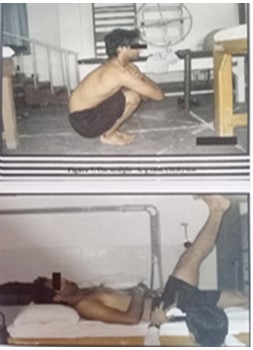
A total of 50 subjects participated in the study. The study was conducted in the department of Physiotherapy, Uttaranchal (PG) College of biomedical sciences and Hospital, Dehradun. The subjects were recruited from Uttaranchal (PG) College of biomedical sciences and Hospital Dehradun. Subjects were chosen as per the inclusion and exclusion criteria and informed consent should be obtained from all of them. After explaining the procedure, the subjects were assessed and divided into two groups possible squatting group and impossible squatting group. The subjects were asked to sit in the deep squatting posture with their heel down and arm Crossed and maintain the posture for more than 5 second and they were divided into 2 groups. Two points to be kept in mind while squatting were as follows: (a) Both the knees and feet should be brought together to the maximum possible extent throughout the deep squat and (b) The thigh and calf should be in contact with each other. The subjects were divided into two groups possible squatting and impossible deep squatting groups. The possible deep squatting group can be described as those who can performed the squatting i.e, both the knee and feet should be brought together to maximum possible and the thigh and calf should be in contact with each other and maintain these posture more than 5 second whereas impossible deep squatting group can be described as those who cant performed to contact calf and thigh while squatting. shows the deep squatting posture. The following parameter were measure in two groups, The straight leg raise (SLR), The Heel-buttock distance (HBD), The modified finger floor distance (MFFD), The modified Thomas tests, Ankle dorsiflexion flexibility. To examine the possible differences between the two squatting groups regard to each test parameters the Mann-Whitney u test (if the distribution of the data is not normal) was used. The dependent variables for the deep squatting posture were analyzed by step wise linear discriminate analysis to determine their relative importance for differentiating between the two groups. The dependent variables for the deep squatting posture are hip flexibility, knee flexibility, trunk flexibility, flexibility of hip and pelvis and ankle dorsiflexion flexibility. The possible deep squatting group shows increase in ankle dorsiflexion flexibility than the impossible deep squatting posture. Thus deep squatting posture is easy and objective method to measure the ankle joint dorsiflexion flexibility.
References
- 1. A Hemmerich, H Brown, S Smith, S.S.K. MArathandam, U.P Wyss: Hip, knee, ankle kinematics of highrange of motion activities of dily living. Journal of orthopaedic research: 25 october 2005.
- 2. Amol Saxena, DMP AND Will Kim, DMP; Ankle dorsiflexion in adolescent athletes: journal of American podiatricmedical associati 2003, volume 93 number 4321-314.
- 3. Andra Bagus Sriwarno, Yoshihiro Shimomura, KoichiIwanaga, AND Tetsuo Katsuura; The evaluation of effect of stool height alteration on workload of squatting posture performed by Indonesian with different body mass index. humanergol: 20 december 2006, volume 35:31 390.
- 4. Cha ng-yuHsier, Joan M. Walker, and katie Gillis; Straight leg raising test comparison of three instruments. September 1983, volume 63/number 9.
- 5. Craig R. Dineger, Jay Harteland Jose Fonseca; The effect of lateral ankle spta in on dorsiflexion range of motion, posterior talarglide, and joint la xity. Journal of Orthopaedic and Sport physical therapy April 2002; volume 32/
- 6. Cunningham, Don H. Paterson, Peter A. Rechnitzer and John J. Koval; Age and sex effects on the mobility of the human ankle anatoie ontological society of america oxford journals; 28 june 1991 (abstracts).
- 7. Emika Kato, Toshiaki Oda, Kentaro Chino, Toshiyuki Kurihara, Toshihiko Nagayoshi, Tetsou Fukunaga and Yasuo Kawakami; Musculotendinous factors influencing difference in ankle joint flexibility between woman and me. International journal of sport and health science; 23 may 2005, volume 3, 74 218-225.
- 8. GKathiresan, N. Jali, N. Rhyhanafiqah, N. Azila Aznie, N. FIdieyana and N.Osop: The relationship between ankle joint flexibility and squatting knee flexion posture in young malaysian men. World journal of sport science.2010 volume 3:226-230.
- 9. Jennifer C. Nitz, Nancy Low Choy; The relationship between ankle dorsiflexion range, fall and activity level in women aged 40 to 80 Meears. zealand J. of physiotherapy; november 2004.
- 10. Jennifer L Kneating, Clair Parks and Merilyn Mackenzie; Measurement of ankle dorsiflexion in strock subject obtain using standardised dorsiflexion forea Australean J. of physiotherapy. 2006, volume 46.
- 11. Jeffrey Tucker; Overhead deep squatting: Understanding movement and function. Dynamic Chiropractic; 28 september 2006, volume 24.
- 12. John Weir and Nachiappan Chockalingam; Ankle joint dorsiflexion: assessment of the true values, 31 july.
- 13. Kim Bennell, Richard Talbot, Henry Wajswelner, Wassana Techovanich and David Kelly: Intra-rater and Inter-rater reliability of a weight- bearing lunge measure of ankle dorsiflexion. Australian physiotherapy,1998, volume 44.
- 14. Marei Johnson, Jennifer Baer, Holly Hovermale and Phouvy Phouthavong: Subtalarjoint position during gastrocnemius stretching and ankle dorsiflexion range of motion. Journal of athletic training; 2008 volume 43(2):172-178.
- 15. Margaret Schenkman, Richard A berger, Patrick O Rlly, Robert Wmann and 75 DI.
Data Sharing Statement
There are no additional data available.
Funding
This research received no funding.
Author Contributions
All authors contributed significantly to the work and approve its publication.
Ethics Declaration
This article does not involve any human or animal subjects, and therefore does not require ethics approval
Acknowledgements
Information Not Provided
Conflicts of Interest
No conflicts of interest in this work.
About this article

Cite this article
Aslam M. Deep squating posture will be influenced by intrinsic factor apart from passive ankle dorsiflexion range of motion. Physiother Occup Ther J. 2023;16(4):179-185.
Licence:
Attribution-Non-commercial 4.0 International (CC BY-NC 4.0)This license enables reusers to distribute, remix, adapt, and build upon the material in any medium or format for noncommercial purposes only, and only so long as attribution is given to the creator.
| Received | Accepted | Published |
|---|---|---|
| September 29, 2023 | November 02, 2023 | December 26, 2023 |
DOI: http://dx.doi.org/10.21088/potj.0974.5777.16423.2
Keywords
Heel-Buttock DistanceStraight Leg Raise (SLR)Modified-Finger Floor DistanceModified Thomas TestsAnkle Dorsiflexion FlexibilitySearch for Similar Articles
Similar Articles
- Cross-Cultural Adaptation, Reliability, and Validity of the Gujarati Version of...
- Physiotherapy Management of Multiple Sclerosis: An Overview of Recent Technologi...
- Converging Technologies in Cardiopulmonary Physiotherapy: A Review of VR, AR, AI...
- Cross-Cultural Adaptation, Reliability, and Validity of the Gujarati Version of...
- Effects of Kinesiotaping in Lateral Epicondylitis: A Narrative Review
Article Level Metrics
Last UpdatedTuesday 28 July 2026, 21:12:35 (IST)
1956
Accesses
2
425
00
Citations
NA
NA
NA
Download citation
Article Keywords
Keyword Highlighting
Highlight selected keywords in the article text.
Timeline
| Received | September 29, 2023 |
| Accepted | November 02, 2023 |
| Published | December 26, 2023 |
licence
Attribution-Non-commercial 4.0 International (CC BY-NC 4.0)
This license enables reusers to distribute, remix, adapt, and build upon the material in any medium or format for noncommercial purposes only, and only so long as attribution is given to the creator.