Full Text (PDF)
Journal of Emergency and Trauma Nursing 6(1):p 13-18, January-June 2025. | DOI: NA
Review Article
Comprehensive Review on Artificial Intelligence (AI) in Nursing
Author Information
Licence:
Attribution-Non-commercial 4.0 International (CC BY-NC 4.0)This license enables reusers to distribute, remix, adapt, and build upon the material in any medium or format for noncommercial purposes only, and only so long as attribution is given to the creator.
Journal of Emergency and Trauma Nursing 6(1):p 13-18, January-June 2025. | DOI: NA
How Cite This Article:
Vijayalakshmi. Comprehensive Review on Artificial Intelligence (AI) in Nursing. J of Emer and Trauma Nurs. 2025; 6(1): 13–18Timeline
Received : March 01, 2025
Accepted : April 18, 2025
Published : June 25, 2025
Abstract
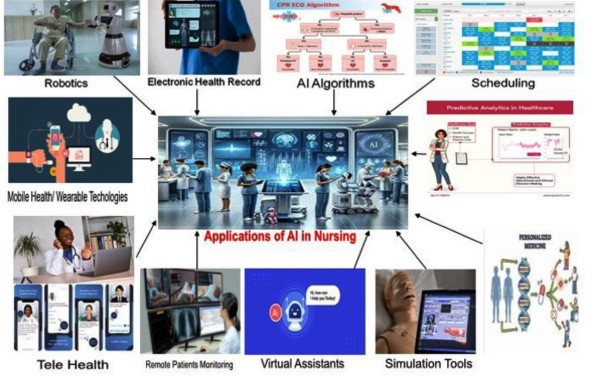
Artificial Intelligence in nursing offers tools to enhance efficiency, improve patient care, and support nurses. AI can automate administrative tasks, predict patient needs, and provide personalized care plans, ultimately reducing workload and allowing nurses to focus on direct patient interaction. While AI presents exciting possibilities, it also raises important considerations and challenges about algorithmic bias, data privacy, and the ethical implications of integrating technology into a profession that values human connection. AI is transforming nursing practice, and its impact will continue to grow as technology advances. Nurses will need to adapt to this changing landscape by embracing continuous learning, developing new skills in data analysis and AI interpretation, and prioritizing the human element of care.
References
- 1. Brian J. Douthit, et al. (2022). Artificial intelligence in Nursing. American nurse Journal.
- 2. Anja Grimes. (2024). Introduction to AI in Nursing: Transforming health care delivery. https://wildirismedical education.com.
- 3. Ross Pancho MACN. (2024). The Role of AI in Modern Nursing Practice: Nurse Click. https://www.acn.edu.au.
- 4. Kaul, V., Enslin, S., & Gross, S.A. (2020). History of artificial intelligence in medicine. American Society for Gastrointestinal Endoscopy, 92(4), 807-812.
- 5. Salem, H., Soria, D., Lund, J.N., & Awwad, A. (2021). A systematic review of the applications of Expert Systems (ES) and machine learning (ML) in clinical urology. BMC Medical Informatics and Decision Making, 21(223), 1-36.
- 6. Rajpurkar, P., Chen, E., Banerjee, O., & Topol, E.J. (2022). AI in health and medicine. Nature Medicine, 28, 31-38.
- 7. Askin, S., Burkhalter, D., Calado, G., & El Dakrouni, S. (2023). Artificial Intelligence applied to clinical trials: Opportunities and challenges. Health and Technology, 13(2), 203–213.
- 8. Lundervold, A.S., & Lundervold, A. (2018). An overview of deep learning in medical imaging focusing on MRI. Z Med Phys., 29(2), 102-127.
- 9. Sloane, E.B., & J. Silva, R. (2020). Artificial intelligence in medical devices and clinical decision support systems. Clinical Engineering Handbook, 556–568.
- 10. Michelle Clark, and Sharon Bailey (2024). Chatbots in Health Care: Connecting Patients to Information. Canadian Agency for Drugs and Technologies in Health, Report No.: EH0122.
- 11. Wang H., Zu Q., Chen J., Yang Z., Ahmed MA. (October 2021). “Application of Artificial Intelligence in Acute Coronary Syndrome: A Brief Literature Review”. Advances in Therapy. 38 (10): 5078–5086
Data Sharing Statement
There are no additional data available. All raw data and code are available upon request.
Funding
This research received no funding.
Author Contributions
All authors contributed significantly to the work and approve its publication.
Ethics Declaration
This article does not involve any human or animal subjects, and therefore does not require ethics approval.
Acknowledgements
We would like to express our gratitude to the patients, their families, and all those who have contributed to this study.
Conflicts of Interest
No conflicts of interest in this work.
About this article

Cite this article
Vijayalakshmi. Comprehensive Review on Artificial Intelligence (AI) in Nursing. J of Emer and Trauma Nurs. 2025; 6(1): 13–18
Licence:
Attribution-Non-commercial 4.0 International (CC BY-NC 4.0)This license enables reusers to distribute, remix, adapt, and build upon the material in any medium or format for noncommercial purposes only, and only so long as attribution is given to the creator.
| Received | Accepted | Published |
|---|---|---|
| March 01, 2025 | April 18, 2025 | June 25, 2025 |
DOI: NA
Keywords
Artificial IntelligenceNursingReviewSearch for Similar Articles
Similar Articles
- Transfusion-Related Acute Lung Injury: Trali
- Fall Risk Assessment and Management: Nursing Role and Responsibilities
- A Study to assess the Effectiveness of a Structured Teaching Programme on Knowle...
- Non-randomized Control Trial to assess the Effectiveness of Structured Teaching...
- Peripheral Nerve Damage: Local “Pehalwan” or Injection Induced? The Challenge
Article Level Metrics
Last UpdatedSaturday 24 October 2026, 15:15:58 (IST)
1175
Accesses
13
215
00
Citations
NA
NA
NA
Download citation
Article Keywords
Keyword Highlighting
Highlight selected keywords in the article text.
Timeline
| Received | March 01, 2025 |
| Accepted | April 18, 2025 |
| Published | June 25, 2025 |
licence
Attribution-Non-commercial 4.0 International (CC BY-NC 4.0)
This license enables reusers to distribute, remix, adapt, and build upon the material in any medium or format for noncommercial purposes only, and only so long as attribution is given to the creator.