Full Text (PDF)
Journal of Emergency and Trauma Nursing 6(1):p 19-24, January-June 2025. | DOI: NA
Review Article
Evolving Acute Coronary Syndrome (ACS) Diagnosis: Role of Emerging Biomarkers
S. Rajathi, C. Sriramalakshmi, D.K. Sriram
Author Information
Licence:
Attribution-Non-commercial 4.0 International (CC BY-NC 4.0)This license enables reusers to distribute, remix, adapt, and build upon the material in any medium or format for noncommercial purposes only, and only so long as attribution is given to the creator.
Journal of Emergency and Trauma Nursing 6(1):p 19-24, January-June 2025. | DOI: NA
How Cite This Article:
C. Sriramalakshmi, S. Rajathi, D.K. Sriram. Evolving Acute Coronary Syndrome (ACS) Diagnosis: Role of Emerging Biomarkers. J of Emer and Trauma Nurs. 2025; 6(1): 19–24.Timeline
Received : April 19, 2025
Accepted : May 21, 2025
Published : June 25, 2025
Abstract
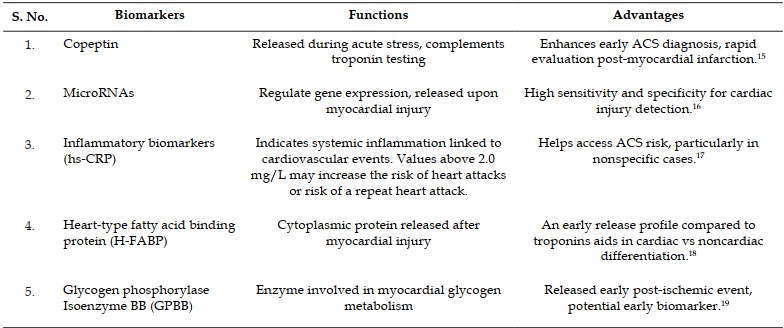
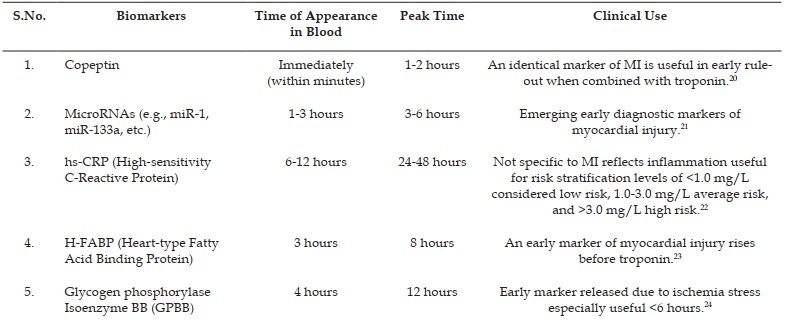
The future of Acute Coronary Syndrome (ACS) diagnosis lies in combining traditional and emerging biomarkers to optimize patient outcomes and improve efficiency in emergency settings. To minimize the negative consequences of this potentially fatal illness, has to be identified and treated quickly in the Emergency Department (ED). Although cardiac troponins, myoglobin, CKMB, and electrocardiograms (ECGs) constitute the golden standard for diagnosing ACS, their shortcomings in early identification underscore the need for further biomarkers. Copeptin, microRNAs (miRNAs), inflammatory indicators, Heart-type Fatty Acid-Binding Peptin (H-FABP), and Glycogen Phosphorylase Isoenzyme BB (GPBB) are among the new biomarkers examined in this article. These biomarkers have the potential to enhance early ACS identification by enhancing conventional diagnostic techniques. Extensive validation through large-scale research is necessary to evaluate the cost-effectiveness and reliability of integrating these new biomarkers into clinical practice.
References
- 1. Mitsis A., Myrianthefs M., Sokratous S., Karmioti G., et al. Emerging Therapeutic Targets for Acute Coronary Syndromes: Novel Advancements and Future Directions. Biomedicines. 2024; 12(8): 1670. https://doi. org/10.3390/biomedicines12081670
- 2. Chapman A.R., Mills N.L. High-sensitivity cardiac troponin and the early rule out of myocardial infarction: time for action. Heart. 2020 July; 106(13): 955-957. doi: 10.1136/ heartjnl-2020-316811. Epub 2020 Apr 27. PMID: 32341134; PMCID: PMC7211104.
- 3. Jaffe A.S., Babuin L., Apple F.S. Biomarkers in acute cardiac disease: the present and the future. J Am Coll Cardiol. 2006 Jul 4; 48(1): 1-11. doi: 10.1016/j.jacc.2006.02.056. Epub 2006 Jun 12. PMID: 16814641.
- 4. Roffi, M. et al. (2015). 2015 ESC Guidelines for the management of acute coronary syndromes in patients presenting without persistent ST-segment elevation. European Heart Journal, 37(3), 267–315. https://doi.org/10.1093/eurheartj/ehv320
- 5. Musci, R. V., Reiner, Ž., & Traldi, F. (2023). Biomarkers in Cardiovascular Diseases: Current Issues and Future Perspectives. Life, 13(10), 1992. https://www.mdpi.com/2075- 1729/13/10/1992
- 6. Crea, F. & Libby, P. (2017). Acute Coronary Syndromes. In: Libby, P., Bonow, R.O., Mann, D.L., Zipes, D.P., editors. Braunwald’s Heart Disease: A Textbook of Cardiovascular Medicine. 11th edition. Philadelphia: Elsevier. https:// www.ncbi.nlm.nih.gov/books/NBK507805/
- 7. Kankra M, Mehta A, Sawhney JPS, Solanki S, Bhargava S, Ahirwar A., Manocha A., Singla P., Sharma A., Sharma M. Improving the ACS Triage-Using High Sensitivity TroponinI and Copeptin for Early ‘Rule-Out’ of AMI. Indian J Clin Biochem. 2022 Oct; 37(4): 449-457. doi: 10.1007/s12291-021-01015-7. Epub 2022 Jan 8. PMID: 36262786; PMCID: PMC9573839.
- 8. Elsevier. Copeptin – Overview and Clinical Significance. 2023. https://www.sciencedirect. com/topics/medicine-and-dentistry/copeptin
- 9. Tanase D.M., Gosav E.M., Ouatu A., Badescu MC, Dima N., Ganceanu-Rusu A.R., Popescu D., Floria M., Rezus E., Rezus C. Current Knowledge of MicroRNAs (miRNAs) in Acute Coronary Syndrome (ACS): STElevation Myocardial Infarction (STEMI). Life (Basel). 2021 Oct 8; 11(10): 1057. doi: 10.3390/ life11101057. PMID: 34685428; PMCID: PMC8541211.
- 10. Bassuk S.S., Rifai N., Ridker P.M. Highsensitivity C-reactive protein: clinical importance. Curr ProblCardiol. 2004 Aug; 29(8): 439-93. PMID: 15258556.
- 11. Arroyo-Espliguero R., Viana-Llamas M.C., Silva-Obregón A., Avanzas P. The Role of C-reactive Protein in Patient Risk Stratification and Treatment. EurCardiol. 2021 Jul 7; 16: e28. doi: 10.15420/ecr.2020.49. PMID: 34276813; PMCID: PMC8280753.
- 12. Jaiswal A., Vamne A., Verma M.K., Doctor B. H-FABP as a diagnostic marker for early detection of young myocardial infarction among Indians. Bioinformation. 2022 Jun 30; 18(6): 506-512. doi: 10.6026/97320630018506. PMID: 37168777; PMCID: PMC10165047.
- 13. Singh N., Rathore V., Mahat R.K., Rastogi P. Glycogen Phosphorylase B.B.: A more Sensitive and Specific Marker than Other Cardiac Markers for Early Diagnosis of Acute Myocardial Infarction. Indian J Clin Biochem. 2018 Jul; 33(3): 356-360. doi: 10.1007/s12291- 017-0685-y. Epub 2017 Aug 3. PMID: 30072837; PMCID: PMC6052728.
- 14. Thupakula S., Nimmala S.S.R., Ravula H., Chekuri S., Padiya R. Emerging biomarkers for the detection of cardiovascular diseases. Egypt Heart J. 2022 Oct 20; 74(1): 77. doi: 10.1186/ s43044-022-00317-2. PMID: 36264449; PMCID: PMC9584006.
- 15. Szarpak L., Lapinski M., Gasecka A., Pruc M., Drela W.L., Koda M., Denegri A., Peacock F.W., Jaguszewski M.J., Filipiak K.J. Performance of Copeptin for Early Diagnosis of Acute Coronary Syndromes: A Systematic Review and Meta-Analysis of 14,139 Patients. J Cardiovasc Dev Dis. 2021 Dec 27; 9(1): 6. doi: 10.3390/jcdd9010006. PMID: 35050216; PMCID: PMC8780262.
- 16. Kramna D., Riedlova P., Jirik V. MicroRNAs as a Potential Biomarker in the Diagnosis of Cardiovascular Diseases. Medicina (Kaunas). 2023 Jul 19;59(7):1329. doi: 10.3390/ medicina59071329. PMID: 37512140; PMCID: PMC10386031.
- 17. C-reactive protein test - Mayo Clinic. (n.d.). h t t p s : / / w w w . m a y o c l i n i c . o r g / t e s t s - p r o c e d u r e s / c - r e a c t i v e - p r o t e i n - t e s t / about/pac-20385228#:~:text=Values%20 above%202.0%20mg%2FL,can%20help%20 determine%20the%20risk.
- 18. Okamoto, Fumio, Sohmiya, Koichi, Ohkaru, Yasuhiko, Kawamura, Keishiro, Asayama, Kumiko, Kimura, Hiroshi, Nishimura, Shinzo, Ishii, Hiroo, Sunahara, Noriyuki and Tanaka, Takao. “Human Heart-Type Cytoplasmic Fatty Acid-Binding Protein (H-FABP) for the Diagnosis of Acute Myocardial Infarction. Clinical Evaluation of H-FABP in Comparison with Myoglobin and Creatine Kinase Isoenzyme MB”, vol. 38, no. 3, 2000, pp. 231- 238. https://doi.org/10.1515/CCLM.2000.034
- 19. Singh N., Rathore V., Mahat R.K., Rastogi P. Glycogen Phosphorylase BB: A more Sensitive and Specific Marker than Other Cardiac Markers for Early Diagnosis of Acute Myocardial Infarction. Indian J Clin Biochem. 2018 Jul; 33(3): 356-360. doi: 10.1007/s12291- 017-0685-y. Epub 2017 Aug 3. PMID: 30072837; PMCID: PMC6052728.
- 20. Möckel M., Searle J. Copeptin-marker of acute myocardial infarction. Curr Atheroscler Rep. 2014 Jul; 16(7): 421. doi: 10.1007/s11883-014- 0421-5. PMID: 24844208; PMCID: PMC4061474.
- 21. Lee G.K., Hsieh Y.P., Hsu S.W., Lan S.J. Exploring diagnostic and prognostic predictive values of microRNAs for acute myocardial infarction: A PRISMA-compliant systematic review and meta-analysis. Medicine (Baltimore). 2021 Jul 23; 100(29):e26627. doi: 10.1097/MD.0000000000026627. PMID: 34398018; PMCID: PMC8294880.
- 22. Pavel, A.L., Kundnani, N.R., Morariu, S.I., Tudor, A., Man, D.E., Duda-Seiman, D.M., Velimirovici, D.E., Valcovici, M.D., Calin, P., & Dragan, S.R. (2024). Importance of H-FABP in early diagnosis of acute myocardial infarction. International Journal of General Medicine, Volume 17, 4335–4346. https://doi.org/10.2147/ijgm. s476736
- 23. Ghimire A Giri S Khanal N Rayamajhi S Thapa A Bist A, Devkota S. Diagnostic accuracy of glycogen phosphorylase BB for myocardial infarction: A systematic review and metaanalysis. J Clin Lab Anal. 2022 May; 36(5): e24368. doi: 10.1002/jcla.24368. Epub 2022 Mar 24. PMID: 35325479; PMCID: PMC9102511.
- 24. Fang-Shu Ou, Stefan Michiels, Yu Shyr, Alex A. Adjei, Ann L. Oberg, Biomarker Discovery and Validation: Statistical Considerations, Journal of Thoracic Oncology, Volume 16, Issue 4, 2021, Pages 537-545, ISSN 1556-0864, https://doi.org/10.1016/j.jtho.2021.01.1616
- 25. Chacko S., Haseeb S., Glover B.M., Wallbridge D, Harper A. The role of biomarkers in the diagnosis and risk stratification of acute coronary syndrome. Future Sci OA. 2017 Oct 27; 4(1): FSO251. doi: 10.4155/fsoa-2017-0036. PMID: 29255623; PMCID: PMC5729601.
- 26. Martínez-Sellés M., Marina-Breysse M. Current and Future Use of Artificial Intelligence in Electrocardiography. J Cardiovasc Dev Dis. 2023 Apr 17; 10(4): 175. doi: 10.3390/ jcdd10040175. PMID: 37103054; PMCID: PMC10145690.
- 27. Larkins M.C., Thombare A. Point-of-Care Testing. Updated 2023 May 29. In: StatPearls Internet. Treasure Island (FL): StatPearls Publishing; 2025 Jan-. Available from: https:// www.ncbi.nlm.nih.gov/books/NBK592387/
- 28. Junwen Su, Lamei Yang, Ziran Sun, Xianquan Zhan, Personalized Drug Therapy: Innovative Concept Guided With Proteoformics, Molecular & Cellular Proteomics, Volume 23, Issue 3, 2024, 100737, ISSN 1535-9476, https:// doi.org/10.1016/j.mcpro.2024.100737
Data Sharing Statement
There are no additional data available. All raw data and code are available upon request.
Funding
This research received no funding.
Author Contributions
All authors contributed significantly to the work and approve its publication.
Ethics Declaration
This article does not involve any human or animal subjects, and therefore does not require ethics approval.
Acknowledgements
We would like to express our gratitude to the patients, their families, and all those who have contributed to this study.
Conflicts of Interest
No conflicts of interest in this work.
About this article

Cite this article
C. Sriramalakshmi, S. Rajathi, D.K. Sriram. Evolving Acute Coronary Syndrome (ACS) Diagnosis: Role of Emerging Biomarkers. J of Emer and Trauma Nurs. 2025; 6(1): 19–24.
Licence:
Attribution-Non-commercial 4.0 International (CC BY-NC 4.0)This license enables reusers to distribute, remix, adapt, and build upon the material in any medium or format for noncommercial purposes only, and only so long as attribution is given to the creator.
| Received | Accepted | Published |
|---|---|---|
| April 19, 2025 | May 21, 2025 | June 25, 2025 |
DOI: NA
Keywords
Emerging BiomarkersAcute coronary syndromeCopeptinmiRNAsInflammatory MarkersSearch for Similar Articles
Similar Articles
- Transfusion-Related Acute Lung Injury: Trali
- Fall Risk Assessment and Management: Nursing Role and Responsibilities
- A Study to assess the Effectiveness of a Structured Teaching Programme on Knowle...
- Non-randomized Control Trial to assess the Effectiveness of Structured Teaching...
- Peripheral Nerve Damage: Local “Pehalwan” or Injection Induced? The Challenge
Article Level Metrics
Last UpdatedSaturday 24 October 2026, 14:07:56 (IST)
1175
Accesses
12
215
00
Citations
NA
NA
NA
Download citation
Article Keywords
Keyword Highlighting
Highlight selected keywords in the article text.
Timeline
| Received | April 19, 2025 |
| Accepted | May 21, 2025 |
| Published | June 25, 2025 |
licence
Attribution-Non-commercial 4.0 International (CC BY-NC 4.0)
This license enables reusers to distribute, remix, adapt, and build upon the material in any medium or format for noncommercial purposes only, and only so long as attribution is given to the creator.