Full Text (PDF)
Indian Journal of Anesthesia and Analgesia 11(4):p 185-191, Oct - Dec. 2024. | DOI: https://doi.org/10.21088/ijaa.2349.8471.11424.2
Original Article
Comparison of Two Different Doses of Dexmedetomidine as an Adjuvant in Spinal Anaesthesia to Bupivacaine for Abdominal Hysterectomy
Yash Patel, Bina P Butala, Sarla Baria
Author Information
Licence:
Attribution-Non-commercial 4.0 International (CC BY-NC 4.0)This license enables reusers to distribute, remix, adapt, and build upon the material in any medium or format for noncommercial purposes only, and only so long as attribution is given to the creator.
Indian Journal of Anesthesia and Analgesia 11(4):p 185-191, Oct - Dec. 2024. | DOI: https://doi.org/10.21088/ijaa.2349.8471.11424.2
How Cite This Article:
Patel Y, Butala BP, Baria S, et al. Comparison of two different doses of dexmedetomidine as an adjuvant in spinal anaesthesia to bupivacaine for abdominal hysterectomy. Ind J Anesth Analg. 2024;11(4):185-91.Timeline
Received : May 17, 2024
Accepted : June 18, 2024
Published : December 20, 2024
Abstract
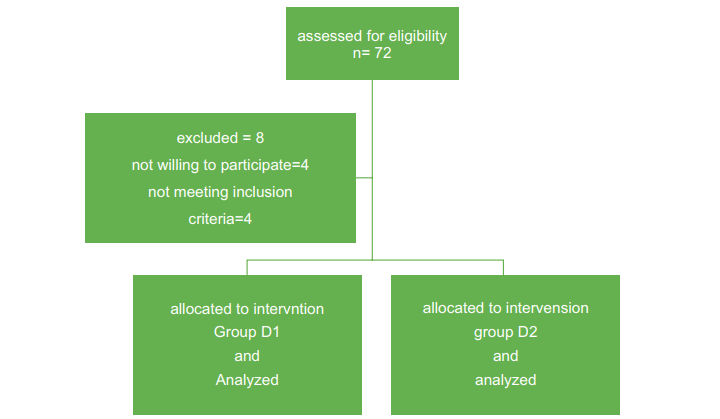
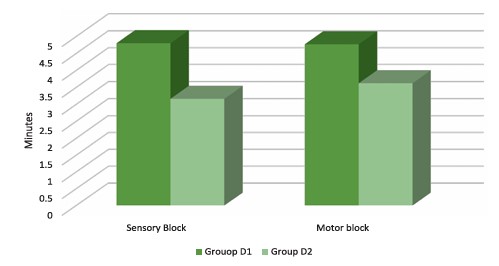
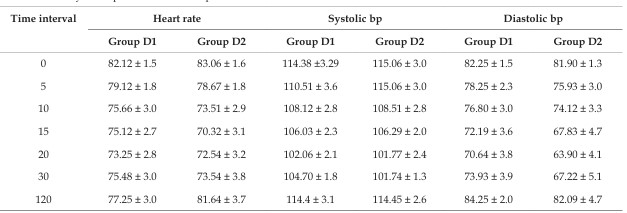
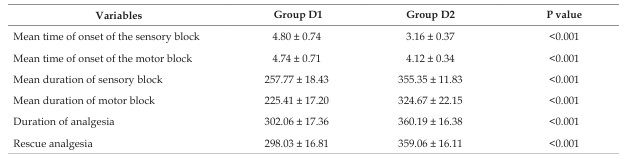
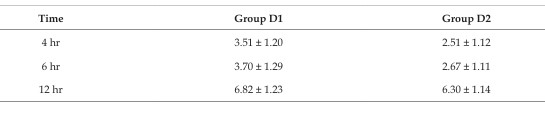
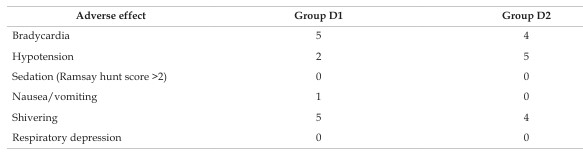
Background and Aim: Lower abdominal surgeries today are done preferentially under subarachnoid block. The relatively short duration of analgesia is a limiting factor which is overcome by adding an adjuvant to intrathecal bupivacaine.Adjuvants have been helpful in induction of early ambulation but at the cost of their associated adverse effects. We aimed to compare two different doses of dexmedetomidine as adjuvant to 0.5% hyperbaric Bupivacaine in abdominal hysterectomy. Material and Methods: It was a prospective, double-blind study among 60 patients posted for abdominal hysterectomy under spinal anaesthesia. The patients were randomly allocated to 2 groups (Group D1 and Group D2) of 30 each. Group D1 received hyperbaric Bupivacaine (15 mg) with Dexmedetomidine (5 µg). Group D2 received hyperbaric bupivacaine (15 mg) with Dexmedetomidine (10 µg). The onset time of sensory and motor block, regression time of sensory and motor block, duration of analgesia, hemodynamic parameters were recorded both intra and postoperatively. The primary efficacy parameters were to determine the onset and duration of sensory block, motor block and duration of postoperative analgesia. Secondarily any associated hemodynamic changes and adverse effects of Dexmedetomidine were also recorded. Results: Onset of sensory block was 3.16 ± 0.37 minutes in Group D2 as compared to 4.80 ± 0.74 minutes in Group D1 with total duration of sensory block as 355.35 ± 11.83 minutes in Group D2 and 257.77 ± 18.43 minutes in Group D1. Similarly, the onset of motor block was 4.12 ± 0.34 minutes and 4.74 ± 0.71 minutes, with total duration of motor block as 324.67 ± 22.15 minutes and 225.41 ± 17.20 minutes in Group D2 and in Group D1 respectively. Duration of analgesia was360.19 ± 16.38 minutes with Dexmedetomidine 10 µg but 302.06 ± 17.36 minutes in Dexmedetomidine 5 µg group. Conclusions: Addition of 10 µg of Dexmedetomidine to 0.5% hyperbaric Bupivacaine 15mg (3 mL) in spinal anaesthesia significantly decreases the onset time, prolongs the duration of both sensory and motor blockade, improves the quality of postoperative analgesia with better hemodynamic stability as compared to bupivacaine with 5 µg Dexmedetomidine
References
- 1. Rodgers A, Walker N, Schug S, McKee A, Kehlet H, van Zundert A, et al.. Reduction of postoperative mortality and morbidity with epidural or spinal anaesthesia: results from overview of randomised trials. BMJ 2000. Dec;321(7275):1493.
- 2. Gertler R, Brown HC, Mitchell DH, Silvius EN. Dexmedetomidine: a novel sedative-analgesic agent. Proc (BaylUniv Med Cent). 2001;14(1):13– 21.
- 3. Gupta R, Verma R, Bogra J, Kohli M, Raman R, Kushwaha JK. A comparative study of intrathecal dexmedetomidine and fentanyl as adjuvants to bupivacaine. J Anaesthesiol Clin Pharmacol. 2011; 27: 339-343. doi: 10.4103/0970- 9185.83678.
- 4. Joana A, Flávio R. Dexmedetomidine: current role in anaesthesia and intensive care. Rev Bras Anestesiol. 2012;62(1):125-33.
- 5. Shah A, Patel I, Gandhi R. Haemodynamic effects of intrathecal dexmedetomidine added to ropivacaine intraoperatively and for postoperative analgesia. Intl J Basic Clin Pharm 2013;2:26-9.
- 6. Tufanogullari B, White PF, Peixoto MP, Kianpour D, Lacour T, Griffin J et al. Dexmedetomidine infusion during laproscopic bariatric surgery; The effect on recovery outcome variables. Intl Anesth Res Society 2008;106:1741-48.
- 7. Sultan P, Gutierrez MC, Carvalho B. Neuraxial morphine and respiratory depression: finding the right balance. Drugs 2011. Oct;71(14): 1807- 1819.
- 8. Shukla D, Verma A, Agarwal A, Pandey HD, Tyagi C. Comparative study of intrathecal dexmedetomidine with intrathecal magnesium sulfate used as adjuvants to bupivacaine. J Anaesthesiol Clin Pharmacol. 2011;27:495-99.
- 9. Sunil BV, Sahana KS,Jajee PR, Mandal N. Effect of adding dexmedetomidine to hyperbaric bupivacaine on spinal block charecteristics: A double blind controlled study. Intl J Chem Pharm Res 2013;2:225- 34.
- 10. Mohamed AA, Fares K M, Mohamed SA. Efficacy of intrathecally administered dexmedetomidine versus dexmedetomidine with fentanyl in patients undergoing major abdominal cancer surgery. Pain physician.2012;15: 339-48.
- 11. Al-Mustafa MM, Abu-Halaweh SA, Aloweidi AS, Murshidi MM, Ammari BA, Awwad ZM, et al. Effect of dexmedetomidine added to spinal bupivacaine for urological procedures. Saudi Med J. 2009;30(3):365-70.
- 12. Abdelhamid SA, El-lakany MH. Intrathecal dexmedetomidine: Useful or not? J Anaesth Clin Res. 2013;4:351. doi:10.4172/2155-6148.1000351.
- 13. Kanazi GE, Aouad MT, Jabbour-Khoury SI, et al. Effect of low-dose dexmedetomidine or clonidine on the characteristics of bupivacaine spinal block. Acta Anaesthesiol Scand. 2006;50(2):222- 227. doi:10.1111/j.1399- 6576.2006.00919.
- 14. Halder S, Das A, Mandal D, et al. Effect of different doses of dexmedetomidine as adjuvant in bupivacaine-induced subarachnoid block for traumatized lower limb orthopaedic surgery: a prospective, double-blinded and randomized controlled study. J Clin Diagn Res. 2014;8(11):GC1- GC6. doi:10.7860/ JCDR/2014/9670.5118.
- 15. Shaikh SI, Mahesh SB. The efficacy and safety of epidural dexmedetomidine and clonidine with bupivacaine in patients undergoing lower limb orthopedic surgeries. J Anaesthesiol Clin Pharmacol 2016;32(2):203-209.
- 16. Hamalainen MM, Pertovaara A. The antinociceptive action of an 2-adrenoceptor agonist in the spinal dorsal horn is due to a direct spinal action and not to activation of descending inhibition. Brain Res Bull. 1995;37(6):581- 587. doi:10.1016/0361-9230(95)00044-F
- 17. Ishii H, Kohno T, Yamakura T, Ikoma M, Baba H. Action of dexmedetomidine on the substantia gelatinosa neurons of the rat spinal cord. Eur J Neurosci. 2008;27(12):3182- 3190. doi:10.1111 /j.1460-9568.2008.06260.
- 18. Urits I, Virgen CG, Alattar H, et al. A comprehensive review and update of the use of dexmedetomidine for regional blocks. Psychopharmacol Bull. 2020;50(4 Suppl 1):121- 141.
Data Sharing Statement
There are no additional data available.
Funding
This research received no funding.
Author Contributions
All authors contributed significantly to the work and approve its publication.
Ethics Declaration
This article does not involve any human or animal subjects, and therefore does not require ethics approval.
Acknowledgements
Information not provided.
Conflicts of Interest
The authors report no conflicts of interest in this work.
About this article

Cite this article
Patel Y, Butala BP, Baria S, et al. Comparison of two different doses of dexmedetomidine as an adjuvant in spinal anaesthesia to bupivacaine for abdominal hysterectomy. Ind J Anesth Analg. 2024;11(4):185-91.
Licence:
Attribution-Non-commercial 4.0 International (CC BY-NC 4.0)This license enables reusers to distribute, remix, adapt, and build upon the material in any medium or format for noncommercial purposes only, and only so long as attribution is given to the creator.
| Received | Accepted | Published |
|---|---|---|
| May 17, 2024 | June 18, 2024 | December 20, 2024 |
DOI: https://doi.org/10.21088/ijaa.2349.8471.11424.2
Keywords
BupivacaineDexmedetomidinePostoperative analgesiaSubarachnoid blockSearch for Similar Articles
Similar Articles
- Awake Fibreoptic Intubation for Airway Management in Massive Thyroid Enlargement...
- A Case of Thoracotomy with One Lung Ventilation for Carcinoma Oesophagus
- A Case of Empyema for Thoracotomy and Decortication-Anaesthesia Management
- Full Mouth Rehabilitation in a 3-Year-Old Female Child with Repaired Tetralogy o...
- Do Gel Manicures Affect SpO2 Readings ? A Clinical Investigation
Article Level Metrics
Last UpdatedMonday 13 July 2026, 12:35:05 (IST)
5653
Accesses
14
678
00
Citations
NA
NA
NA
Download citation
Article Keywords
Keyword Highlighting
Highlight selected keywords in the article text.
Timeline
| Received | May 17, 2024 |
| Accepted | June 18, 2024 |
| Published | December 20, 2024 |
licence
Attribution-Non-commercial 4.0 International (CC BY-NC 4.0)
This license enables reusers to distribute, remix, adapt, and build upon the material in any medium or format for noncommercial purposes only, and only so long as attribution is given to the creator.