Full Text (PDF)
Indian Journal of Anesthesia and Analgesia 9(5):p 233-237, September-October 2022. | DOI: https://doi.org/10.21088/ijaa.2349.8471.9522.3
Original Article
Comparison of Dexmedetomidine Versus Fentanyl as an Adjuvent to Epidural Ropivacaine in the Patient Undergoing Lower Limb, Lower Abdomen Surgery
Anuj Goyal null, Anuj Goyal 1 null, Chetan Shukla 2 null, Vijeta Khandelwal 3 null
Author Information
Licence:
Attribution-Non-commercial 4.0 International (CC BY-NC 4.0)This license enables reusers to
distribute, remix, adapt, and build upon the material in any medium or format
for noncommercial purposes only, and only so long as attribution is given to
the creator.
Indian Journal of Anesthesia and Analgesia 9(5):p 233-237, September-October 2022. | DOI: https://doi.org/10.21088/ijaa.2349.8471.9522.3
How Cite This Article:
How to cite this article: Anuj Goyal, Chetan Shukla, Vijeta Khandelwal/Comparison of Dexmedetomidine Versus Fentanyl as an Adjuvent to Epidural Ropivacaine in the Patient Undergoing Lower Limb, Lower Abdomen Surgery/Indian J Anesth Analg. 2022;9(5)233- 237.
Timeline
Received : April 24, 2022
Accepted : May 28, 2022
Published : October 10, 2022
Abstract
Background: Ropivacaine, the pure S enantiomer of propivacaine, due to its less lipophilicity than bupivacaine does not produce cardiotoxicity or neurotoxicity and causes less motor blockade. Dexmedetomidine the newer selective alpha 2 adrenergic agonist has several advantages when given through epidural route as a neuraxial adjuvant.
Aim: To compare 0.75% Inj. Ropivacaine with Inj. Fentanyl and 0.75% Inj. Ropivacaine with Inj. Dexmedetomidine epidurally for the duration of analgesia, hemodynamic changes, degree of motor blockade and occurrence of side effects.
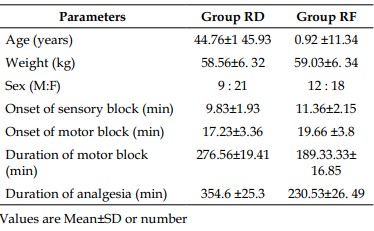
Materials and Methods: 60 patients undergoing lower limb, lower abdomen surgeries were randomized to two groups. Group RF (n=30) received 0.75% Inj. Ropivacaine 15 ml with Inj. Fentanyl 1 mcg/kg in 2 ml preparation. whereas Group RD (n=30) received 0.75% Inj. Ropivacaine 15 ml with Inj. Dexmedetomidine 1 mcg /kg in 2ml preparation. Quality of sensory block, motor block, pulse rate, blood pressure, pain assessment and any adverse outcome were noted.
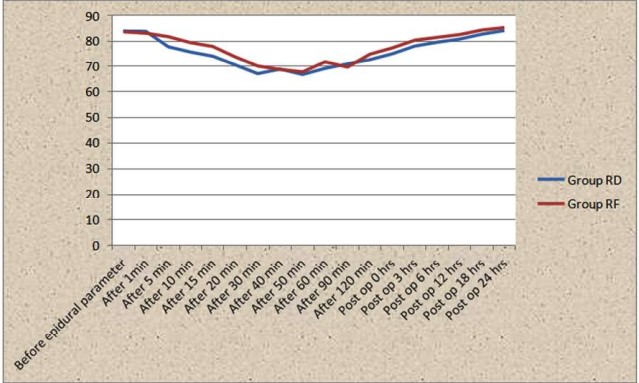
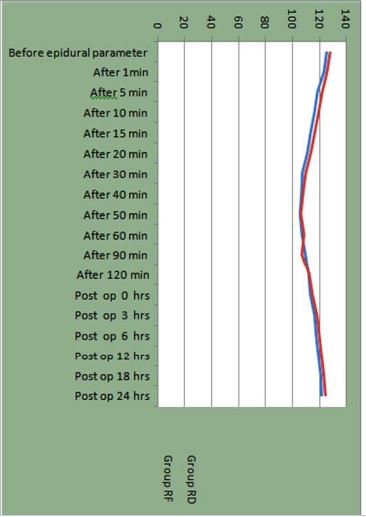
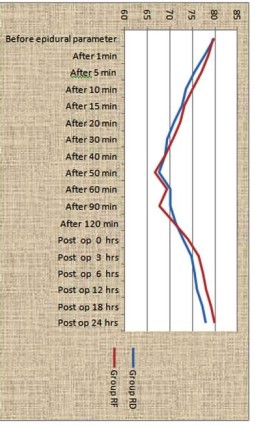
Results: Dexmedetomidine fastens the onset of analgesia, prolongs the duration of analgesia thereby reducing the doses of rescue analgesics post operatively, improves the quality of motor blockade without aggravating changes in haemodynamic parameters and has less adverse effects.
Conclusion: We conclude that dexmedetomidine serves as a good neuraxial adjuvant when added to 0.75% ropivacaine in epidural anesthesia given for lower limb, lower abdomen surgery.
References
- 1. Richards JT, Read JR, Chambers WA.Epidural anesthesia as a method of pre-emptive analgesia for abdominal hysterectomy. Anesthesia 1998; 53:296-8.
- 2. Rigg JR, Jamrozik K, Myles PS, et al:, MASTER Anestheisa Trial Study Group.Epidural anesthesia and analgesia and outcome of major surgery: A randomized trial.Lancet 2002; 359:1276-82.
- 3. Zaric D, Nydahl PA, Philipson L, Sanuelsson L, Heierson A, Axelsson K. The effect of continuous lumbar epidural infusion of ropivacaine (0.1%, 0.2% and 0.3%) and 0.25% bupivacaine on sensory and motor block in volunteers:A double blind study. Reg Anesth 1996;21:1425.
- 4. Mcclellan KJ, Faulds D. Ropivacaine:An update of its use in regional anesthesia. Drugs 2000; 60:106593
- 5. Benzon HT, Wong HY, Belavic AM Jr, Goodman I, Mitchell D, Lefheit T, et al. A randomized double-blind comparison of epidural fentanyl infusion versus patient controlled analgesia with morphine for post thoracotomy pain. Anesth Analg 1993;76:316-22.
- 6. Bhana N, Goa KL, McClellan KJ. Dexmedetomidine. Drugs 2000;59:263-70.
- 7. Jaakola Ml, Salonen M, Lehtinen R, Scheinin H. The analgesicaction of dexmedetomidine: A novel alpha2-adrenoceptor agonist—in healthy volunteers. Pain 1991;46:281-5.
- 8. Talke P, Richardson CA, Scheinin M, Fisher DM. Postoperative pharmacokinetics and sympatholytic effects of dexmedetomidine. Anesth Analg 1997; 85:1136-42.
- 9. 9. Rashpal Singh Gill, Gaurav Acharya, Abhimanyu Rana, K. K. Arora, Dewesh Kumar, Lokesh Kumar Sonkaria: fentanyl and dexmedetomidine to ropivacaine for epidural anesthesia & analgesia in lower abdominal and lower limb orthopedic surgeries; ejpmr, 2016,3(2), 200-205
- 10. Pratibha J S, Rashmi N, Chandrapal B, Kunal T. “Dexmedetomidine V/S Fentanyl with 0.75% Ropivacaine for Epidural Anesthesiain Lower Abdominal Surgeries - A Comparative Study”. J Anest & Inten Care Med. 2017; 3(3): 555611. DOI:10…19080/JAICM.2017.03.555611.
- 11. Dr. Reshma Korat, Dr. Malti Pandya, Dr. Pinal Patel, Dr. Pragna Vachharajani. Comparative Study of Dexmedetomidine and Fentanyl for Epidural Analgesia for Lower Limb Orthopaedic Surgeries. International Journal of Science and Research (IJSR) ISSN (Online): 2319-7064 Index Copernicus Value (2015): 78.96 | Impact Factor (2015): 6.391).
- 12. Bajwa S, Arora V, Kaur J, Singh A, Parmar SS.Comparative evaluation of dexmedetomidine and fentanyl for epidural analgesia in lower limb orthopedic surgeries. Saudi J Anesth 2011;5:365-70.
Data Sharing Statement
There are no additional data available. All raw data and code are available upon request.
Funding
This research received no funding.
Author Contributions
All authors contributed significantly to the work and approve its publication.
Ethics Declaration
This article does not involve any human or animal subjects, and therefore does not require ethics approval.
Acknowledgements
We would like to express our gratitude to the patients, their families, and all those who have contributed to this study.
Conflicts of Interest
No conflicts of interest in this work.
About this article

Cite this article
How to cite this article: Anuj Goyal, Chetan Shukla, Vijeta Khandelwal/Comparison of Dexmedetomidine Versus Fentanyl as an Adjuvent to Epidural Ropivacaine in the Patient Undergoing Lower Limb, Lower Abdomen Surgery/Indian J Anesth Analg. 2022;9(5)233- 237.
Licence:
Attribution-Non-commercial 4.0 International (CC BY-NC 4.0)This license enables reusers to
distribute, remix, adapt, and build upon the material in any medium or format
for noncommercial purposes only, and only so long as attribution is given to
the creator.
| Received | Accepted | Published |
|---|---|---|
| April 24, 2022 | May 28, 2022 | October 10, 2022 |
DOI: https://doi.org/10.21088/ijaa.2349.8471.9522.3
Keywords
Ropivacaine; Dexmedetomidine; Fentanyl; Neuraxial adjuvant.Search for Similar Articles
Similar Articles
- Awake Fibreoptic Intubation for Airway Management in Massive Thyroid Enlargement...
- A Case of Thoracotomy with One Lung Ventilation for Carcinoma Oesophagus
- A Case of Empyema for Thoracotomy and Decortication-Anaesthesia Management
- Full Mouth Rehabilitation in a 3-Year-Old Female Child with Repaired Tetralogy o...
- Do Gel Manicures Affect SpO2 Readings ? A Clinical Investigation
Article Level Metrics
Last UpdatedTuesday 14 July 2026, 17:01:10 (IST)
5702
Accesses
6
679
00
Citations
NA
NA
NA
Download citation
Article Keywords
Keyword Highlighting
Highlight selected keywords in the article text.
Timeline
| Received | April 24, 2022 |
| Accepted | May 28, 2022 |
| Published | October 10, 2022 |
licence
Attribution-Non-commercial 4.0 International (CC BY-NC 4.0)
This license enables reusers to
distribute, remix, adapt, and build upon the material in any medium or format
for noncommercial purposes only, and only so long as attribution is given to
the creator.