Full Text (PDF)
Indian Journal of Obstetrics and Gynecology 10(1):p 25-34, January – March 2022. | DOI: https://doi.org/10.21088/ijog.2321.1636.10122.4
Original Article
Clinical Correlates of PCOS in A Tertiary Health Care Centre
Author Information
Licence:
Attribution-Non-commercial 4.0 International (CC BY-NC 4.0)This license enables reusers to distribute, remix, adapt, and build upon the material in any medium or format for noncommercial purposes only, and only so long as attribution is given to the creator.
Indian Journal of Obstetrics and Gynecology 10(1):p 25-34, January – March 2022. | DOI: https://doi.org/10.21088/ijog.2321.1636.10122.4
How Cite This Article:
How to cite this article: Simran Singh, Kiran Patole/Clinical Correlates of PCOS in A Tertiary Health Care Centre/ Indian J Obstet Gynecol. 2022;10(1):25–34.Timeline
Received : August 20, 2021
Accepted : September 28, 2021
Published : March 30, 2022
Abstract
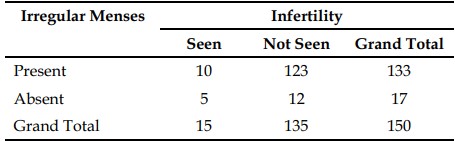
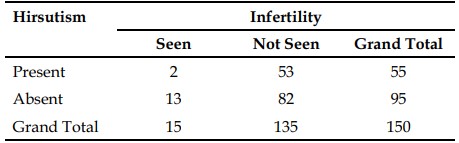
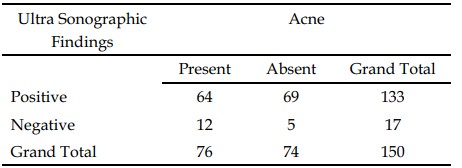
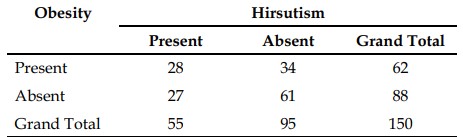
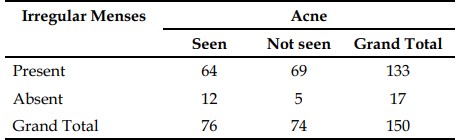
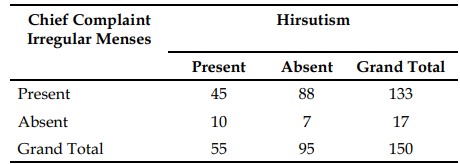
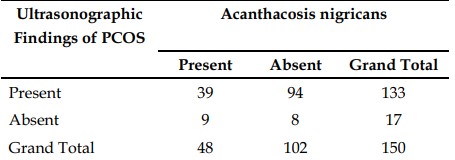
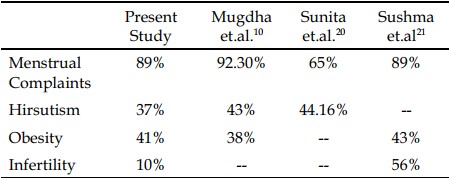
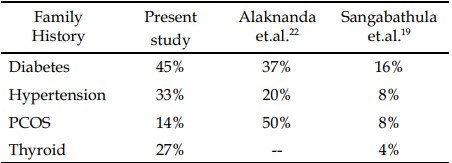
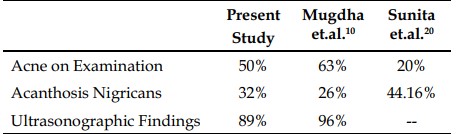
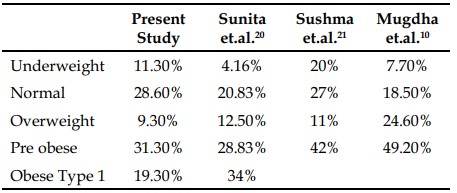
Aims: To study, analyse and find the correlation between different signs and symptoms of polycystic ovarian syndrome in a tertiary health care centre. Settings and Design: (1) Type of study: Observational Study (2) Sample size: 150 (3) Study participants: All patients attending gynaecology OPD diagnosed with PCOS. Study design: It was a Questionnaire based observational study. Methods and Material: This study was conducted on 150 patients of Polycystic Ovarian Syndrome. Diagnosis of Polycystic Ovarian Syndrome was done on the basis of 2003 Rotterdam diagnostic criteria. Ferriman Gallwey score was used for assessment of hirsutism and WHO cut-offs of Body Mass Index modified for Asian population was used for assessment of Body mass index, Statistical analysis used: Statistical Analysis: Data was compiled and analysed using site. Results: Percentages of Chief complaints: Irregular menses (89%), Obesity (41%), Hirsutism (37%), Acne (32% ), Infertility (10%). A Family History of Diabetes (45%), Hypertension 33%), Obesity (29%), Thyroid disorder (27%), PCOD (14%), Cardiac Disorder (13%) was also analysed. Polycystic changes in ultrasonographic findings were Present in 89% of the population and absent in 11% of the population. Only 33% participants were regular with the exercise routine rest. Hirsutism was graded according to mild (22%), moderate (62%), and severe (16%).50 % had Acne on examination. Body Mass Index was measured and graded into Underweight (11.3%), Normal (28.60%), Overweight (9.30%), Pre-obese (31.30%), Obese type 1 (19.30 %). Acanthosis nigricans (AN) was present in 32% And absent in 68%. There was significant Correlation between : ( p value <0.05) Irregular menses and infertility- 7%, Hirsutism and infertility- 3%, Ultrasonographic Findings and Acne- 48%, Obesity and Hirsutism- 45%, Irregular menses and acne - 48% Irregular menses and hirsutism- 33%, Ultrasonographic findings and acanthosis nigricans-29.3%. Conclusions: There is a diversity in the presentation of chief complaints of PCOS patients. PCOS patients show a variety in the presentation of the history of metabolic syndromes and of PCOS in their families. They show cutaneous manifestations in the form of Acne, Hirsutism and Acanthosis nigricans. PCOS patients mostly have moderate grades of hirsutism. Acne is present in almost half of PCOS patients even though most of them don't consider it as their chief complaint. Most of the participants who had increased BMI had Polycystic Ovarian Syndrome. Acanthosis is related to an increase in the BMI. Very few patients include exercise in their daily routine. There is a significant correlation in PCOS patients between: Irregular menses and infertility, Hirsutism and infertility, Ultrasonographic findings and Acne as chief complaint. Chief Complaints of Obesity and Chief Complaints of Hirsutism. Chief Complaints of irregular menses and Acne. Chief Complaints of Irregular menses and Hirsutism. Ultrasonographic findings and Acanthosis nigricans. Key Messages: This study has come up with the result of many statistically significant correlations between many common signs and symptoms like irregular menses, acne, hirsutism, infertility, Ultrasonographic findings, body mass index and acanthosis nigricans . Which will help in the further understanding of Polycystic ovarian syndrome. This study has also included various statistical analysis like having a family history of metabolic syndrome.
References
- 1. Fatemeh Bazarganipour, M.Sc.,1Saeide Ziaei, M.D., Ph.D.,1Ali Montazeri, M.P.H., Ph.D.,2 Fatemeh Foroozanfard, M.D.,3 and Soghrat Faghihzadeh, Ph.D Health-related quality of life and its relationship with clinical symptoms among Iranian patients with polycystic ovarian syndrome; 11(5): 371–378; .Iran J Reprod Med. 2013 May Available From: www.ncbi.nlm.nih.gov.
- 2. ZZhou DZheng HWuRLi SXuY KangYCao XChen YZhu SXu ZJChen BW MolJ Qiao Epidemiology of infertility in China:apop ulationbasedstudy;Pages432-441; Special Issue: Asia Pacific Research ; Volume125, Issue4 Avialable from:- https: //doi. org/10.1111/1471-0528.14966
- 3. M.N. Kalima-Munalula, YAhmed, BV walika Issue. Factors associated with infertility among women attending the gynaecology clinic at University Teaching Hospital, Lusaka, Zambia; Vol. 44 No. 1 (2017)
- 4. Kabir Sardana MBBS, MD, MNAMS Prekshi Bansal MBBS Lokesh K. Sharma MBBS, MDUmesh C. Garga MBBS, MD Gauri Vats MBBS, MDA study comparing the clinical and hormonal profile of late onset and persistent acne in adult females: Volume59, Issue4; April 2020; Pages 428-433 Available From https://doi.org/10.1111/ijd.14748
- 5. Prekshi Bansal, Kabir Sardana, Lokesh Sharma, Umesh Chandra Garga & Gauri Vats. A prospective study examining isolated acne and acne with hyperandrogenic signs in adult females; Published online: 03 Jan 2020; Volume 2019 |Article ID 6126808 | https:// doi.org/ 10.1155/ 2019/ 6126808
- 6. Besa Gacaferri Lumezi, Violeta Lokaj Berisha; Department of Physiology and Immunology, Medical Faculty, University of Prishtina, Kosovo Investigation of body mass index, insulin resistance and diabetes in patients with hirsutism; Online publish date: 2020/09/15: https://doi.org/10.5114/ada.2020.98132
- 7. Ola A Bakry, Eman M.A Al Gayed, Amina G.M Seadan; Assessment of obesity, dyslipidemia, and insulin resistance in idiopathic hirsutism: a case–control study Ola ABakry Year : 2020 | Volume : 17 | Issue : 2 | Page :113-118
- 8. R Aswiniand Sabeena Jayapalan; Modified Ferriman–Gallwey Score in Hirsutism and its Association with Metabolic Syndrome; Int J Trichology;.2017 Jan-Mar; 9(1):7–13
- 9. Anupama Bahadur, Rajlaxmi Mundhra, Jyotshna Kashibhatla, Rashmi Rajput, Neha Verma & Mumta Kumawat; Prevalence of metabolic syndrome among women with different PCOS phenotypes – a prospective study; 09 Jun 2020 ; Pages 21-25|
- 10. Mugdha L Jungari1*, Priyanka Nair2, Surinder Gode3, Arpita Jaiswal4; PCOS: Clinical Picture of Pcos Patients in a Peri Urban Tertiary Care Hospital of Centralindia Journal of Critical Reviews ISSN- 2394-5125 Vol 7, Issue 8, 2020
- 11. Dure-e-Shehwar Ali1, Muhammad Zahid2, Henna Salman1, Umema Zaffar1, Afshan Ali3 and Mubashra Ali4; Frequency of Infertility, Hirsutism and Acne in Patients with Polycystic Ovarian Syndrome and their Association with Body Mass index: A Cross Sectional Study; ; Med. Forum, Vol. 30, No. 7 79 July, 2019
- 12. Anjali Chaudhary, Priyanka Chaudhary, SwetaJain. Prevalence and symptoma tology of PCOS in Indian women:is there a rising incidence. Int J Reprod Contracept Obstet Gynecol. 2017 Nov; 6(11): 4971-4975
- 13. Mahesh Gupta, Daneshwar Singh et al. A cross sectional study of PCOS among young women in Bhopal, Central India. Int J Community Med Public Health. 2018 Jan;5(1): 95-100
- 14. Tabassum K. Ultra Sonographic Prevalence of PCOS in different age groups. Indian Journal of Clinical Practice. November 2014. Vol.25,No.6.561-564
- 15. Ioannis Kyrou, Emmanouil Karteris, Tim Robbins, Kamaljit Chatha, Fotios Drenos & Harpal S. Randeva; Polycystic ovary syndrome (PCOS) and COVID-19: an overlooked female patient population at potentially higher risk during the COVID-19 pandemic;: 15 July 2020; BMC Medicine volume 18, Article number: 220 (2020)
- 16. Seema Pate; l Polycystic ovary syndrome (PCOS), an inflammatory, systemic, lifestyle endocrinopathy; The Journal of Steroid Biochemistry and Molecular Biology Volume 182, September 2018, Pages 27-36
- 17. https://www.google.com/url?sa = i&url = https%3 A%2F%2 Fwww. resear chgate.net%2F figure %2F ModifiedF e r r i m a n - G a l l w e y - S c o r e - m F G -score-10_ fig1_335003295 & psig = AOv Vaw3da-SyN_cj16RBv TxdQJ3Y & ust = 1615761049524000 & source = images & cd=vfe & ved = 0CAIQjRxq FwoTCNCk7opru8 CFQAAAAAdAAAAABAD
- 18. https://www.google.com/url?sa=i& url=https%3 A%2F%2 Fwww. facebook. com%2F1056366 14495617%2 Fposts%2 Fpcos%2 F127543378971607%2 F & psig = AOvVaw0IfPTk2qJfLylizh CExfBE & ust=1615760346103000 & source=images & cd=vfe & ved=0CAIQj Rxq Fwo TCPC 86pyqru 8CFQAAAAAdAAAAABAD
- 19. Sangabathula H, Varaganti N. Clinical Profile Polycystic Ovarian Syndrome-100 Cases.Int J Contemp Med Res. 2017;4 (6):1249
- 20. Sunita J. Ramanand, Balasaheb B. Ghongane, Jaiprakash B. Ramanand,1 Milind H. Patwardhan, 2Ravi R. Ghanghas, and Suyog S. Jain; Clinical characteristics of polycystic ovary syndrome in Indian women; Indian J Endocrinol Metab. 2013 Jan-Feb; 17(1):138 – 145.
- 21. Dr. Sushma sharma and Dr. Jankidevi S Borade; Clinical profile of PCOS patients in a rural tertiary care hospital; Gynaecology Journal www.gynaecologyjournal.com 2019; 3(4): 01-05.
- 22. Alakananda D, Prasad Das B, Goel I. A Study on Clinical Profile of Patients with Polycystic Ovarian Syndrome. Int J Sci Res [Internet]. 2015;6:2319–7064. Available from: www.ijsr.net
- 23. S. West,1H. Lashen,2A. Bloigu,3S. Franks, 4K. Puukka,5A. Ruokonen,5M.-R. Järvelin, 3,6,7,8,9J.S. Tapanainen,1,10 and L. MorinPapunen1, ; Irregular menstruation and hyperandro genaemia in adolescence are associated with polycystic ovary syndrome and infertility in later life: Northern Finland Birth Cohort 1986 study; 2014 Oct 10; 29(10): 2339–2351.Published online 2014 Aug 1.
- 24. Yu-Yang Wang, Shang-Wei Li, Shan Luo, Lang Qin, Xun Zeng, Lei Li, Xiao-Hong Li,
- 25. Sadia Jabeen, FariaAsad, Zahida Rani, Khawar Khurshid, Sabrina Suhail Pal; Frequency of polycystic ovarian syndrome among patients presenting with acne; Journal of Pakistan Association of Dermatologist Vol. 28 No. 3 (2018): July -September
- 26. Keen MA, Shah IH, Sheikh G. Cutaneous Manifestations of Polycystic Ovary Syndrome: A Cross-Sectional Clinical Study. Indian Dermatol Online J. 2017; 8(2):104-110.doi:10.4103/2229-5178.202275
- 27. Ref :- D C Dutta’s textbook of gynaecology and Shaw’s textbook of Gynaecology 28. Khan, Ayesha & Karim, Nasim & Ainuddin, Jahan & Faheem, Muhammad. (2019). Polycystic Ovarian Syndrome: Correlation between clinical hyperan drogenism, anthropometric, metabolic and endocrine parameters. Pakistan Journal of Medical Sciences. 35. 10.12669/pjms. 35.5.742.
- 29. https://www.diabetes.co.uk/bmi/howto-calculate-bmi.html
- 30. Girdhar, Sangeeta & Sharma, Sarit & Chaudhary, Anurag & Bansal, Priya & Satija, Mahesh. (2016). An Epidemiological Study of Overweight and Obesity Among Women inan Urban Area of North India. Indian Journal of Community Medicine. 41. 154-7. 10.4103/0970-0218.173492.
- 31. D C Dutta’s textbook of gynaeco logy and Shaw’s textbook of Gynaecology
Data Sharing Statement
There are no additional data available. All raw data and code are available upon request.
Funding
This research received no funding.
Author Contributions
All authors contributed significantly to the work and approve its publication.
Ethics Declaration
This article does not involve any human or animal subjects, and therefore does not require ethics approval.
Acknowledgements
We would like to express our gratitude to the patients, their families, and all those who have contributed to this study.
Conflicts of Interest
No conflicts of interest in this work.
About this article

Cite this article
How to cite this article: Simran Singh, Kiran Patole/Clinical Correlates of PCOS in A Tertiary Health Care Centre/ Indian J Obstet Gynecol. 2022;10(1):25–34.
Licence:
Attribution-Non-commercial 4.0 International (CC BY-NC 4.0)This license enables reusers to distribute, remix, adapt, and build upon the material in any medium or format for noncommercial purposes only, and only so long as attribution is given to the creator.
| Received | Accepted | Published |
|---|---|---|
| August 20, 2021 | September 28, 2021 | March 30, 2022 |
DOI: https://doi.org/10.21088/ijog.2321.1636.10122.4
Keywords
Polycystic ovarian syndromeAcneInfertilityHirsutismObesityFamily historyChief complaintsacanthosis nigricansIrregular mensesSearch for Similar Articles
Similar Articles
- Fibromyoma: A Clinical Dilemma
- Optimizing Obstetric Care: A Review of Indications and Outcomes for First-Time C...
- A Rare Case of Geriatric Endometrial Adenocarcinoma Presenting with Nonpuerperal...
- Relationship between Hypothyroidism and Gestational Diabetes Mellitus: A Prospec...
- Influence of Maternal Anthropometry and Hemoglobin on Neonatal Anthropometry
Article Level Metrics
Last UpdatedWednesday 09 September 2026, 17:47:10 (IST)
3515
Accesses
15
590
00
Citations
NA
NA
NA
Download citation
Article Keywords
Keyword Highlighting
Highlight selected keywords in the article text.
Timeline
| Received | August 20, 2021 |
| Accepted | September 28, 2021 |
| Published | March 30, 2022 |
licence
Attribution-Non-commercial 4.0 International (CC BY-NC 4.0)
This license enables reusers to distribute, remix, adapt, and build upon the material in any medium or format for noncommercial purposes only, and only so long as attribution is given to the creator.