Full Text (PDF)
RFP Indian Journal of Hospital Infection 3(1):p 26-34, January-June 2026. | DOI: NA
Review Article
Causation Beyond the Final Breath: Reframing Fatality in Medical Jurisprudence
Shri Gopal Kabra, Vivekanshu Verma
Author Information
Licence:
Attribution-Non-commercial 4.0 International (CC BY-NC 4.0)This license enables reusers to distribute, remix, adapt, and build upon the material in any medium or format for noncommercial purposes only, and only so long as attribution is given to the creator.
RFP Indian Journal of Hospital Infection 3(1):p 26-34, January-June 2026. | DOI: NA
How Cite This Article:
Shri Gopal Kabra, Vivekanshu Verma. Causation Beyond the Final Breath: Reframing Fatality in Medical Jurisprudence. RFP Ind. Jr. Hosp. Inf., 2026; 3(1): 26-34.Timeline
Received : February 09, 2026
Accepted : March 10, 2026
Published : June 30, 2026
Abstract
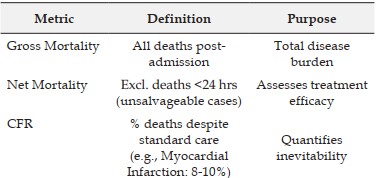
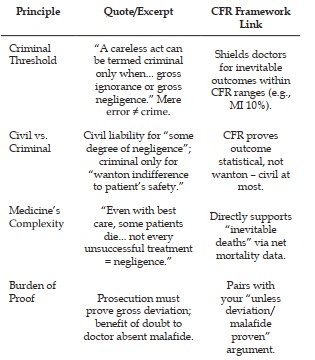
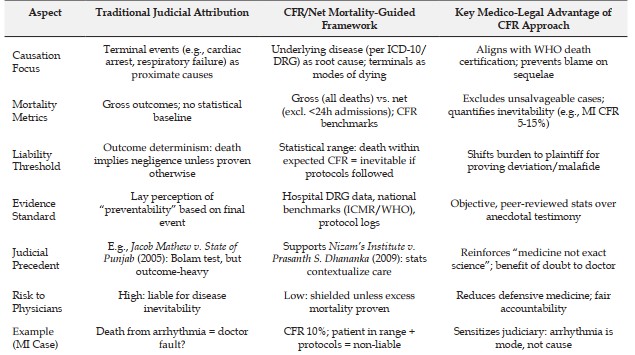
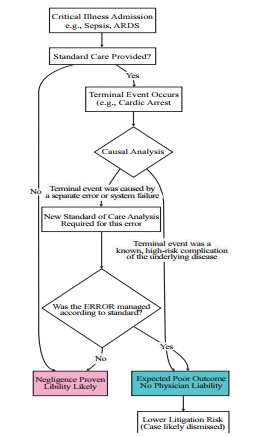
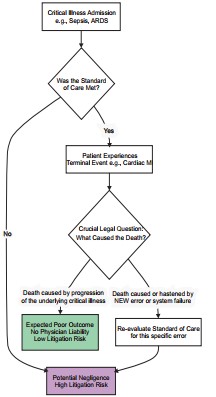
Background: Fatal outcomes in critical illnesses often lead to medicolegal disputes regarding physician liability. In medical practice, causation is attributed to the underlying disease that initiates the fatal sequence, not to intermediate or terminal events such as cardiac arrest or respiratory failure. Case Fatality Ratio (CFR) and net mortality provide objective measures of disease lethality and are essential for contextualizing outcomes in judicial settings. Methods: This article examines the principles of medical causation and death certification, referencing ICD coded disease related groups (DRGs) and hospital mortality data.1 Gross mortality (all deaths) and net mortality (excluding deaths within 24 hours of admission) are analyzed to distinguish inevitable deaths from those potentially preventable. CFR benchmarks are used to frame expected mortality ranges for specific diseases. Results: Analysis demonstrates that a proportion of patients inevitably die despite adherence to standard treatment protocols, reflecting the inherent severity of the disease rather than negligence. Net mortality and CFR data provide a statistical baseline against which individual outcomes can be assessed. When patient deaths fall within expected CFR ranges, they represent inevitable outcomes; deaths exceeding these ranges may indicate deviation, negligence, or malafide intent. Conclusion: Judicial consideration of CFR and net mortality is critical to ensuring fair attribution of liability in medical negligence cases. Physicians should not be held accountable for statistically inevitable outcomes when standard care has been provided. Incorporating these metrics into medico legal reasoning aligns judicial decisions with medical reality, protecting both patient rights and practitioner accountability.
References
- 1. World Health Organization. International Statistical Classification of Diseases and Related Health Problems. 10th rev. Geneva: WHO; 2010.
- 2. Supreme Court of India. Jacob Mathew v. State of Punjab, (2005) 6 SCC 1; 2005.
- 3. Supreme Court of India. Nizam’s Institute of Medical Sciences v. Prasanth S. Dhananka. (2009) 6 SCC 1.
- 4. Section 106 of BNS, 2023.
- 5. Vincent J.L., Moreno R. Clinical review: scoring systems in the critically ill. Crit Care. 2010; 14(2): 207.
- 6. Dr. Suresh Gupta v. Govt. of NCT Delhi (2004) 6 SCC 422.
- 7. World Health Organization. Medical Certification of Cause of Death. Geneva: WHO; 2016.
- 8. Goldhill D.R., McNarry A.F. The longer patients are in hospital before Intensive Care admission the higher their mortality. Intensive Care Med. 2004; 30(10): 1908-13.
- 9. ICMR 2023-24 report: Source: https:// www.icmr.gov.in/icmrobject/uploads/ D o c u m e n t s / 1 7 4 4 7 0 6 5 5 5 _ i c m r _ annualreport_2023-24_78804328_1.pdf
- 10. Divatia, J.V., et al.; INDICAPS Study Investigators. Intensive Care in India: The Indian Intensive Care Case Mix and Practice Patterns Study. Indian J Crit Care Med. 2016 Apr; 20(4): 216-25. doi: 10.4103/0972- 5229.180042. PMID: 27186054; PMCID: PMC4859158.
- 11. Prescott H.C., Angus D.C. Enhancing Recovery From Sepsis: A Review. JAMA. 2018; 319(7): 622-33.
- 12. National Health Service. NHS Litigation Authority Annual Report 2022-23. London: NHSLA; 2023.
- 13. National Medical Commission. Indian Medical Register Regulations. New Delhi: NMC; 2023.
Data Sharing Statement
There are no additional data available. All raw data and code are available upon request.
Funding
This research received no funding.
Author Contributions
All authors contributed significantly to the work and approve its publication.
Ethics Declaration
This article does not involve any human or animal subjects, and therefore does not require ethics approval.
Acknowledgements
We would like to express our gratitude to the patients, their families, and all those who have contributed to this study.
Conflicts of Interest
No conflicts of interest in this work.
About this article

Cite this article
Shri Gopal Kabra, Vivekanshu Verma. Causation Beyond the Final Breath: Reframing Fatality in Medical Jurisprudence. RFP Ind. Jr. Hosp. Inf., 2026; 3(1): 26-34.
Licence:
Attribution-Non-commercial 4.0 International (CC BY-NC 4.0)This license enables reusers to distribute, remix, adapt, and build upon the material in any medium or format for noncommercial purposes only, and only so long as attribution is given to the creator.
| Received | Accepted | Published |
|---|---|---|
| February 09, 2026 | March 10, 2026 | June 30, 2026 |
DOI: NA
Keywords
Case Fatality Ratio (CFR)Net MortalityUnderlying Cause of DeathMedical JurisprudenceICD CodingDisease Related Groups (DRGs)Judicial AttributionMedical Negligence DefenseCritical Illness OutcomesPhysician LiabilitySearch for Similar Articles
Similar Articles
- Uncontrollable Immune Crisis Cascades in Medicine: A Medico-Legal Defense Framew...
- The Pivotal Role of the Perioperative Nurse in Preventing Surgical Site Infectio...
- Nurses' Role in Infection Control at Critical Care Units: Integrating Clinical W...
- The Central Role of Nurses in the Prevention and Management of Nosocomial Infect...
- Hospital-acquired Infections in India: Rising Burden, Systemic Gaps, and Urgent...
Article Level Metrics
Last UpdatedFriday 23 October 2026, 16:02:05 (IST)
1015
Accesses
20
206
00
Citations
NA
NA
NA
Download citation
Article Keywords
Keyword Highlighting
Highlight selected keywords in the article text.
Timeline
| Received | February 09, 2026 |
| Accepted | March 10, 2026 |
| Published | June 30, 2026 |
licence
Attribution-Non-commercial 4.0 International (CC BY-NC 4.0)
This license enables reusers to distribute, remix, adapt, and build upon the material in any medium or format for noncommercial purposes only, and only so long as attribution is given to the creator.