Full Text (PDF)
Journal of Microbiology and Related Research 10(1):p 21-27, January – June 2024. | DOI: https://doi.org/10.21088/jmrr.2395.6623.10124.3
Original Article
Blood Metagenomic Sequence Analysis for Evaluation of Chronic Systemic Infections
Chand Pasha, Mohammed Shakeel, Ayla Sanjay, Zainab Kausar, Vadlamudi Nikhil
Author Information
Licence:
Attribution-Non-commercial 4.0 International (CC BY-NC 4.0)This license enables reusers to distribute, remix, adapt, and build upon the material in any medium or format for noncommercial purposes only, and only so long as attribution is given to the creator.
Journal of Microbiology and Related Research 10(1):p 21-27, January – June 2024. | DOI: https://doi.org/10.21088/jmrr.2395.6623.10124.3
How Cite This Article:
Mohammed Shakeel, Ayla Sanjay, Zainab Kausar et al. Blood Metagenomic Sequence Analysis for Evaluation of Chronic Systemic Infections. J Microbiol Relat Res. 2024;10(1):21–27.Timeline
Received : February 21, 2024
Accepted : May 08, 2024
Published : June 25, 2024
Abstract
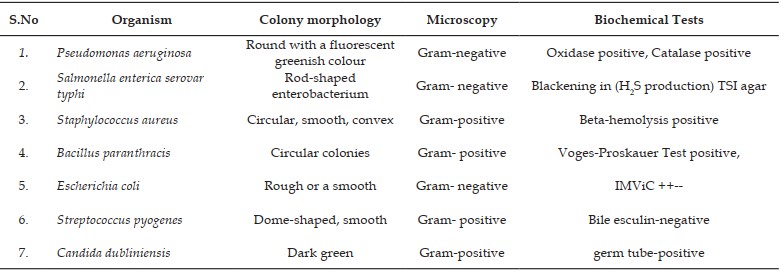
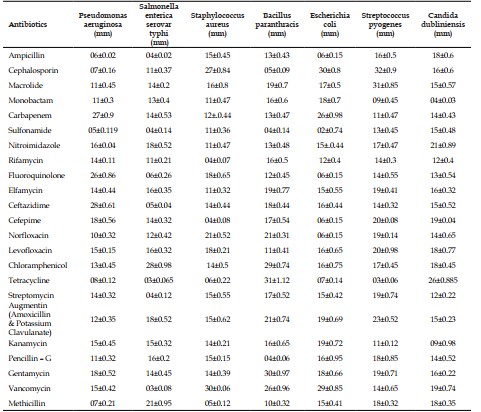
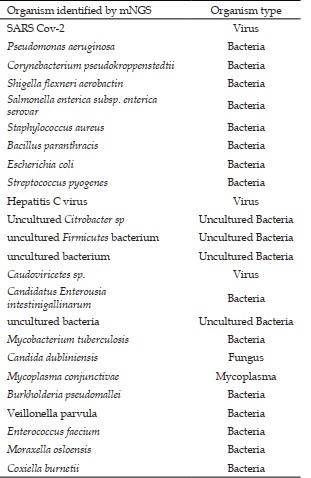
Blood systemic infections (BSIs) are major threat in hemodialysis patients. BSIs are diagnosed by blood culturing for bacteria and serology for virus infections. These two methods are time taking and expensive and not covering all BSI microbes. An attempt is made to compare microbial culturing and viral screening with serology by ELISA with blood metagenomic sequencing and sequence analysis. In blood agar media culturing 7 microbes (6 bacterial and 1 fungus), in ELISA screening 0 viruses and in metagenomic sequence analysis 24 microbes (19 bacteria and 1 fungus, 3 viruses, 1 mycoplasma) were detected. Unculturable bacteria are also detected by metagenomic sequence analysis. Hence metagenomic sequence analysis can be best as method for effective detection of BSI’s.
References
- 1. Chen, Y., Ye, W., Zhang, Y., & Xu, Y. (2015). High speed BLASTN: an accelerated MegaBLAST search tool. Nuc aci res, 43(16), 7762-7768. doi: https://doi.org/10.1093/nar/ gkv784
- 2. Forbes, J. D., Knox, N. C., Ronholm, J., Pagotto, F., & Reimer, A. (2017). Metagenomics: the next culture-independent game changer. Front. Microb., 8, 1069.doi: https://doi.org/10.3389/ fmicb.2017.01069
- 3. Gan, S. D., & Patel, K. R. (2013). Enzyme immunoassay and enzyme-linked immunosorbent assay. Jou of Inv Derm, 133(9), 1-3.doi: https://doi.org/10.1038/jid.2013.287
- 4. Garcia, R. A., Spitzer, E. D., Beaudry, J., Beck, C., Diblasi, R., Gilleeny-Blabac, M., & Torregrosa, E. (2015). Multidisciplinary team review of best practices for collection and handling of blood cultures to determine effective interventions for increasing the yield of truepositive bacteremias, reducing contamination and eliminating false-positive central line– associated bloodstream infections. Amer. J. inf. Cont., 43(11), 1222-1237.doi: https://doi. org/10.1016/j.ajic.2015.06.030
- 5. Geng, S., Mei, Q., Zhu, C., Fang, X., Yang, T., Zhang, L., ... & Pan, A. (2021). Metagenomic next-generation sequencing technology for detection of pathogens in blood of critically ill patients. Int. J. Inf. Dise., 103, 81-87.doi: https://doi.org/10.1016/j.ijid.2020.11.166
- 6. Grundy, B. S., Parikh, H., Jacob, S., Banura, P., Moore, C. C., Liu, J., & Houpt, E. R. (2023). Pathogen detection using metagenomic nextgeneration sequencing of plasma samples from patients with sepsis in Uganda. Microb. Spe., 11(1), e04312-22.doi: https://doi.org/10.1128/ spectrum.04312-22
- 7. Guo, S. S., Fu, G., Hu, Y. W., Liu, J., & Wang, Y. Z. (2024). Application of metagenomic next-generation sequencing technology in the etiological diagnosis of peritoneal dialysisassociated peritonitis. Op. Lif. Sci., 19(1), 20220865.doi: https://doi.org/10.1515/biol- 2022-0865
- 8. Gupta, S., Sakhuja, A., Kumar, G., McGrath, E., Nanchal, R. S., & Kashani, K. B. (2016). Culturenegative severe sepsis: nationwide trends and outcomes. Che., 150(6), 1251-1259.doi: https:// doi.org/10.1016/j.chest.2016.08.1460
- 9. Jerome, H., Taylor, C., Sreenu, V. B., Klymenko, T., Filipe, A. D. S., Jackson, C., ... & Thomson, E. C. (2019). Metagenomic next-generation sequencing aids the diagnosis of viral infections in febrile returning travellers. J. Inf., 79(4), 383-388.doi: https://doi.org/10.1016/j. jinf.2019.08.003
- 10. Li, N., Cai, Q., Miao, Q., Song, Z., Fang, Y., & Hu, B. (2021). High-throughput metagenomics for identification of pathogens in the clinical settings. Sm. Metho., 5(1), 2000792.doi: https:// doi.org/10.1002/smtd.202000792
- 11. Lu, D., Abudouaini, M., Kerimu, M., Leng, Q., Wu, H., Aynazar, A., & Zhong, Z. (2023). Clinical evaluation of Metagenomic Next-Generation sequencing and identification of risk factors in patients with severe communityacquired pneumonia. Inf. D. Resis., 5135-5147. doi: https://doi.org/10.2147/IDR.S421721
- 12. Lamy, B., Sundqvist, M., & Idelevich, E. A. (2020). Bloodstream infections–Standard and progress in pathogen diagnostics. Clin. Microb. Inf., 26(2), 142-150.doi: https://doi. org/10.1016/j.cmi.2019.11.017
- 13. Ma, L. N., Zhang, J., Chen, H. T., Zhou, J. H., Ding, Y. Z., & Liu, Y. S. (2011). An overview on ELISA techniques for FMD. Vir jou, 8, 1-9.doi: https://doi.org/10.1186/1743-422X-8-419
- 14. Moghnia, O. H., & Al-Sweih, N. A. (2022). Whole genome sequence analysis of multidrug resistant Escherichia coli and Klebsiella pneumoniae strains in Kuwait. Micr, 10(3), 507.doi: https://doi.org/10.3390/ microorganisms10030507
- 15. Moragues-Solanas, L., Le-Viet, T., McSorley, E., Halford, C., Lockhart, D. S., Aydin, A., & Gilmour, M. W. (2024). Development and proof-of-concept demonstration of a clinical metagenomics method for the rapid detection of bloodstream infection. BMC Med. Geno., 17(1), 71.doi: https://doi.org/10.1186/s12920- 024-01835-5
- 16. Nie, S., Zhang, Q., Chen, R., Lin, L., Li, Z., Sun, Y., & Chen, X. (2023). Rapid detection of pathogens of peritoneal dialysis-related peritonitis, especially in patients who have taken antibiotics, using metagenomic nextgeneration sequencing: a pilot study. Ren. Fail., 45(2), 2284229.doi: https://doi.org/10.10 80/0886022X.2023.2284229
- 17. Qian, M., Li, C., Zhang, M., Zhan, Y., Zhu, B., Wang, L., & Cheng, Y. (2023). Blood metagenomics next-generation sequencing has advantages in detecting difficult-to-cultivate pathogens and mixed infections: results from a real-world cohort. Front. Cell. Inf. Microb., 13, 1268281.doi: https://doi.org/10.3389/ fcimb.2023.1268281
- 18. Rudd, K. E., Johnson, S. C., Agesa, K. M., Shackelford, K. A., Tsoi, D., Kievlan, D. R., ... & Naghavi, M. (2020). Global, regional and national sepsis incidence and mortality, 1990– 2017: analysis for the Global Burden of Disease Study. T Lan, 395(10219), 200-211.doi: https:// doi.org/10.1016/S0140-6736(19)32989-7
- 19. Somasekar, S., Lee, D., Rule, J., Naccache, S. N., Stone, M., Busch, M. P., ... & Chiu, C. Y. (2017). Viral surveillance in serum samples from patients with acute liver failure by metagenomic next-generation sequencing. Cli. Inf. Dis., 65(9), 1477-1485.doi: https://doi. org/10.1093/cid/cix596
- 20. Vijayvargiya, P., Jeraldo, P. R., Thoendel, M. J., Greenwood-Quaintance, K. E., Esquer Garrigos, Z., Sohail, M. R., ... & Patel, R. (2019). Application of metagenomic shotgun sequencing to detect vector-borne pathogens in clinical blood samples. PLo. On., 14(10), e0222915.doi: https://doi.org/10.1371/ journal.pone.0222915
- 21. Wang, L., Li, S., Qin, J., Tang, T., Hong, J., Tung, T. H., ... & Qian, J. (2023). Clinical diagnosis application of metagenomic nextgeneration sequencing of plasma in suspected sepsis. Inf. Dru. Res., 891-901.doi: https://doi. org/10.2147/IDR.S395700
- 22. Wilson, M. R., Naccache, S. N., Samayoa, E., Biagtan, M., Bashir, H., Yu, G., & Chiu, C. Y. (2014). Actionable diagnosis of neuroleptospirosis by next-generation sequencing. New Eng. J. Med., 370(25), 2408-2417. DOI: https://doi.org/10.1056/ NEJMoa1401268
- 23. Yu, J., Zhang, L., Gao, D., Wang, J., Li, Y., & Sun, N. (2024). Comparison of metagenomic next-generation sequencing and blood culture for diagnosis of bloodstream infections. Front. Cell. Inf. Microb., 14, 1338861.doi: https://doi. org/10.3389/fcimb.2024.1338861
- 24. Zuo, Y. H., Wu, Y. X., Hu, W. P., Chen, Y., Li, Y. P., Song, Z. J., ... & Zhang, J. (2023). The clinical impact of metagenomic nextgeneration sequencing (mNGS) test in hospitalized patients with suspected sepsis: a multicenter prospective study. Diag., 13(2), 323.doi: https://doi.org/10.3390/ diagnostics13020323
Data Sharing Statement
There are no additional data available. All raw data and code are available upon request.
Funding
This research received no funding.
Author Contributions
All authors contributed significantly to the work and approve its publication.
Ethics Declaration
This article does not involve any human or animal subjects, and therefore does not require ethics approval.
Acknowledgements
We would like to express our gratitude to the patients, their families, and all those who have contributed to this study.
Conflicts of Interest
No conflicts of interest in this work.
About this article

Cite this article
Mohammed Shakeel, Ayla Sanjay, Zainab Kausar et al. Blood Metagenomic Sequence Analysis for Evaluation of Chronic Systemic Infections. J Microbiol Relat Res. 2024;10(1):21–27.
Licence:
Attribution-Non-commercial 4.0 International (CC BY-NC 4.0)This license enables reusers to distribute, remix, adapt, and build upon the material in any medium or format for noncommercial purposes only, and only so long as attribution is given to the creator.
| Received | Accepted | Published |
|---|---|---|
| February 21, 2024 | May 08, 2024 | June 25, 2024 |
DOI: https://doi.org/10.21088/jmrr.2395.6623.10124.3
Keywords
Meta genomic DNA sequence analysisSystemic infectionsDialysisUncultured BacteriaBlood infectionSearch for Similar Articles
Similar Articles
- Clinical Identification & Anti-fungal Susceptibility of Candida Species by Vitek...
- Preparation of Organic Compost from Kitchen Waste and its Efficiency: Managing W...
- Leprosy Pathophysiology, Clinical Features and Management
- Unusual Presentation of Cysticercosis: A detailed Case Report
- A Review on Monkey Pox: From Pandemic to Endemic
Article Level Metrics
Last UpdatedThursday 10 September 2026, 19:18:08 (IST)
1342
Accesses
3
175
00
Citations
NA
NA
NA
Download citation
Article Keywords
Keyword Highlighting
Highlight selected keywords in the article text.
Timeline
| Received | February 21, 2024 |
| Accepted | May 08, 2024 |
| Published | June 25, 2024 |
licence
Attribution-Non-commercial 4.0 International (CC BY-NC 4.0)
This license enables reusers to distribute, remix, adapt, and build upon the material in any medium or format for noncommercial purposes only, and only so long as attribution is given to the creator.