Full Text (PDF)
Physiotherapy and Occupational Therapy Journal 17(2):p 69-73, April – June 2024. | DOI: 10.21088/potj.0974.5777.17224.1
Original Article
Bio-markers of Serum High Sensitive C-reactive Protein in Patients of Strokes
Anuj Kumar Dwivedi, Swati Sharma
Author Information
Licence:
Attribution-Non-commercial 4.0 International (CC BY-NC 4.0)This license enables reusers to distribute, remix, adapt, and build upon the material in any medium or format for noncommercial purposes only, and only so long as attribution is given to the creator.
Physiotherapy and Occupational Therapy Journal 17(2):p 69-73, April – June 2024. | DOI: 10.21088/potj.0974.5777.17224.1
How Cite This Article:
Dwivedi AK, Sharma S. Bio-markers of serum high sensitive C-reactive protein in patients of strokes. Physio Ther Occup Ther J. 2024;17(2):69-73.Timeline
Received : May 13, 2024
Accepted : June 26, 2024
Published : June 30, 2024
Abstract
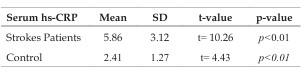
Background: Stroke is among the most common causes of adult-onset disability. 70–85% of first strokes are accompanied by hemiplegia. Several case control studies with ischemic stroke patients have indicated that recent infections are a possible risk factor for ischemic stroke. Stroke occurs when reduced blood supply to the brain results in cell death. Aim: The aim of this study is to compare serum high sensitive C-reactive protein levels in stroke patients to controls. Objective: The primary goal of this study is to examine serum high sensitive C-reactive protein levels in stroke patients and to link them to stroke related death. The secondary goal is to enhance AMI early detection, management and therapy, and prognosis. Material & Methods: The present study was carried out in the Department of physiotherapy and Central Investigation Laboratory in collaboration with the Department of Biochemistry Medicine, Intense cardiac care units, medical intensive care units, and emergency and private hospitals. The study was approved by Institutional Ethical and Research Committee to use human subjects in the research study. Informed consent was taken from patient and control subjects. Out of 100 subjects, 50 were strokes patients and 50 were age matched healthy controls. The study was conducted from June 2023 to March 2024. The Microlab 300 analyzers (semiauto analyzer) were used to assess High Sensitive C-reactive Protein concentrations, and the comparisons between the two groups were examined using an unpaired t-test. A P < 0.05 was deemed statistically significant. Results: There was a substantial elevated in the mean serum high sensitive C-reactive protein in strokes cases were 5.86 ± 3.12 mg/dl, which were higher than controls group 2.41 ± 1.27 mg/ dl. Comparison between control and serum high sensitive C-reactive protein on strokes cases was found to be more significant. Unpaired t-test showed that there was significant increase in serum high sensitive C-reactive protein level in cases as compared to controls (p<0.005). Conclusion: The analysis of serum high sensitive C-reactive protein in serum plays an important role in the diagnostic marker and management of ischemic strokes.
References
- 1. Dobkin BH, Strategies for stroke rehabilitation, Lancet Neurol. 2004; 3(9): 528–536. doi:10.1016/ S1474-4422(04)00851-8.
- 2. Bova IY, Bornstein NM, Korczyn AD. Acute infection as a risk factor for ischemic stroke. Stroke. 1996;27:2204 –2206.
- 3. Dirnagl U, Iadecola C, Moskowitz MA. Pathobiology of ischaemic stroke: an integrated view. Trends Neurosci. 1999;22:391–397.
- 4. Napoli MD, Papa F, Bocola V et al.,C-Reactive Protein in Ischemic Stroke An Independent Prognostic Factor Stroke. 2001; 32:917-924.
- 5. Anwar R, Haider SS, Anwar S, et al., Association between High sensitivity CRP and Ischaemic stroke - A case control study. P J M H S. 2018; 12,( 4):1773-77.
- 6. Vos.T, Barbar.RM, Bell.B, Bertozzi-villa.A, Biryukov.S, Bolliger.I, et al, Global, regional and national incidence, prevalence and years lived with disability foe 301 acute and chronic diseases and injuries in 188 countries, 1990-2013, a systematic analysis for the Global burden of disease study 2013. The Lancet 2015;386:743-800.
- 7. Thakur S, Gupta S, Parchwani H, Shah V, Yadav V. Hs-CRP - a potential marker for coronary heart disease.Ind J of Funda Applied Life Sci 2011;1(1):1-4.
- 8. Singh RK, Sharma S, Sabharwal RK., “Evaluation of patients with acute chest pain with microalbuminuria and C- reactive protein.” World Heart J. 2016: 8(2):184-193.
- 9. Chaudhuri JR, Mridula KR, Umamahesh M, Swathi A, Balaraju B, Bandaru VC. High sensitivity C-reactive protein levels in Acute Ischemic Stroke and subtypes: A study from a tertiary care center. Iranian journal of neurology. 2013;12(3):92.
- 10. Anwar R, Haider SS, Anwar S, et al., Association between High sensitivity CRP and Ischaemic stroke - A case control study.P J M H S.2018;12, (4):1773- 1776.
- 11. Nair SJ, Pipliwal PS, kumawatGK,et al., Study of High Sensitivity C Reactive Protein in Acute IschemicStroke. Internat. J. Pharm. Clin. Res. 2022; 14(8); 342-347.
- 12. Wilson PW. Metabolic risk factors for coronary heart disease: Current and future prospects. CurrOpinCardiol 1999; 14:176-85.
- 13. Ridker PM. Evaluating novel cardiovascular risk factors: Can webetter predict heart attacks? Ann Intern Med 1999; 130:933-7.
- 14. Bhaisare S D, Jog A S, Rao A K, Kolapkar H U. High Sensitivity CReactive Protein Level in Acute Cerebrovascular Accident (Stroke) at a Tertiary Care Centre. J. Evolution Med. Dent. Sci (2020); 9(10): :764-767.
- 15. Khan, A., Tidman D. M. M., Shakir, D. S., & Darmal D. I. Breast Cancer in Afghanistan: Issues, Barriers, and Incidence. Journal of Medical Research and Health Sciences, 2022;5(8), 2125–2134.
- 16. Chaudhuri J R, Mridula K R, Umamahesh M, Swathi A, Balaraju B, Bandaru V C S. High sensitivity Creactive protein levels in Acute Ischemic Stroke and subtypes: A study from a tertiary care center. Iranian Journal of Neurology (2013); 12(3): 92-97.
- 17. Sabatine MS, Morrow DA, Jablonski KA, Rice MM, Warnica JW, Domanski MJ, et al. Prognostic significance of the Centers for Disease Control/American Heart Association high-sensitivity C-reactive protein cut points for cardiovascular and other outcomes in patients with stable coronary artery disease. Circulation 2007; 115(12): 1528-36
Data Sharing Statement
There are no additional data available.
Funding
This research received no funding.
Author Contributions
All authors contributed significantly to the work and approve its publication.
Ethics Declaration
This article does not involve any human or animal subjects, and therefore does not require ethics approval
Acknowledgements
Information Not Provided
About this article

Cite this article
Dwivedi AK, Sharma S. Bio-markers of serum high sensitive C-reactive protein in patients of strokes. Physio Ther Occup Ther J. 2024;17(2):69-73.
Licence:
Attribution-Non-commercial 4.0 International (CC BY-NC 4.0)This license enables reusers to distribute, remix, adapt, and build upon the material in any medium or format for noncommercial purposes only, and only so long as attribution is given to the creator.
| Received | Accepted | Published |
|---|---|---|
| May 13, 2024 | June 26, 2024 | June 30, 2024 |
DOI: 10.21088/potj.0974.5777.17224.1
Keywords
StrokesHigh Sensitive C-reactive ProteinAcute ischemic strokesMortalitySearch for Similar Articles
Similar Articles
- Leadership in Physiotherapy: A Narrative Review
- Effectiveness of Low Level Laser Theapy in the Management of Temporomandibular J...
- The Impact of Air Pollution on Cardiopulmonary Health: Molecular Mechanisms, Pre...
- Efectiveness of Physiotherapy in Postpartum Women with Diastasis Recti: A Review
- Pain Neuroscience Education: Transforming Physiotherapy Practice
Article Level Metrics
Last UpdatedFriday 23 October 2026, 16:21:47 (IST)
4358
Accesses
21
739
00
Citations
NA
NA
NA
Download citation
Article Keywords
Keyword Highlighting
Highlight selected keywords in the article text.
Timeline
| Received | May 13, 2024 |
| Accepted | June 26, 2024 |
| Published | June 30, 2024 |
licence
Attribution-Non-commercial 4.0 International (CC BY-NC 4.0)
This license enables reusers to distribute, remix, adapt, and build upon the material in any medium or format for noncommercial purposes only, and only so long as attribution is given to the creator.