Full Text (PDF)
International Physiology 12(2-3):p 50-54, May -Dec. 2024. | DOI: https://doi.org/10.21088/ip.2347.1506.122234.2
Review Article
Battling the Balance: Oxidative Stress and the Power of Antioxidants
Author Information
Licence:
Attribution-Non-commercial 4.0 International (CC BY-NC 4.0)This license
enables reusers to distribute, remix, adapt, and build upon the material in any
medium or format for noncommercial purposes only, and only so long as
attribution is given to the creator.
International Physiology 12(2-3):p 50-54, May -Dec. 2024. | DOI: https://doi.org/10.21088/ip.2347.1506.122234.2
How Cite This Article:
Amitava Khan, Battling the Balance: Oxidative Stress and the Power of Antioxidants. Int.Phy.2024;12(2-3):50–54.Timeline
Received : October 28, 2024
Accepted : December 08, 2024
Published : December 27, 2024
Abstract
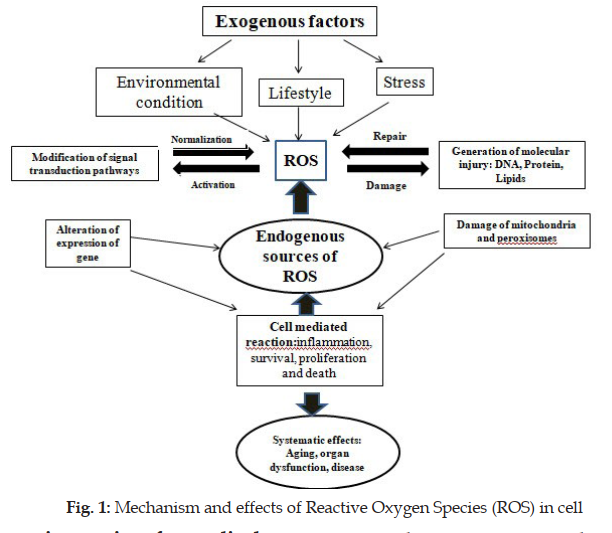
Background: Oxidative stress results from an imbalance between the production of reactive oxygen species (ROS) and the body’s antioxidative defenses. ROS, derived from oxygen, are essential in cellular signaling but can also damage cellular macromolecules, including lipids, proteins, and DNA, when produced excessively. This imbalance is associated with aging and a range of diseases, including atherosclerosis, neurodegenerative disorders, diabetes, and cancer. Aims: The aim of this article is to investigate the mechanisms of oxidative stress, its biological effects, and the role of antioxidants in mitigating oxidative damage. Additionally, the article explores the implications of oxidative stress in various diseases and potential therapeutic strategies. Materials and Methods: The article involves a comprehensive review of existing literature to elucidate the sources and types of ROS, their mechanisms of action, and the body’s enzymatic (e.g., superoxide dismutase, catalase) and non-enzymatic (e.g., vitamins C and E, glutathione) antioxidant defenses. Special attention is given to the biochemical pathways of ROS formation and detoxification. Results: Findings indicate that ROS are naturally produced during cellular metabolism and play dual roles in physiological and pathological processes. Under stress conditions or exposure to environmental toxins, ROS production overwhelms antioxidant defenses, leading to lipid peroxidation, protein oxidation, and DNA damage. Antioxidants mitigate this damage by neutralizing ROS, maintaining cellular integrity, and reducing the risk of oxidative stress-related diseases. Conclusion: Oxidative stress plays a pivotal role in aging and the development of chronic diseases. Antioxidants, both endogenous and exogenous, are crucial in managing oxidative damage. Enhancing antioxidant defenses through dietary intake or pharmacological interventions may provide therapeutic benefits and prevent oxidative stress-related pathologies. Further research into targeted antioxidant therapies is recommended to improve health outcomes.
References
- 1. Rhodes CJ. In Toxicology of the Human Environment-the critical role of free radicals (Taylor & Francis, London) 2001.
- 2. Metzler DE. In Biochemistry- the chemical reaction of living cell (Academic Press, California, US) 2001: 10.
- 3. Meister A. Glutathione-Ascorbic acid antioxidant system in animal. J Biol.Chem. 1994; 269(13): 9397-9400.
- 4. Stamler JS. Redox signalling:nitorsylation and related target interactions of NO. Cell. 1994;78(6): 931-936.
- 5. Mettler FAJ, Voelz GL. Major radiation exposurewhat to expect and how to respond. N Eng J Med. 2002; 346(20): 1554-1561.
- 6. Khalid R. Studies on free radicals, antioxidants, and co-factors. Clinical Interventions in Aging. 2007; 2(2): 219-236.
- 7. El-Agamey A, Lowe GM, McGarvey DJ, Mortensen A, Phillip DM, Truscott TG. Carotenoid radical chemistry and antioxidant/pro-oxidant properties. Arch. Biochem. Biophys.
- 8. Niles RM. Signaling pathways in retinoid chemoprevention and treatment of cancer. Mutat Res. 2004; 555(1-2): 81-96.
- 9. Donato LJ, Noy N. Suppression of mammary carcinoma growth by retinoic acid: proapoptotic genes are targets for retinoic acid receptor and cellular retinoic acid-binding protein II signalling. Cancer Res. 2005; 65(18): 8193-8899.
- 10. Niizuma H, Nakamura Y, Ozaki T, Nakanishi H, Ohira M. Bcl-2 is a key regulator for the retinoic acid-induced apoptotic cell death in neuroblastoma. Oncogene. 2006; 25(36):5046-5055.
- 11. Khan A, Manna K, Bose C, Sinha M, Das DK, Kesh SB, Chakrabarty A, Banerji A, Dey S. Gossypetin, a naturally occurring hexahydroxy flavone, ameliorates gamma radiation-mediated DNA damage. International Journal of Radiation Biology. 2013; 89(11): 965-975.
- 12. Khan A, Manna K, Das DK, Kesh SB, Sinha M, Das U, Biswas S, Sengupta S, Sikder K, Chakrabarty A, Banerji A, Dey S. Gossypetin ameliorates ionizing radiation-induced oxidative stress in mice liver—a molecular approach. Free Radical Research. 2015; 49(10): 1173-1186.
- 13. Khan A, Manna K, Bose C, Das DK, Sinha M, Kesh SB, Das U, Dey RS, Dey S. Seabuckthron (Hippophae rhamnoides L.) leaf extract ameliorates the gamma radiation mediated DNA damage and hepatic alterations. Indian journal of experimental biology. 2014; 52:952-964.
Data Sharing Statement
There are no additional data available. All raw data and code are available upon request.
Funding
This research received no funding.
Author Contributions
All authors contributed significantly to the work and approve its publication.
Ethics Declaration
This article does not involve any human or animal subjects, and therefore does not require ethics approval.
Acknowledgements
We would like to express our gratitude to the patients, their families, and all those who have contributed to this study.
Conflicts of Interest
No conflicts of interest in this work.
About this article

Cite this article
Amitava Khan, Battling the Balance: Oxidative Stress and the Power of Antioxidants. Int.Phy.2024;12(2-3):50–54.
Licence:
Attribution-Non-commercial 4.0 International (CC BY-NC 4.0)This license
enables reusers to distribute, remix, adapt, and build upon the material in any
medium or format for noncommercial purposes only, and only so long as
attribution is given to the creator.
| Received | Accepted | Published |
|---|---|---|
| October 28, 2024 | December 08, 2024 | December 27, 2024 |
DOI: https://doi.org/10.21088/ip.2347.1506.122234.2
Keywords
Oxidative StressReactive Oxygen SpeciesAntioxidantsChronic Diseases.Reactive Oxygen SpeciesAntioxidantsChronic Diseases.Search for Similar Articles
Similar Articles
- Mechanisms of Myocardial Damage and Structural Remodeling Caused by Doxorubicin-...
- Impact of Sleep Deprivation on Human Physiology: A Review
- The Effect of a Brief Heart Rate Variability Biofeedback Session on Salivary Cor...
- Impact of Vitamin D Supplementation in Enhancing Pulmonary Function in Adults wi...
- Mona Bedi - Editiorial
Article Level Metrics
Last UpdatedSunday 27 September 2026, 07:40:33 (IST)
1960
Accesses
23
194
00
Citations
NA
NA
NA
Download citation
Article Keywords
Keyword Highlighting
Highlight selected keywords in the article text.
Timeline
| Received | October 28, 2024 |
| Accepted | December 08, 2024 |
| Published | December 27, 2024 |
licence
Attribution-Non-commercial 4.0 International (CC BY-NC 4.0)
This license
enables reusers to distribute, remix, adapt, and build upon the material in any
medium or format for noncommercial purposes only, and only so long as
attribution is given to the creator.