Full Text (PDF)
Indian Journal of Research in Anthropology 12(1):p 39-46, January-June 2026. | DOI: https://doi.org/10.21088/ijra.2454.9118.12126.4
Original Article
BAIp as an Indicator of Measuring Adiposity among Preschool Children of Jalpaiguri, West Bengal, India
Author Information
Licence:
Attribution-Non-commercial 4.0 International (CC BY-NC 4.0)This license
enables reusers to distribute, remix, adapt, and build upon the material in any
medium or format for noncommercial purposes only, and only so long as
attribution is given to the creator.
Indian Journal of Research in Anthropology 12(1):p 39-46, January-June 2026. | DOI: https://doi.org/10.21088/ijra.2454.9118.12126.4
How Cite This Article:
Arindam Biswas, Argina Khatun. BAIp as an Indicator of Measuring Adiposity among Preschool Children of Jalpaiguri, West Bengal, India. Ind J Res Anthropol 2026; 12(1): 39-46.Timeline
Received : January 29, 2026
Accepted : February 28, 2026
Published : June 30, 2026
Abstract
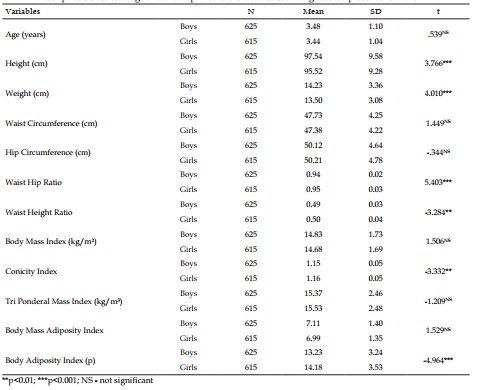
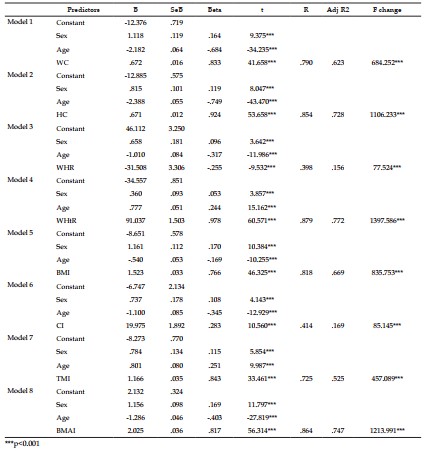
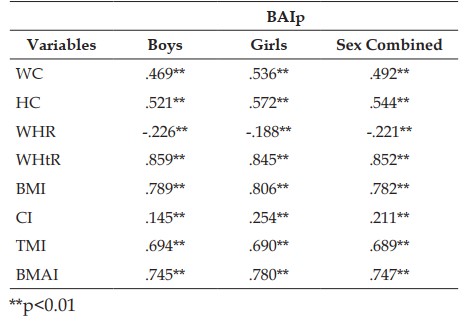
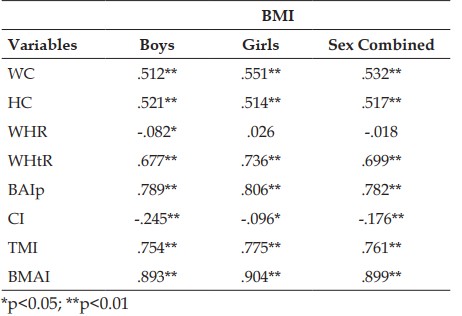
Childhood obesity is a global concern, with approximately 39 million children under five being overweight or obese worldwide in 2020. The Body Mass Index (BMI) includes lean mass and fat components of the body, which may differ in children with similar BMI. Recently proposed Body Adiposity Index (BAI) is an alternative to BMI and this index shows equivalence in paediatric populations (i.e. BAIp). The present cross-sectional study was done on 1240 preschool children (boys 625; girls 615) aged 2-5 years from 48 Integrated Child Development Scheme centres in Maynaguri Block, Jalpaiguri, West Bengal, India to evaluate childhood obesity and association between adiposity index and anthropometric variables to depict the adiposity. For this study various anthropometric measurements were recorded following standard methods. This study shows a significant sex difference was found in children’s height and weight with higher mean values for boys than girls. The correlation between BAIp and Waist Height Ratio (WHtR) was higher than for BMI, Body Mass Adiposity Index (BMAI) and Tri ponderal Mass Index (TMI) respectively. The correlation between BMI and BMAI was higher than BAIp, TMI and WHtR respectively. Research shows that good adiposity measures should have a strong relationship with BMI, which is an indicator of overall adiposity. The present study confirmed the existing hypothesis that BAIp, as a new index for children’s body fatness measures, works with acceptable accuracy, suggested researchers. It must be mentioned that the advantage of BAIp over other anthropometric measures of adiposity should be validated by other direct adiposity measures.
References
- 1. Alves Junior, C. A., Mocellin, M. C., Gonçalves, E. C. A., Silva, D. A., & Trindade, E. B. (2017). Anthropometric indicators as body fat discriminators in children and adolescents: a systematic review and meta-analysis. Advances in Nutrition 8(5), 718–727.
- 2. Ashley-Martin, J., Ensenauer, R., Maguire, B., & Kuhle, S. (2019). Predicting cardiometabolic markers in children using tri-ponderal mass index: a cross-sectional study. Archives of disease in childhood, 104(6), 577-582.
- 3. Baioumi, A. Y. A. A. (2019). Comparing measures of obesity: waist circumference, waist-hip, and waist-height ratios. In Nutrition in the prevention and treatment of abdominal obesity, 1, 29-40.
- 4. Bergman, R. N., Stefanovski, D., Buchanan, T. A., Sumner, A. E., Reynolds, J. C., Sebring, N. G., ... & Watanabe, R. M. (2011). A better index of body adiposity. Obesity, 19(5), 1083-1089.
- 5. Biswas, S., & Bose, K. (2010). The Utility of a New Index of Adiposity among Preschool Children. Mal J Nutr, 16(3), 447-450.
- 6. Bray, G. A. (2023). Beyond BMI. Nutrients.15, 2254.
- 7. Brownell, K. D., Schwartz, M. B., Puhl, R. M., Henderson, K. E., & Harris, J. L. (2009). The need for bold action to prevent adolescent obesity. Journal of Adolescent Health, 45(3), S8-S17.
- 8. Browning, L. M., Hsieh, S. D., & Ashwell, M. (2010). A systematic review of waist-to-height ratio as a screening tool for the prediction of cardiovascular disease and diabetes: 0· 5 could be a suitable global boundary value. Nutrition research reviews, 23(2), 247-269.
- 9. Camhi, S. M., Bray, G. A., Bouchard, C., Greenway, F. L., Johnson, W. D., Newton, R. L., ... & Katzmarzyk, P. T. (2011). The relationship of waist circumference and BMI to visceral, subcutaneous, and total body fat: sex and race differences. Obesity, 19(2), 402-408.
- 10. Cole, T. J., Flegal, K. M., Nicholls, D., & Jackson, A. A. (2007). Body mass index cut offs to define thinness in children and adolescents: international survey. BMJ, 335(7612), 194.
- 11. Das, S., & Bose, K. (2011). Body mass abdominal index: a new index for a diposity among preschool children. Ibrahim Medical College Journal, 5(1), 9-12.
- 12. Datta Banik, S., Das, S., Bhattacharjee, P. (2016). Body Adiposity Index in Relation to Body Mass Index and Central Adiposity Measures in Preschool children of Purulia, West Bengal, India. Mal J Nutr. 22(3), 345-350.
- 13. de Souza, WC, Junior, DT, Mascarenhas, LPG, & Grzelczak, MT (2015). Body adiposity index (BAI) as a predictor of body fat: a review study. Health and Environment: Interdisciplinary Journal, 4 (1), 32-38.
- 14. Dong, B., Wang, Z., Wang, H. J., & Ma, J. (2015). Associations between adiposity indicators and elevated blood pressure among Chinese children and adolescents. Journal of human hypertension, 29(4), 236-240.
- 15. El Aarbaoui, T., Samouda, H., Zitouni, D., Di Pompeo, C., de Beaufort, C., Trincaretto, F., ... & Guinhouya, B. C. (2013). Does the body adiposity index (BAI) apply to paediatric populations?. Annals of human biology, 40(5), 451-458.
- 16. Ellis, K. J., Abrams, S. A., & Wong, W. W. (1999). Monitoring childhood obesity: assessment of the weight/height2 index. American journal of epidemiology, 150(9), 939-946.
- 17. El-Sayed, A. M., Scarborough, P., & Galea, S. (2011). Ethnic inequalities in obesity among children and adults in the UK: a systematic review of the literature. Obesity Reviews, 12(5), e516-e534.
- 18. Filgueiras, M. D. S., Cecon, R. S., de Faria, E. R., de Faria, F. R., Pereira, P. F., Ribeiro, A. Q., ... & de Novaes, J. F. (2019). Agreement of body adiposity index (BAI) and paediatric body adiposity index (BAIp) in determining body fat in Brazilian children and adolescents. Public Health Nutrition, 22(1), 132-139.
- 19. Freedman, D. S., & Sherry, B. (2009). The validity of BMI as an indicator of body fatness and risk among children. Pediatrics, 124(Supplement_1), S23-S34.
- 20. Freedman, D. S., Thornton, J. C., Pi‐Sunyer, F. X., Heymsfield, S. B., Wang, J., Pierson Jr, R. N., ... & Gallagher, D. (2012). The body adiposity index (hip circumference÷ height1. 5) is not a more accurate measure of adiposity than is BMI, waist circumference, or hip circumference. Obesity, 20(12), 2438-2444.
- 21. Freedman, D. S., Wang, J., Thornton, J. C., Mei, Z., Pierson Jr, R. N., Dietz, W. H., & Horlick, M. (2008). Racial/ethnic differences in body fatness among children and adolescents. Obesity, 16(5), 1105-1111.
- 22. Kumar, P. A. (2009). Hypothetical Index for Adiposity “Body Mass Abdominal Index”- That will predict Cardiovascular disease risk factors in Children. Internet J Ped Neonat, 11, 1.
- 23. Lohman, T. G., Roche, A. F., Martorell, R. (1988). Anthropometric Standardization Reference Manual, Human Kinetics Books, Chicago.
- 24. Mahmoud, I., Al-Wandi, A. S., Gharaibeh, S. S., & Mohamed, S. A. (2021). Concordances and correlations between anthropometric indices of obesity: a systematic review. Public Health, 198, 301-306.
- 25. Okunogbe, A., Nugent, R., Spencer, G., Powis, J., Ralston, J., & Wilding, J. (2022). Economic impacts of overweight and obesity: current and future estimates for 161 countries. BMJ global health, 7(9), e009773.
- 26. Peterson, C. M., Su, H., Thomas, D. M., Heo, M., Golnabi, A. H., Pietrobelli, A., & Heymsfield, S. B. (2017). Tri-ponderal mass index vs body mass index in estimating body fat during adolescence. JAMA pediatrics, 171(7), 629-636.
- 27. Puder, J. J., Marques-Vidal, P., Schindler, C., Zahner, L., Niederer, I., Bürgi, F., ... & Kriemler, S. (2011). Effect of multidimensional lifestyle intervention on fitness and adiposity in predominantly migrant preschool children (Ballabeina): cluster randomised controlled trial. BMJ, 343.
- 28. Taylor, R. W., Jones, I. E., Williams, S. M., & Goulding, A. (2000). Evaluation of waist circumference, waist-to-hip ratio, and the conicity index as screening tools for high trunk fat mass, as measured by dual-energy X-ray absorptiometry, in children aged 3–19 y. The American journal of clinical nutrition, 72(2), 490-495.
- 29. Thibault, R., & Pichard, C. (2012). The evaluation of body composition: a useful tool for clinical practice. Annals of Nutrition and Metabolism, 60(1), 6-16.
- 30. Wang, X., Dong, B., Ma, J., Song, Y., Zou, Z., & Arnold, L. (2020). Role of tri-ponderal mass index in cardio-metabolic risk assessment in children and adolescents: compared with body mass index. International Journal of Obesity, 44(4), 886-894.
- 31. Wang, Y., Xu, K., Wang, M., Tuerxun, P., Dong, W., Wei, M., ... & Zhang, J. (2024). Comparison of BMI, triponderal mass index and paediatric body adiposity index for predicting body fat and screening obesity in preschool children. British Journal of Nutrition, 132(11), 1466-1473.
- 32. Weiner, J. S., & Lourie, J. A. (1981). Practical Human Biology, Academic Press.
- 33. Wells, J. C. K. (2010). The evolutionary biology of human body fatness: thrift and control. Cambridge: Cambridge University Press.
- 34. WHO Expert Committee. (1995). Physical status: the use and interpretation of anthropometry. World Health Organ Tech Rep Ser. 854, 312-44.
- 35. WHO. (2009). Global health risks: mortality and burden of disease attributable to selected major risks. Geneva: World Health Organization.
- 36. Ye, X. F., Dong, W., Tan, L. L., Zhang, Z. R., Qiu, Y. L., & Zhang, J. (2020). Identification of the most appropriate existing anthropometric index for home-based obesity screening in children and adolescents. Public Health, 189, 20-25.
- 37. Yu, Y., Wang, L., Liu, H., Zhang, S., Walker, S. O., Bartell, T., & Wang, X. (2015). Body mass index and waist circumference rather than body adiposity index are better surrogates for body adiposity in a Chinese population. Nutrition in Clinical Practice, 30(2), 274-282.
- 38. Zhao, D. P., Li, Y., Zheng, L., & Yu, K. (2013). Body mass index, body adiposity index, and percent body fat in Asians. Am. J. Phys. Anthrop. 294-299.
Data Sharing Statement
There are no additional data available. All raw data and code are available upon request.
Funding
This research received no funding.
Author Contributions
All authors contributed significantly to the work and approve its publication.
Ethics Declaration
This article does not involve any human or animal subjects, and therefore does not require ethics approval.
Acknowledgements
We would like to express our gratitude to the patients, their families, and all those who have contributed to this study.
Conflicts of Interest
No conflicts of interest in this work.
About this article

Cite this article
Arindam Biswas, Argina Khatun. BAIp as an Indicator of Measuring Adiposity among Preschool Children of Jalpaiguri, West Bengal, India. Ind J Res Anthropol 2026; 12(1): 39-46.
Licence:
Attribution-Non-commercial 4.0 International (CC BY-NC 4.0)This license
enables reusers to distribute, remix, adapt, and build upon the material in any
medium or format for noncommercial purposes only, and only so long as
attribution is given to the creator.
| Received | Accepted | Published |
|---|---|---|
| January 29, 2026 | February 28, 2026 | June 30, 2026 |
DOI: https://doi.org/10.21088/ijra.2454.9118.12126.4
Keywords
Body Adiposity Index paediatricsPreschoolAdiposityChildrenSearch for Similar Articles
Similar Articles
- Contemporary Issues and Challenges in Women’s Weavers in the Varanasi Silk Saree...
- Understanding through Traversing the Corridors of History: Richness of Indian He...
- Challenges and Opportunities in Digital Preservation of Intangible Culture Herit...
- Assessment of Nutritional Indicators: A Comparative Study among Pre-School Child...
- Prenatal and Postnatal Health-Seeking Behaviour among the Muria Tribe of Bastar...
Article Level Metrics
Last UpdatedFriday 23 October 2026, 12:25:36 (IST)
2456
Accesses
21
529
00
Citations
NA
NA
NA
Download citation
Article Keywords
Keyword Highlighting
Highlight selected keywords in the article text.
Timeline
| Received | January 29, 2026 |
| Accepted | February 28, 2026 |
| Published | June 30, 2026 |
licence
Attribution-Non-commercial 4.0 International (CC BY-NC 4.0)
This license
enables reusers to distribute, remix, adapt, and build upon the material in any
medium or format for noncommercial purposes only, and only so long as
attribution is given to the creator.