Full Text (PDF)
International Journal of Practical Nursing 14(2):p 49-54, May-August 2026. | DOI: https://doi.org/10.21088 ijpn.2347.7083.14226.2
Original Article
Assessment of Menstrual Hygiene Practices among Adolescent Girls in selected Schools
Author Information
Licence:
Attribution-Non-commercial 4.0 International (CC BY-NC 4.0)This license enables reusers to distribute, remix, adapt, and build upon the material in any medium or format for noncommercial purposes only, and only so long as attribution is given to the creator.
International Journal of Practical Nursing 14(2):p 49-54, May-August 2026. | DOI: https://doi.org/10.21088 ijpn.2347.7083.14226.2
How Cite This Article:
Kalpana Joshi. Assessment of Menstrual Hygiene Practices among Adolescent Girls in selected Schools. Int J Practical Nurs. 2026; 14(2): 49-54.Timeline
Received : June 16, 2026
Accepted : July 20, 2026
Published : August 30, 2026
Abstract
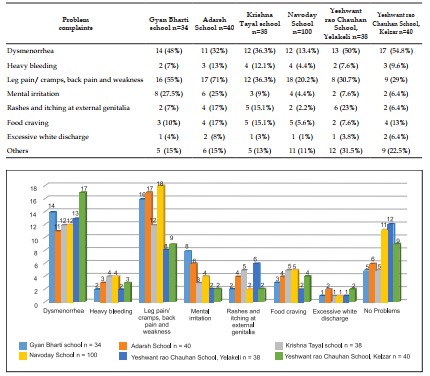
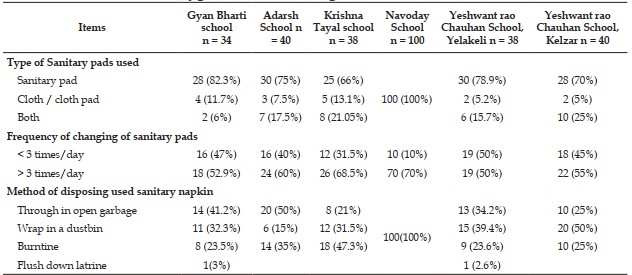
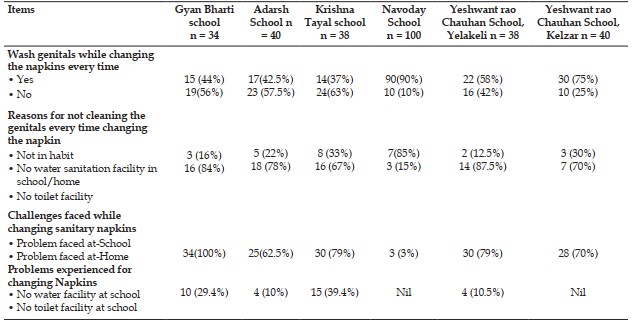
Adolescents’ are 10-19 years age group. Adolescent is the stage of transition between puberty to adulthood. It is a unique period of human development and an important time for rapid growth of physical, cognitive and psychosocial health.1 Girls miss 1-2 days of school per month.4 Globally more than 300 million women are menstruating and approximately 500 million women has inadequate facilities like menstrual products for menstrual hygiene management.6 Aim of the study was to assess menstrual pattern and menstrual hygiene among adolescent girls in selected government schools of Wardha district in Maharashtra. Study was community based cross sectional survey design conducted under 284 adolescent girls from six different schools from Wardha district, Maharashtra. sample size estimated on the basis of previous study. study conducted from February 2022 to September 2023. Study conducted in two phases, in first phase covered girls’ students to administer questionnaire and then conduct a school teaching programme in different methods like discussion, group participation and cooperative learning methods. adolescent girls those were attended menarche age between 11-15 years age group. Outcome of the study was majority of adolescent girls were 18 (45%) in 13 years, 30% (12) years age and 8 were (20%) 14 years age group. 28 (70%) had attended menarche at the age of 12 years, 9(23%) had at the age of 11 years, 3 (7.5%) attended menarche in 13 years of age. most of the adolescent 70% were belongs in nuclear family and 56% girls were vegetarian. 80% girls were using sanitary pad and 20% girls were using both cloth and sanitary pad. most of the girls herd menstrual cycle from mother or teachers. 28% girls were facing dysmenorrhea, 5 % were experienced heavy bleeding more than 7 days 90% girls were faced achene problems, pain in abdomen and breast heaviness. two girls shared her problem like irregular cycle and gaining weight. 100% girls faced problem changes of absorbent in school, dust bean how to discard and sanitation facilities like water and soap. so the main reason during first and second day most of the student not come in college. 64% girls were under weight and week. only 20% of girls took iron folic acid supplementation in weekly that provided by government of India. After intervention majority of students had 88% moderate knowledge and 8% had good knowledge and 2% had poor knowledge. Study depicted that there is need to create awareness programme and develop environment so the girls will able to tell their problems in detail and agree to change or modify the behaviour.
References
- 1. Ghai OP, Paul VK, Bagga A. Essential Pediatrics. 7th ed. New Delhi: CBS Publishers and Distributors Pvt Ltd; 2009. [Google Scholar]World Health Organization. https://www.who.int, 22-Jun-2022.
- 2. National Family Health Survey (NFHS-5) India.[Aug;2022].2019. http://rchiips.org/ nfhs/NFHS-5_FCTS/India.pdf.
- 3. Ccras.nic.in. http://ccras.nic.in. December 2015.
- 4. Dabell, J. (2019). What is the jigsaw classroom technique? Seced, 2019(11), 14-15.
- 5. Sharma N et al, omparative study of knowledge and practice regarding menstrual hygiene among private and government schools.International Journal of Community Medicine and Public Health.. Int J Community Med Public Health. 2019 Sep;6(9): DOI: http://dx.doi.org/10.18203/2394-6040. ijcmph20193608.
- 6. Soleheti Tetti Effect of Jigsaw Technique on the Education of Menstrual Self-care Behaviour to Female Adolescents. 10.22038/ ebcj.2020.43801.2185
- 7. Jarrahi Reihaneh et al. 2020, effects of menstrual hygiene education based on peer and small group teaching methods. evidence based care journal, Volume 10, issue1 April, 2020, pg no. 70-74. http;//ebcj. Mums.ac.ir.
- 8. World Health Organization report. Global Report reveals major gaps in menstrual health and hygiene in schools. 28 May, 2024 repot. http://www.who.int.
- 9. Binkley J Catherine1, Knowlton W Johnson .2 Application of the PRECEDE-PROCEED Planning Model in Designing an Oral Health Strategy. Journal Theory Pract Dent Public Health. 2013;1(3):14–25. PMC: 2014 Oct 16.[PubMed Central]
Data Sharing Statement
There are no additional data available. All raw data and code are available upon request.
Funding
This research received no funding.
Author Contributions
All authors contributed significantly to the work and approve its publication.
Ethics Declaration
This article does not involve any human or animal subjects, and therefore does not require ethics approval.
Acknowledgements
We would like to express our gratitude to the patients, their families, and all those who have contributed to this study.
Conflicts of Interest
No conflicts of interest in this work.
About this article

Cite this article
Kalpana Joshi. Assessment of Menstrual Hygiene Practices among Adolescent Girls in selected Schools. Int J Practical Nurs. 2026; 14(2): 49-54.
Licence:
Attribution-Non-commercial 4.0 International (CC BY-NC 4.0)This license enables reusers to distribute, remix, adapt, and build upon the material in any medium or format for noncommercial purposes only, and only so long as attribution is given to the creator.
| Received | Accepted | Published |
|---|---|---|
| June 16, 2026 | July 20, 2026 | August 30, 2026 |
DOI: https://doi.org/10.21088 ijpn.2347.7083.14226.2
Keywords
Adolescent girlsMenstrual HealthMenstrual HygieneSearch for Similar Articles
Similar Articles
- From Artificial Limbs to Intelligent Limbs: Advances in Sensory-Enabled Prosthet...
- Pilot Study to Evaluate the Effectiveness of Novel Designed Nebulizer (NDN) on P...
- Periodic Review of Benchmarks Contributing to Reduction of Healthcare Associated...
- Forensic Nursing
- Women Empowerment in Rural Community
Article Level Metrics
Last UpdatedWednesday 21 October 2026, 09:24:31 (IST)
1796
Accesses
22
211
00
Citations
NA
NA
NA
Download citation
Article Keywords
Keyword Highlighting
Highlight selected keywords in the article text.
Timeline
| Received | June 16, 2026 |
| Accepted | July 20, 2026 |
| Published | August 30, 2026 |
licence
Attribution-Non-commercial 4.0 International (CC BY-NC 4.0)
This license enables reusers to distribute, remix, adapt, and build upon the material in any medium or format for noncommercial purposes only, and only so long as attribution is given to the creator.