Full Text (PDF)
International Journal of Practical Nursing 14(2):p 43-47, May-August 2026. | DOI: https://doi.org/10.21088 ijpn.2347.7083.14226.1
Original Article
A Study to assess the Effectiveness of Structured Teaching Program on Knowledge Regarding Corporal Punishment and Positive Discipline among Primary Schools Teachers at Selected Schools af Olpad Taluka, Surat, Gujarat
Alka Tajne, Aarti Patel, Rathod Binal, Shinde Rohini, Upadhyay Ayushi, Valvi Rinkal, Valvi Sneha, Vasava Sanjana, Yadav Nigam
Author Information
Licence:
Attribution-Non-commercial 4.0 International (CC BY-NC 4.0)This license enables reusers to distribute, remix, adapt, and build upon the material in any medium or format for noncommercial purposes only, and only so long as attribution is given to the creator.
International Journal of Practical Nursing 14(2):p 43-47, May-August 2026. | DOI: https://doi.org/10.21088 ijpn.2347.7083.14226.1
How Cite This Article:
Alka Tajne, Aarti Patel, Rathod Binal, Shinde Rohini et. al, A Study to assess the Effectiveness of Structured Teaching Program on Knowledge Regarding Corporal Punishment and Positive Discipline among Primary Schools Teachers at Selected Schools af Olpad Taluka, Surat, Gujarat. Int J Practical Nurs. 2026; 14(2): 43-47.Timeline
Received : June 16, 2026
Accepted : July 15, 2026
Published : August 30, 2026
Abstract
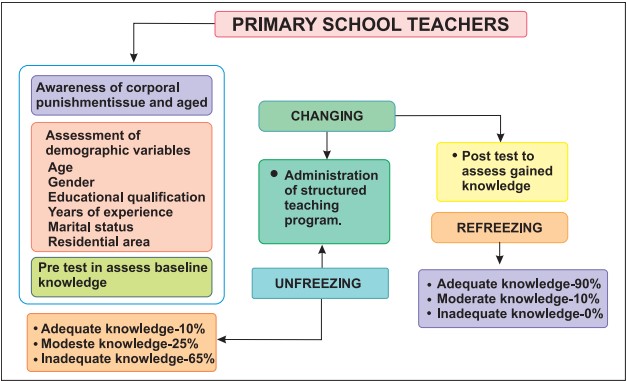
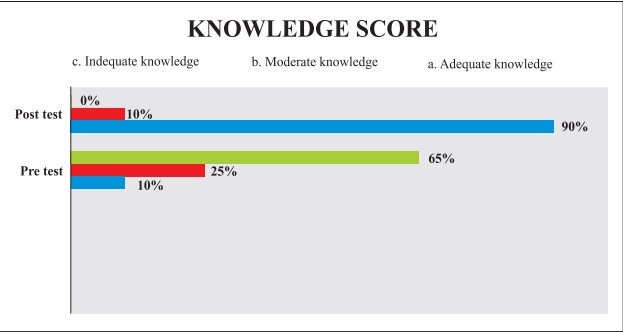
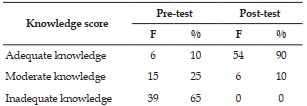
Statement of the Problem: “A study to assess the effectiveness of a structured teaching program on knowledge regarding corporal punishment and positive discipline among primary school teachers at selected schools, Olpad taluka, Surat. Gujarat.” This study was conducted by Ms. Binal Rathod, Ms. Rohini Shinde, Ms. Ayushi Upadhyay, Ms. Rinkal Valvi, Ms. Sneha Valvi, Ms. Sanjana Vasava, and Ms. Nigam Yadav in partial fulfillment of the Bachelor of Science in Nursing degree under Veer Narmad South Gujarat University, Surat. Objectives of the Study: 1. To assess the knowledge regarding corporal punishment and positive discipline among primary school teachers in selected schools of Olpad taluka, Surat, Gujarat. 2. To evaluate the effectiveness of a structured teaching program on knowledge regarding corporal punishment and positive discipline among these teachers. Methodology: A quantitative research approach with a quasi-experimental onegroup pre-test and post-test design was adopted. The study was conducted in five selected primary schools of Olpad, Surat, Gujarat. A total of 60 teachers were selected through non-probability convenience sampling technique. Data was collected using a self-structured questionnaire covering demographic variables and knowledge items on corporal punishment and positive discipline. A 45–60-minute structured teaching program served as the independent variable, and teachers’ knowledge scores were the dependent variable. Content validity and reliability of the tool were established. Pre-test data was taken on Day 1, followed by the teaching program on Day 2, and post-test data was collected afterward. Analysis and Interpretation: Descriptive statistics (frequency, percentage, mean, SD) and inferential statistics (paired t-test) were used. Results showed a significant improvement in post-test knowledge scores at the 0.05 level, demonstrating the effectiveness of the structured teaching program. Conclusion: The study concludes that the structured teaching program significantly improved teachers’ knowledge about corporal punishment and positive discipline. Such educational interventions can promote safer, more supportive, and childfriendly school environments.
References
- 1. Basavanthappa, B. T. 2007). Nursing research. Jaypee Brothers.
- 2. Polit, D. F., & Beck, C. T. (2021). Nursing research: Generating and assessing evidence for nursing practice (11th ed.). Wolters Kluwer.
- 3. Suresh, K. (2011). An introduction to biostatistics. Jaypee Brothers.
- 4. Suresh, K. (2011). An introduction to biostatistics. Jaypee Brothers.
- 5. Kothari, C. R. (2004). Research methodology: Methods and techniques (2nd ed.). New Age International.
- 6. Kruger, T. H. C., & Schmid, G. (2015). Phantom vibrations and related hallucinations in healthy individuals. Journal of Behavioral Addictions, 4(3), 130-136.
- 7. Roberts. J.A., Pullig, C., & Manolis, C. (2015). I need my smartphone: A hierarchical model of personality and cell-phone addiction. Personality and Individual Differences, 79, 13-19.
- 8. Cheever, N. A., Rosen, L. D., Carrier, L. M., & Chavez, A. (2014). Out of sight is not out of mind: The impact of restricting wireless mobile device use on anxietylevels among low, moderate and high users. Computers in Human Behavior, 37, 290- 297.
- 9. Hadlington, L. (2015). Cognitive failures in daily life: Exploring the link with Internet addiction and problematic mobile phone use. Computers in Human Behavior, 51, 75-81.
- 10. Thomée, S., Härenstam, A., & Hagberg, M. (2011). Mobile phone use and stress, sleep disturbances, and symptoms of depression among young adults a prospective cohort study. BMC Public Health, 11, 66.
Data Sharing Statement
There are no additional data available. All raw data and code are available upon request.
Funding
This research received no funding.
Author Contributions
All authors contributed significantly to the work and approve its publication.
Ethics Declaration
This article does not involve any human or animal subjects, and therefore does not require ethics approval.
Acknowledgements
We would like to express our gratitude to the patients, their families, and all those who have contributed to this study.
Conflicts of Interest
No conflicts of interest in this work.
About this article

Cite this article
Alka Tajne, Aarti Patel, Rathod Binal, Shinde Rohini et. al, A Study to assess the Effectiveness of Structured Teaching Program on Knowledge Regarding Corporal Punishment and Positive Discipline among Primary Schools Teachers at Selected Schools af Olpad Taluka, Surat, Gujarat. Int J Practical Nurs. 2026; 14(2): 43-47.
Licence:
Attribution-Non-commercial 4.0 International (CC BY-NC 4.0)This license enables reusers to distribute, remix, adapt, and build upon the material in any medium or format for noncommercial purposes only, and only so long as attribution is given to the creator.
| Received | Accepted | Published |
|---|---|---|
| June 16, 2026 | July 15, 2026 | August 30, 2026 |
DOI: https://doi.org/10.21088 ijpn.2347.7083.14226.1
Keywords
Structured Teaching ProgramKnowledgeCorporal PunishmentPositive DisciplinePrimary School TeachersSearch for Similar Articles
Similar Articles
- From Artificial Limbs to Intelligent Limbs: Advances in Sensory-Enabled Prosthet...
- Pilot Study to Evaluate the Effectiveness of Novel Designed Nebulizer (NDN) on P...
- Periodic Review of Benchmarks Contributing to Reduction of Healthcare Associated...
- Forensic Nursing
- Women Empowerment in Rural Community
Article Level Metrics
Last UpdatedWednesday 21 October 2026, 07:47:24 (IST)
1795
Accesses
13
211
00
Citations
NA
NA
NA
Download citation
Article Keywords
Keyword Highlighting
Highlight selected keywords in the article text.
Timeline
| Received | June 16, 2026 |
| Accepted | July 15, 2026 |
| Published | August 30, 2026 |
licence
Attribution-Non-commercial 4.0 International (CC BY-NC 4.0)
This license enables reusers to distribute, remix, adapt, and build upon the material in any medium or format for noncommercial purposes only, and only so long as attribution is given to the creator.