Full Text (PDF)
International Journal of Food, Nutrition & Dietetics 12(1):p 7-15, January – April 2024. | DOI: https://doi.org/10.21088/ijfnd.2322.0775.12124.1
Original Article
Assessing the Impact of Dietary Habits on Physical Status among Adolescents of Uttar Pradesh, India
Author Information
Licence:
Attribution-Non-commercial 4.0 International (CC BY-NC 4.0)This license enables reusers to distribute, remix, adapt, and build upon the material in any medium or format for noncommercial purposes only, and only so long as attribution is given to the creator.
International Journal of Food, Nutrition & Dietetics 12(1):p 7-15, January – April 2024. | DOI: https://doi.org/10.21088/ijfnd.2322.0775.12124.1
How Cite This Article:
Avinash Singh, Assessing the Impact of Dietary Habits on Physical Status among Adolescents of Uttar Pradesh, India. Int J Food Nutr Diet. 2024;12(1):07–15.Timeline
Received : March 26, 2024
Accepted : April 19, 2024
Published : April 30, 2024
Abstract
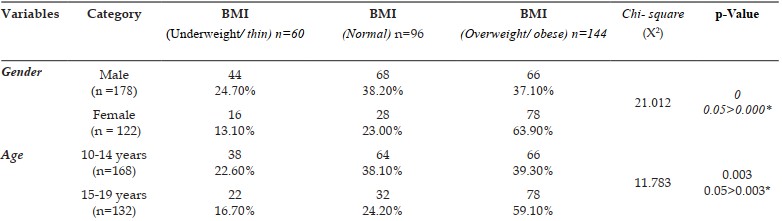
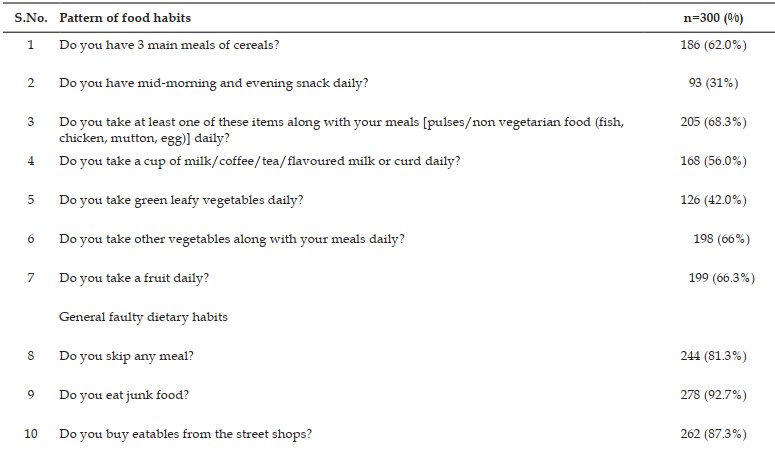
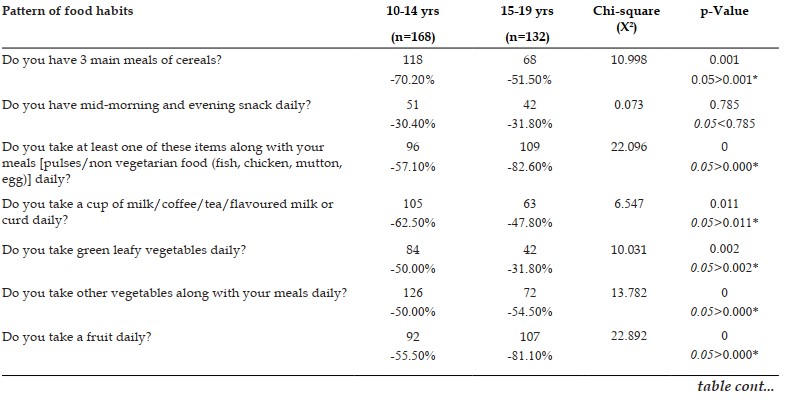
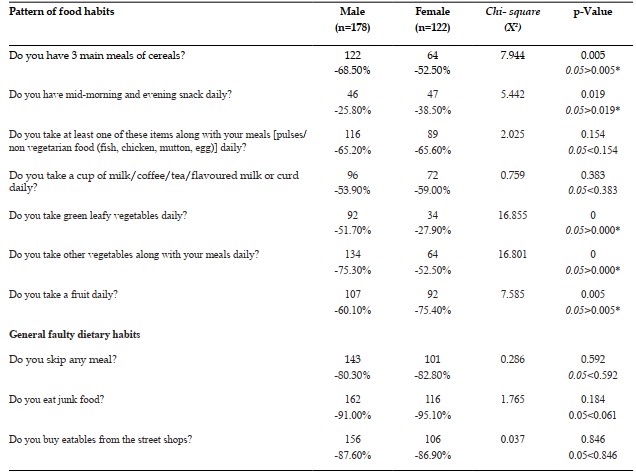
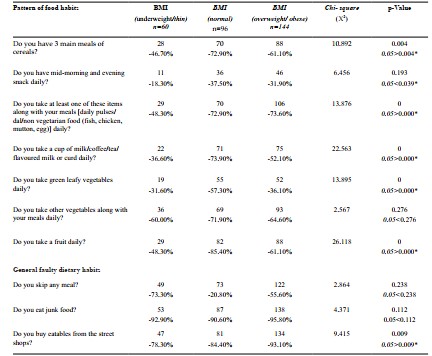
Objective: Adolescence is a vulnerable period of life as health related behaviours that drive the major chronic degenerative diseases start or are reinforced during this time. Dietary habits of adolescents play a significant role in determining both their present and future health. The present study is an attempt to assess the impact of dietary habits on physical status among adolescents of Uttar Pradesh, India. Materials and Methods: A cross sectional study using a self administered questionnaire was carried out among 300 adolescents aged 10-19 years from prominent districts of Uttar Pradesh (Lucknow, Prayagaraj, Gorakhpur, Ghaziabad, Varanasi). The socio-demographic profile, anthropometric measurements (height & weight) and dietary habits using simplified dietary gap assessment tool recommeneded by ICMR/NIN were recorded. The physical status of the adolescents was categorized as per WHO-BMI. Based on their BMI, underweight, normal and overweight adolescents were identified. Chi-square test using SPSS 22 software was employed to assess the association between dietary habits and BMI status. Results: Overall, the adolescents reported poor dietary intakes; over one quarter (38%) reported not consumption of three main meals and (81.3%) reported skipping their regular meals. Nearly one third of the adolescents do not consume any servings of fruits daily. The results revealed that consuming junk food and buying eatables from street shops were considerably high in all the adolescents. More adolescents falling into the overweight/obese category were found to have poor eating habits, such as missing meals, consuming junk food, or buying eatables from street shops. Male adolescents were found to consume fruit and green leafy vegetables more often than female individuals. In general, boys consumed more nutrient-rich diets than girls. Conclusion: The adolescents reported poor food consumption patterns, and the poor dietary choices significantly impact the physical status of adolescents. The study findings highlight the need to develop strategies for promoting good nutrition and creating awareness to encourage healthy eating in adolescence.
References
- 1. Benton D, Jarvis M. The role of breakfast and a mid-morning snack on the ability of chidren to concentrate at school. Physiol Behav. 2007;90(2- 3):382-85.
- 2. Chacko TV, Ganesan S. A tool for quickly identifying gaps in diet of school children for nutritional educational interventions. Indian J Public Health. 2018;62(2):146-49.
- 3. Chincholikar S, Sohani A. Epidemiological determinants of obesity in adolescent population Maharashtra, India. Indian J Community Health. 2016;28(2):157-62.
- 4. Deka MK, Malhotra AK, Yadav R, Gupta S. Dietary pattern and nutritional deficiencies among urban adolescents. J Family Med Prim Care. 2015;4:364–8.
- 5. Dutta M, Selvamani Y, Singh P, Prashad L. The double burden of malnutrition among adults in India: Evidence from the National Family Health Survey-4 (2015- 16). Epidemiol Health. 2019;41:e2019050. Rodrigues P, Luiz R, Monteiro L, Ferreira M, Gonçalves-Silva R, Pereira R. Adolescents’ unhealthy eating habits are associated with meal skipping. Nutrition. 2017;42:114-20.e1.
- 6. Kelder SH, Perry CL, Klepp K-I, Lytle LL. Longitudinal tracking of adolescent smoking, physical activity, and food choice behaviors. Am J Public Health. 1994;84:1121–6.
- 7. Marwaha RK, Tandon N, Singh Y, Aggarwal R, Grewal K, Mani K. A study of growth parameters and prevalence of overweight and obesity in school children from delhi. Indian Pediatr. 2006 Nov;43(11):943-52.
- 8. Meenakshi J. Trends and patterns in the triple burden of malnutrition in India. Agricultural Economics. 2016;47(S1):115-34.
- 9. Mohammadbeigi A, Asgarian A, Moshir E, Heidari H, Afrashteh S, Khazaei S, Ansari H. Fast food consumption and overweight/obesity prevalence in students and its association with general and abdominal obesity. J Prev Med Hyg. 2018 Sep 28;59(3):E236-E240. doi: 10.15167/2421-4248/jpmh2018.59.3.830. PMID: 30397681; PMCID: PMC6196377.
- 10. National Institute of Nutrition. Dietary guidelines for Indians: a manual. 2nd ed. Hyderabad: National Institute of Nutrition; 2010.
- 11. National Sample Survey Office. Report of the National Sample Survey 66th round (July 2009– June 2010):nutritional intake in India. New Delhi: Ministry of Statistics and Programme Implementation, Government of India; 2012.
- 12. Rathi N, Riddell L, Worsley A. Food consumption patterns of adolescents aged 14- 16 years in Kolkata, India. Nutr J. 2017;16(1):50.
- 13. Reicks M, Banna J, Cluskey M, Gunther C, Hongu N, Richards R, et al. Influence of parenting practices on eating behaviors of early adolescents during independent eating occasions: Implications for obesity prevention. Nutrients. 2015;7(10):8783-801.
- 14. Rodrigues P, Luiz R, Monteiro L, Ferreira M, Gonçalves-Silva R, Pereira R. Adolescents’ unhealthy eating habits are associated with meal skipping. Nutrition. 2017;42:114-20.e1.
- 15. Sawyer S, Azzopardi P, Wickremarathne D, Patton G. The age of adolescence. Lancet Child Adolesc Health. 2018;2(3):223-28.
- 16. Schur EA, Sanders M, Steiner H. Body dissatisfaction and dieting in young children. Int J Eat Disord. 2000;27(1):74-82.
- 17. Shetty PS. Nutrition transition in India. Public Health Nutr. 2002;5(1A):175-82.
- 18. Wennberg M, Gustafsson PE, Wennberg P, Hammarström A. Poor breakfast habits in adolescence predict the metabolic syndrome in adulthood. Public Health Nutr. 2015;18:122–9.
- 19. World Health Organization: WHO calls for stronger focus on adolescent health. http:// w w w . w h o . i n t / m e d i a c e n t r e / n e w s / releases/2014/focus-adolescent-health/ en/ (2016).
- 20. Zalewska M, Maciorkowska E. Selected nutritional habits of teenagers associated with overweight and obesity. Peer J. 2017;5:e3681.
Data Sharing Statement
There are no additional data available. All raw data and code are available upon request.
Funding
This research received no funding.
Author Contributions
All authors contributed significantly to the work and approve its publication.
Ethics Declaration
This article does not involve any human or animal subjects, and therefore does not require ethics approval.
Acknowledgements
We would like to express our gratitude to the patients, their families, and all those who have contributed to this study.
Conflicts of Interest
No conflicts of interest in this work.
About this article

Cite this article
Avinash Singh, Assessing the Impact of Dietary Habits on Physical Status among Adolescents of Uttar Pradesh, India. Int J Food Nutr Diet. 2024;12(1):07–15.
Licence:
Attribution-Non-commercial 4.0 International (CC BY-NC 4.0)This license enables reusers to distribute, remix, adapt, and build upon the material in any medium or format for noncommercial purposes only, and only so long as attribution is given to the creator.
| Received | Accepted | Published |
|---|---|---|
| March 26, 2024 | April 19, 2024 | April 30, 2024 |
DOI: https://doi.org/10.21088/ijfnd.2322.0775.12124.1
Keywords
BMIAdolescentsDietary habitsPhysical statusOverweight/obeseSearch for Similar Articles
Similar Articles
- Smart and Sustainable Packaging Approaches for Reducing Heavy Metal Contaminatio...
- Traditional Rhythms for Modern Health: Seed Cycling in the Management of Women’s...
- School-Based Nutrition Education Improves Knowledge and Consumption of Omega-3-R...
- Nutrition as Precision Therapy in Rare Genetic Diseases: Moving beyond Supportiv...
- A Review on Health Risks Associated with the Repetitive use of Cooking Oil and D...
Article Level Metrics
Last UpdatedMonday 07 September 2026, 02:46:30 (IST)
1797
Accesses
10
247
00
Citations
NA
NA
NA
Download citation
Article Keywords
Keyword Highlighting
Highlight selected keywords in the article text.
Timeline
| Received | March 26, 2024 |
| Accepted | April 19, 2024 |
| Published | April 30, 2024 |
licence
Attribution-Non-commercial 4.0 International (CC BY-NC 4.0)
This license enables reusers to distribute, remix, adapt, and build upon the material in any medium or format for noncommercial purposes only, and only so long as attribution is given to the creator.