Full Text (PDF)
Indian Journal of Anatomy 12(2):p 63-74, April-June 2023. | DOI: https://doi.org/10.21088/ija.2320.0022.12223.2
Review Article
Approach to Maxillofacial Injuries
Ravi Kumar Chittoria, Jacob Antony Chakiath
Author Information
Licence:
Attribution-Non-commercial 4.0 International (CC BY-NC 4.0)This license enables reusers to distribute, remix, adapt, and build upon the material in any medium or format for noncommercial purposes only, and only so long as attribution is given to the creator.
Indian Journal of Anatomy 12(2):p 63-74, April-June 2023. | DOI: https://doi.org/10.21088/ija.2320.0022.12223.2
How Cite This Article:
Chakiath JA, Chittoria RK. Approach to maxillofacial injuries. Indian J Anat. 2023;12(2):63–74.Timeline
Received : December 14, 2022
Accepted : January 14, 2023
Published : February 28, 2022
Abstract
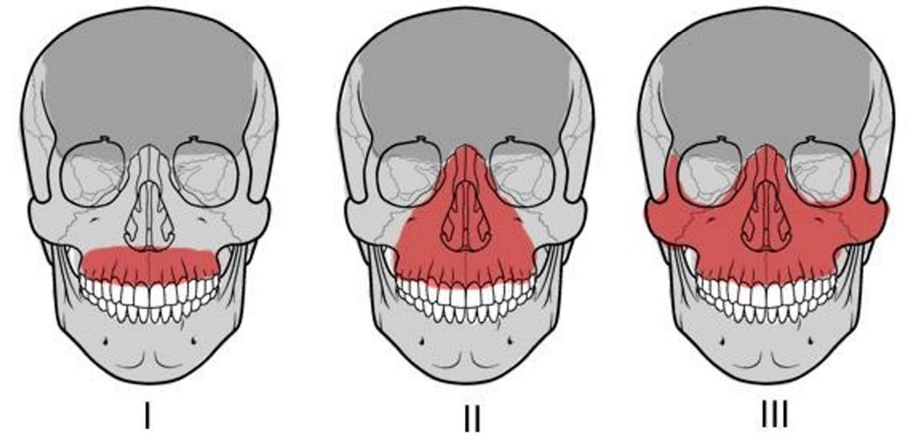
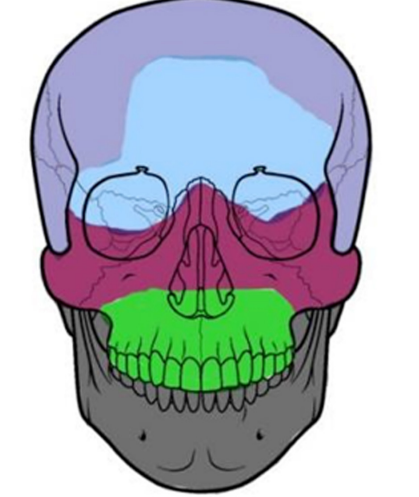
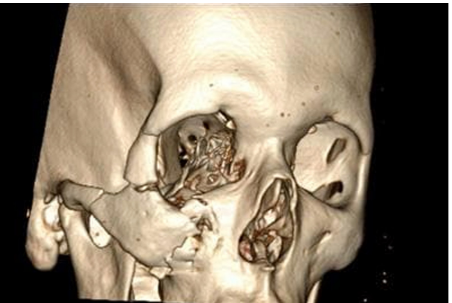
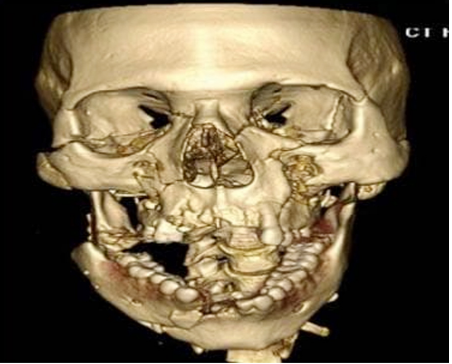
Maxillofacial injuries are commonly encountered in the practice of emergency medicine. Trauma to the maxillofacial region mandates special attention. Maxillofacial trauma is any physical trauma to the facial region, commonly encountered by maxillofacial surgeons, and is often associated with high morbidity. Maxillofacial injuries can occur as an isolated injury or may be associated with multiple injuries in other parts of the body. This review article elaborates on maxillofacial trauma.
References
- 1. Rosen P, Barkin R. Face. In: Rosen P, Barkin RM, editors. Emergency Medicine: Concepts and Clinical Practice. 5th ed. St. Louis (MO): Mosby-Year Book; 2002. p. 315–29.
- 2. Maxillofacial trauma. In: Tintinalli JE, Kelen GD, Stapczynski JS, editors. Emergency Medicine: A Comprehensive Study Guide. 6th ed. New York: McGraw-Hill; 2004. p. 1583–9.
- 3. Delpachitra SN, Rahmel BB. Orbital fractures in the emergency department: a review of early assessment and management. Emerg Med J. 2015;32(9):727–36.
- 4. Nalliah RP, Allareddy V, Kim MK, Venugopalan SR, Gajendrareddy P, Allareddy V. Economics of facial fracture reductions in the United States over 12 months. Dent Traumatol. 2013;29(2):115–20.
- 5. Cohn JE, Smith KC, Licata JJ, et al. Comparing urban maxillofacial trauma patterns to the National Trauma Data Bank©. Ann Otol Rhinol Laryngol. 2020;129(2):149–56.
- 6. Manson PN, Hoopes JE, Su CT. Structural pillars of the facial skeleton: an approach to the management of Le Fort fractures. Plast Reconstr Surg. 1980;66(1):54–62.
- 7. Brandt KE, Burruss GL, Hickerson WL, White CE, DeLozier JB 3rd. The management of mid-face fractures with intracranial injury. J Trauma. 1991;31(1):15–9.
- 8. Fowell C, McQuillan H, Martin T. A peculiar orbital floor ‘blow-out’ fracture – or should that be ‘blow-in’ fracture? Int J Oral Maxillofac Surg. 2015;44(Suppl 1):e210.
- 9. Ziccardi VB, Braidy H. Management of nasal fractures. Oral Maxillofac Surg Clin North Am. 2009;21(2):203–8.
- 10. Papadopoulos H, Salib NK. Management of naso-orbital-ethmoidal fractures. Oral Maxillofac Surg Clin North Am. 2009;21(2):221–5.
- 11. Ellis E 3rd, El-Attar A, Moos KF. An analysis of 2,067 cases of zygomatico-orbital fracture. J Oral Maxillofac Surg. 1985;43(6):417–28.
- 12. Ellis E 3rd, Moos KF, el-Attar A. Ten years of mandibular fractures: an analysis of 2,137 cases. Oral Surg Oral Med Oral Pathol. 1985;59(2):120–9.
- 13. Marão HF, Panzarini SR, Manrrique GR, et al. Importance of clinical examination in dentoalveolar trauma. J Craniofac Surg. 2012;23(2):e404.
- 14. Curtis W, Horswell BB. Panfacial fractures: an approach to management. Oral Maxillofac Surg Clin North Am. 2013;25(4):649–60.
- 15. Choi M, Li Y, Shapiro SA, Havlik RJ, Flores RL. A 10-year review of frontal sinus fractures: clinical outcomes of conservative management of posterior table fractures. Plast Reconstr Surg. 2012;130(2):399–406.
- 16. Yew CC, Shaari R, Rahman SA, Alam MK. White-eyed blowout fracture: diagnostic pitfalls and review of literature. Injury. 2015;46(9):1856–9.
- 17. Krishnan DG. Systematic assessment of the patient with facial trauma. Oral Maxillofac Surg Clin North Am. 2013;25(4):537–44.
- 18. Haug RH, Wible RT, Likavec MJ, Conforti PJ. Cervical spine fractures and maxillofacial trauma. J Oral Maxillofac Surg. 1991;49(7):725–9.
- 19. Lewandowski RJ, Rhodes CA, McCarroll K, Hefner L. Role of routine nonenhanced head computed tomography scan in excluding orbital, maxillary, or zygomatic fractures secondary to blunt head trauma. Emerg Radiol. 2004;10(4):173–5.
- 20. Bell RB. Management of frontal sinus fractures. Oral Maxillofac Surg Clin North Am. 2009;21(2):227–42.
- 21. Appling WD, Patrinely JR, Salzer TA. Transconjunctival approach vs subciliary skin-muscle flap approach for orbital fracture repair. Arch Otolaryngol Head Neck Surg. 1993;119(9):1000–7.
- 22. Kontio R, Lindqvist C. Management of orbital fractures. Oral Maxillofac Surg Clin North Am. 2009;21(2):209–20.
- 23. Ellis E 3rd, Kittidumkerng W. Analysis of treatment for isolated zygomaticomaxillary complex fractures. J Oral Maxillofac Surg. 1996;54(4):386–400.
- 24. Ellis E 3rd. Open reduction and internal fixation of combined angle and body/symphysis fractures of the mandible: how much fixation is enough? J Oral Maxillofac Surg. 2013;71(4):726–33.
- 25. Al-Moraissi EA, Ellis E 3rd. Surgical management of anterior mandibular fractures: a systematic review and meta-analysis. J Oral Maxillofac Surg. 2014;72(12):2507.e1–11.
Data Sharing Statement
There are no additional data available. All raw data and code are available upon request.
Funding
This research received no funding.
Author Contributions
Whether all authors contributed significantly to the work and approve its publication.
Ethics Declaration
This article does not involve any human or animal subjects, and therefore does not require ethics approval.
Acknowledgements
We would like to express our gratitude to the patients, their families, and all those who have contributed to this study.
Conflicts of Interest
The authors report no conflicts of interest in this work.
About this article

Cite this article
Chakiath JA, Chittoria RK. Approach to maxillofacial injuries. Indian J Anat. 2023;12(2):63–74.
Licence:
Attribution-Non-commercial 4.0 International (CC BY-NC 4.0)This license enables reusers to distribute, remix, adapt, and build upon the material in any medium or format for noncommercial purposes only, and only so long as attribution is given to the creator.
| Received | Accepted | Published |
|---|---|---|
| December 14, 2022 | January 14, 2023 | February 28, 2022 |
DOI: https://doi.org/10.21088/ija.2320.0022.12223.2
Keywords
TraumaInjuriesMaxillofacialFracturesSearch for Similar Articles
Similar Articles
- Supernumerary Pulmonary Vein: A Rare Anatomical Variation Observed During Cadave...
- Elongated Styloid Process: Anatomical Variations and Their Clinical Relevance: A...
- Bridging the Gap Between Dissection and Surgery: The Role of Soft Embalming in M...
- A Cadaveric Study of Retro Hepatic Segment of Inferior Vena Cava and Ostia Venae...
- Estimation of Stature from Forearm Length in Medical Undergraduate Students of a...
Article Level Metrics
Last UpdatedSunday 20 September 2026, 21:48:54 (IST)
5038
Accesses
19
601
00
Citations
NA
NA
NA
Download citation
Article Keywords
Keyword Highlighting
Highlight selected keywords in the article text.
Timeline
| Received | December 14, 2022 |
| Accepted | January 14, 2023 |
| Published | February 28, 2022 |
licence
Attribution-Non-commercial 4.0 International (CC BY-NC 4.0)
This license enables reusers to distribute, remix, adapt, and build upon the material in any medium or format for noncommercial purposes only, and only so long as attribution is given to the creator.