Full Text (PDF)
Pediatric Education and Research 10(3):p 90-104, September-December 2022. | DOI: https://doi.org/10.21088/per.2321.1644.10322.5
Review Article
Application of Plaster of Paris, Splints and Casts in Plastic Surgery
Ravi Kumar Chittoria, Jacob Antony Chakiath
Author Information
Licence:
Attribution-Non-commercial 4.0 International (CC BY-NC 4.0)This license enables reusers to distribute, remix, adapt, and build upon the material in any medium or format for noncommercial purposes only, and only so long as attribution is given to the creator.
Pediatric Education and Research 10(3):p 90-104, September-December 2022. | DOI: https://doi.org/10.21088/per.2321.1644.10322.5
How Cite This Article:
Jacob Antony Chakiath, Ravi Kumar Chittoria/Application of Plaster of Paris, Splints and Casts in Plastic Surgery/Pediatr Edu Res. 2022;10(3):97-104.Timeline
Received : July 30, 2022
Accepted : September 04, 2022
Published : December 25, 2022
Abstract
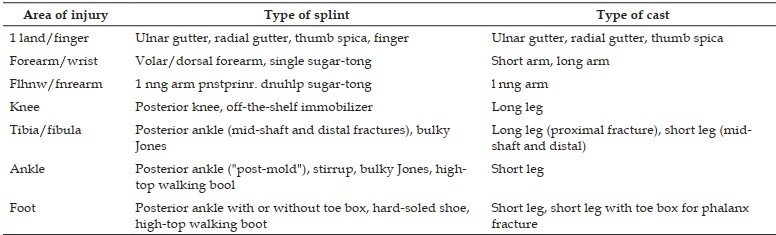
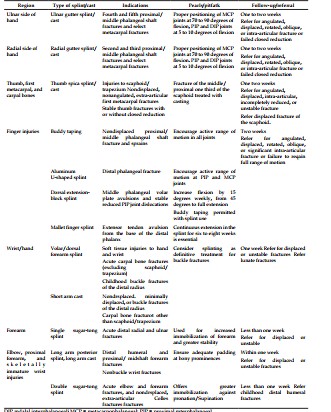
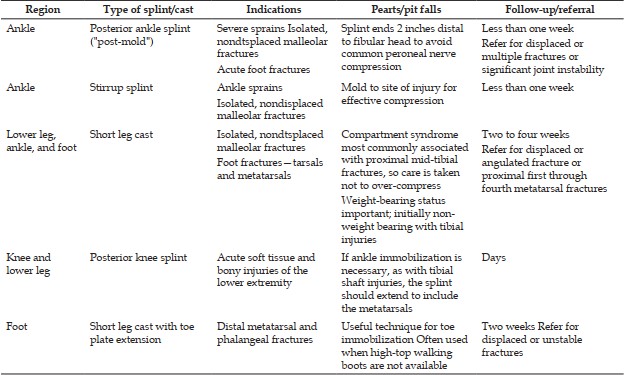
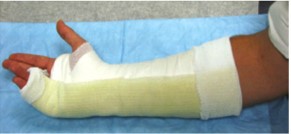
Plaster of Paris has traditionally been the preferred material for splints and Casts. The ability to properly apply casts and splints is a technical skill easily mastered with practice and an understanding of basic principles. Once the need for immobilization has been determined, the physician must decide whether to apply a splint or a cast. Splinting involves subsequent application of a non-circumferential support held in place by an elastic bandage. Casting involves circumferential application of plaster or fiberglass. This review article gives an overview of application of Plaster of Paris, Splints, Casts in Plastic Surgery.
References
- 1. Chudnofsky CR, Byers S. Splinting techniques. In: Roberts, Hedges JR, Chanmugam AS, eds. Clinical Procedures in Emergency Medicine. 4th ed. Philadelphia, Pa.: Saunders; 2004:989.
- 2. Eiff MP, Hatch R, Calmbach WL, eds. Fracture Management for Primary Care. 2nd ed. Philadelphia, Pa.: Saunders; 2003:1-70.
- 3. Parmelee-Peters K, Eathorne S. The wrist: common injuries and management. Prim Care. 2005;32(1):35-70.
- 4. Hong E. Hand injuries in sports medicine. Prim Care. 2005;32(1):91-103.
- 5. General principles. In: Simon RR, Sherman SC, Koenigsknecht SJ, eds. Emergency Orthopedics: The Extremities. 5th ed. New York, NY: McGraw-Hill; 2007:1-29.
- 6. Boyd AS, Benjamin HJ, Asplund C. Principles of casting and splinting. Am Fam Physician. 2009;79(1):16-22.
- 7. Benjamin HJ, Mjannes JM, Hang BT. Getting a grasp on hand injuries in young athletes. Contemp Pediatr. 2008;25(3):49-63.
- 8. Lee SG, Jupiter JB. Phalangeal and metacarpal fractures of the hand. Hand Clin. 2000;16(3):323- 332.
- 9. Slade JF, Magit DP, Geissler WB. Scaphoid fractures in athletes. Atlas Hand Clin. 2006;11(1):27-44.
- 10. Overly F, Steele DW. Common pediatric fractures and dislocations. Clin Pediatr Emerg Med. 2002;3(2):106.
- 11. Bong MR, Egol KA, Leibman M, Koval KJ. A comparison of immediate postreduction splinting constructs for controlling initial displacement of fractures of the distal radius: a prospective randomized study of long-arm versus short-arm splinting. J Hand Surg [Am]. 2006;31(5):766-770.
- 12. Sollerman C, Abrahamsson SO, Lundborg G, Adalbert K. Functional splinting versus plaster cast for ruptures of the ulnar collateral ligament of the thumb. A prospective randomized study of 63 cases. Acta Orthop Scand. 1991;62(6):524- 526.
- 13. Plint AC, Perry JJ, Correll R, Gaboury I, Lawton L. A randomized, controlled trial of removable splinting versus casting for wrist buckle fractures in children. Pediatrics. 2006;117(3):691-697.
- 14. Benjamin HJ, Hang BT. Common acute upper extremity injuries in sports. Clin Pediatr Emerg Med. 2007;8(1):15-30.
- 15. Haller PR, Harris CR. The tibia and fibula. In: Ruiz E, Cicero JJ, eds. Emergency Management of Skeletal Injuries. St Louis, Mo.: Mosby-Year Book; 1995:499-517.
- 16. Roberts DM, Stallard TC. Emergency department evaluation and treatment of knee and leg injuries. Emerg Med Clin North Am. 2000;18(1):67-84.
- 17. Kerkhoffs GM, Struijs PA, Marti RK, Assendelft WJ, Blankevoort L, van Dijk CN. Different functional treatment strategies for acute lateral ankle ligament injuries in adults. Cochrane Database Syst Rev. 2002;(3): CD002938.
- 18. Court-Brown CM. Fractures of the tibia and fibula. In: Rockwood CA, Green DP, Buchholz RW, eds. Rockwood and Green’s Fractures in Adults. 6th ed. Philadelphia, Pa.: Lippincott Williams and Wilkins; 2006:2079-2146.
- 19. LaBella CR. Common acute sports-related lower extremity injuries in children and adolescents. Clin Pediatr Emerg Med. 2007;8(1):31-42.
Data Sharing Statement
There are no additional data available. All raw data and code are available upon request.
Funding
This research received no funding.
Author Contributions
All authors contributed significantly to the work and approve its publication.
Ethics Declaration
This article does not involve any human or animal subjects, and therefore does not require ethics approval.
Acknowledgements
We would like to express our gratitude to the patients, their families, and all those who have contributed to this study.
Conflicts of Interest
No conflicts of interest in this work.
About this article

Cite this article
Jacob Antony Chakiath, Ravi Kumar Chittoria/Application of Plaster of Paris, Splints and Casts in Plastic Surgery/Pediatr Edu Res. 2022;10(3):97-104.
Licence:
Attribution-Non-commercial 4.0 International (CC BY-NC 4.0)This license enables reusers to distribute, remix, adapt, and build upon the material in any medium or format for noncommercial purposes only, and only so long as attribution is given to the creator.
| Received | Accepted | Published |
|---|---|---|
| July 30, 2022 | September 04, 2022 | December 25, 2022 |
DOI: https://doi.org/10.21088/per.2321.1644.10322.5
Keywords
Plaster of ParisSplintsCastsSearch for Similar Articles
Similar Articles
Article Level Metrics
Last UpdatedTuesday 08 September 2026, 03:55:59 (IST)
1930
Accesses
3
235
00
Citations
NA
NA
NA
Download citation
Article Keywords
Keyword Highlighting
Highlight selected keywords in the article text.
Timeline
| Received | July 30, 2022 |
| Accepted | September 04, 2022 |
| Published | December 25, 2022 |
licence
Attribution-Non-commercial 4.0 International (CC BY-NC 4.0)
This license enables reusers to distribute, remix, adapt, and build upon the material in any medium or format for noncommercial purposes only, and only so long as attribution is given to the creator.