Full Text (PDF)
Indian Journal of Anatomy 7(1):p 78-87, Jan-Feb 2018. | DOI: http://dx.doi.org/10.21088/ija.2320.0022.7118.15
Original Article
Anthropometric Measurements of Hypertensive Patients with Special Emphasis on Facial Features
Rutuja Bhongle, II MBBS Student, Mahatma Gandhi Institute of Medical Sciences, Sevagram Wardha, Maharashtra 442102, India. , Pradeep Bokariya1 , Rutuja Bhongle2 , Ruchi Kothari3 , Jyoti Jain4 , Mrinmayee Debbarma5 , M.R. Shende6
Author Information
Licence:
Indian Journal of Anatomy 7(1):p 78-87, Jan-Feb 2018. | DOI: http://dx.doi.org/10.21088/ija.2320.0022.7118.15
How Cite This Article:
Timeline
Received : N/A
Accepted : N/A
Published : N/A
Abstract
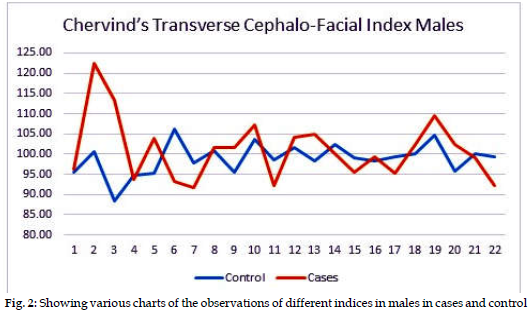
Context: Anthropometric measurements are being used profusely for various medicalresearches. Studies on craniofacial anthropometry have allowed for identification andquantification of syndromic clinical features, planning for treatment, monitoring ofoperative outcomes and sometimes assessment of longitudinal change.Considering that Anthropometry can be important tool in early suggestion of diseases, anattempt was made to study facial Anthropometry in healthy individuals andhypertensive subjects. Aim: The aim of the study was to compare the Anthropometric Measurements in hypertensivepatients and healthy control subjects. Settings and Design: The study was conducted in the Anthropometry section of Department of Anatomy, Mahatma Gandhi Institute of Medical Sciences (MGIMS) incollaboration with Department of Medicine. It was a cross-sectional, Observational study design incorporating a total of 100subjects. Methods and Material: Out of hundred registered for study, fifty were healthy controls and fifty patients in theage range of 34-50 years diagnosed to have hypertension from Sevagram village (a rural area in Vidharbha region of Maharshtra). The instruments used for study are Stadiometer, Digital weighing balance, Spreading Caliper, Vernier caliper and measuring tape and sphygmomanometer for measuring Blood Pressure. Various measurements were made pertaining to facial anthropometry andon the basis of the findings as per literature available, the indices calculated are Physiognomic Facial Index, Morphological Facial Index, Mandible Width- Face Height Index, Sagittal Naso-FacialIndex, Mandible-Face Width Index, Chervinïs Transverse Cephalo- Facial Index. Results: The indices thus obtained are compared for males and female’s separately. Most of the indices are non- significant except Mandible-Face Width Index in femalesand Physiognomic Facial Index and Morphological Facial Index in males. Conclusion: Facial Anthropometry was done on healthy and hypertensivesubjects. Though the data analysis have not concluded any change in facialanthropometry in hypertensive subjects with affirmation but the data obtained forcontrol subjects in Central Indian Population can further be utilised byAnthropometrics, , Anatomists, Forensic Experts and Plastic surgeons too.
References
No records found.
About this article

Cite this article
Licence:
| Received | Accepted | Published |
|---|---|---|
| N/A | N/A | N/A |
DOI: http://dx.doi.org/10.21088/ija.2320.0022.7118.15
Keywords
Anthropometry; Facial Anthropometry; Hypertensive Patients.ÂSearch for Similar Articles
Similar Articles
- Supernumerary Pulmonary Vein: A Rare Anatomical Variation Observed During Cadave...
- Elongated Styloid Process: Anatomical Variations and Their Clinical Relevance: A...
- Bridging the Gap Between Dissection and Surgery: The Role of Soft Embalming in M...
- A Cadaveric Study of Retro Hepatic Segment of Inferior Vena Cava and Ostia Venae...
- Estimation of Stature from Forearm Length in Medical Undergraduate Students of a...
Article Level Metrics
Last UpdatedTuesday 22 September 2026, 00:52:47 (IST)
5057
Accesses
12
655
00
Citations
NA
NA
NA
Download citation
Article Keywords
Keyword Highlighting
Highlight selected keywords in the article text.
Timeline
| Received | N/A |
| Accepted | N/A |
| Published | N/A |