Full Text (PDF)
Indian Journal of Ancient Medicine and Yoga 18(4):p 191-197, Oct-Dec 2025. | DOI: https://doi.org/10.21088/ijamy.2455.8621.18425.5
Review Article
Analysis of Shonitasthapana Mahakashaya in Management of Asrigdara (Abnormal Uterine Bleeding): A Critical Review
Kashavva V. Hiremath, Aishwarya P. Magdum, Pankaj Sharma
Author Information
Licence:
Attribution-Non-commercial 4.0 International (CC BY-NC 4.0)This license enables reusers to distribute, remix, adapt, and build upon the material in any medium or format for noncommercial purposes only, and only so long as attribution is given to the creator.
Indian Journal of Ancient Medicine and Yoga 18(4):p 191-197, Oct-Dec 2025. | DOI: https://doi.org/10.21088/ijamy.2455.8621.18425.5
How Cite This Article:
Magdum AP, Hiremath KV, Sharma P. Analysis of Shonitasthapana Mahakashaya in management of Asrigdara (Abnormal Uterine Bleeding): A Critical Review. Ind J Anct Med Yoga. 2025;18(4):191-197.Timeline
Received : August 22, 2025
Accepted : October 22, 2025
Published : December 24, 2025
Abstract
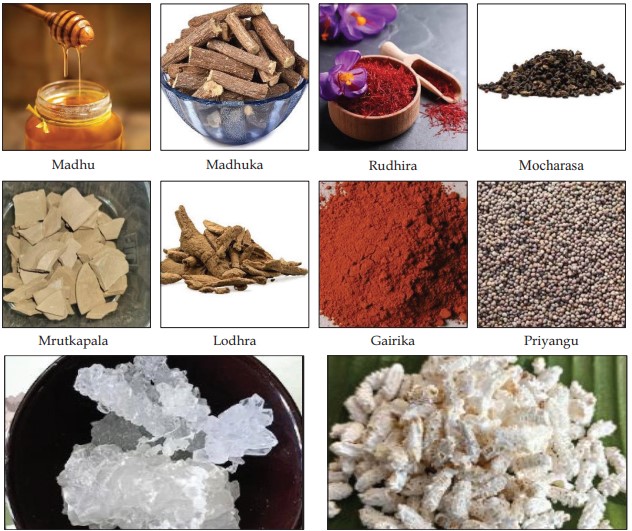
Background: Abnormal uterine bleeding (AUB) is one of the most frequent gynaecological complaints, accounting for nearly 30% of outpatient consultations. In Ayurveda, this condition is conceptualised as Asrigdara, primarily attributed to pitta and rakta vitiation, with vata facilitating excessive expulsion. Charaka has recommended Shonitasthapana Mahakashaya, a group of ten agents, for managing bleeding disorders. Methodology: This review critically evaluated Shonitasthapana Mahakashaya through classical Ayurvedic texts and modern biomedical literature. Each drug was assessed for Ayurvedic pharmacodynamics (rasa, guna, veerya, vipaka) and correlated with reported pharmacological actions relevant to haemostasis, antiinflammatory activity, and uterine regulation. Review Results: The ten agents, Madhu, Madhuka, Rudhira, Mocharasa, Mrutkapala, Lodhra, Gairika, Priyangu, Sharkara, and Laja, demonstrated significant stambhana (haemostatic) and pitta-shamaka activity. Contemporary research substantiates their bioactive effects: tannin-rich herbs (Lodhra, Mocharasa, Priyangu) showed antihaemorrhagic and vascular-stabilising properties; saffron (Rudhira) and liquorice (Madhuka) exerted antioxidant, phytoestrogenic, and uterine-modulatory effects; mineral Gairika demonstrated styptic and hematinic activity. Collectively, these align with the Ayurvedic rationale of pacifying pitta-rakta imbalance and restoring haemostatic balance. Evidence supports the integration of Shonitasthapana Mahakashaya as adjuvant therapy in AUB management. While pharmacological studies affirm their mechanistic potential, robust clinical trials remain scarce. Conclusion: Shonitasthapana Mahakashaya demonstrate promising therapeutic relevance for Asrigdara. Rigorous clinical validation could position them as integrative strategies in gynaecological care.
References
- 1. Charaka Vaidya Jadavji Trikamji Acharya. Charaka Samhita by Agnivesa. Varanasi: Chowkhamba Krishnadas Academy; 2006. p. 642-643.
- 2. Vaidya Jadavji Trikamji Acharya. Charaka Samhita by Agnivesa. Varanasi: Chowkhamba Krishnadas Academy; 2006. p. 34.
- 3. Charaka Vaidya Jadavji Trikamji Acharya. Charaka Samhita by Agnivesa. Varanasi: Chowkhamba Krishnadas Academy; 2006. p. 167.
- 4. E-Nighantu, Bhavaprakasha Nighantu. Available from: https:// niimh.nic.in/ebooks/ e-Nighantu/bhavaprakashanighantu/?m od=read. [Last Accessed on 20 August 2025].
- 5. Vaidya Jadavji Trikamji Acharya. Charaka Samhita by Agnivesa. Varanasi: Chowkhamba Krishnadas Academy; 2006. p. 569.
- 6. Vaidya Jadavji Trikamji Acharya. Susruta Samhita by Sushruta. Bombay: Nirnaya Sagar; 1915. p. 56.
- 7. Kashinathsasthri Rasatarangini, Motilala Banarasidas 1stedn. 2012 chapter 22, sloka 111 p.565.
- 8. Vaidya Jadavji Trikamji Acharya. Charaka Samhita by Agnivesa. Varanasi: Chowkhamba Krishnadas Academy; 2006. p. 166.
- 9. Ahmed A,Khan RA, Saeed SA,Ahmed S, Imran I. ‘Effect of natural honey on human platelets and blood coagulation proteins.’ Pak J Pharm Sci.2011Jul;24[3]:389-97.
- 10. Samarghandian S, Farkhondeh T, Samini F. Honey and health: A review of recent clinical research. Pharmacognosy Res. 2017;9(2): 121-127.
- 11. Mauricio I, Francischett B, Monterio RQ, Guimaraeas JA. “Identification of Glycyrrhizin as thrombin inhibitor”, BiochimBiophys Res Commun 1997; 235:259-263.
- 12. Mendes-Silva W, Assafim M, Ruta B,Monteiro RQ, Guimaraes JA, Zingali RB et al. “Antithrombotic effect of Glycyrrhizin, a plant-derived thrombin-inhibitor” Thromb Res 2003; 112:93-98.
- 13. Hübschle T, et al. Glycyrrhizin in liquorice root– pharmacology, clinical uses, and molecular mechanisms. Phytother Res. 2020;34(9): 2203-2214.
- 14. Verma SK, Bordia A. Antioxidant property of saffron in man. Indian J Med Sci. 1998; 52: 205–7.
- 15. Bhandari PR. Saffron (Crocus sativus L.) for women’s health: A narrative review. Iran J Basic Med Sci. 2015;18(9):870–877.
- 16. Yadava RN, Reddy VM. Anti-inflammatory and astringent principles from Salmalia malabarica. Indian J Chem. 2001;40B: 1107–1111.
- 17. Singh S, et al. Geophagy and traditional clay use: An evaluation of biochemical and therapeutic aspects. Afr Health Sci. 2012;12(1):20-28.
- 18. K Prameela Devi. Clinical evaluation of Pushyanuga choorna and Lodhrasava in Rakta Pradara (DUB). Indian Journal of Traditional Knowledge. 2007; 6(3): 429-431.
- 19. Singh N, Kamal R. A phytopharmacological review of Symplocos racemosa Roxb. (Lodhra). Int J Pharm Sci Res. 2015;6(2):503–510.
- 20. Tabassum Kotagasti. ‘Efficacy of Geru [Red ochre]in controling the bleeding in patients of Adolscent menorrhagia.’ Korean Journal Publishing Service, TANG. 2015. May, 5[2]:12-14.
- 21. World Health Organization. Iron deficiency anaemia: assessment, prevention and control. Geneva: WHO; 2001.
- 22. Singh R, et al. Pharmacognostic and phytochemical studies of Callicarpa macrophylla. Anc Sci Life. 2013;33(1):47-52.
- 23. Egro FM. Sugar in wound healing: A review. J Wound Care. 2013;22(9):442-446.
- 24. Sharma PV. Dravyaguna Vijnana plant-based nutrition and Ayurvedic dietetics relevance today. AYU. 2011;32(4):451–457.
Data Sharing Statement
There are no additional data available.
Funding
This research received no funding.
Author Contributions
All authors contributed significantly to the work and approve its publication.
Ethics Declaration
This article does not involve any human or animal subjects, and therefore does not require ethics approval.
Acknowledgements
Information not provide.
Conflicts of Interest
The authors report no conflicts of interest in this work.
About this article

Cite this article
Magdum AP, Hiremath KV, Sharma P. Analysis of Shonitasthapana Mahakashaya in management of Asrigdara (Abnormal Uterine Bleeding): A Critical Review. Ind J Anct Med Yoga. 2025;18(4):191-197.
Licence:
Attribution-Non-commercial 4.0 International (CC BY-NC 4.0)This license enables reusers to distribute, remix, adapt, and build upon the material in any medium or format for noncommercial purposes only, and only so long as attribution is given to the creator.
| Received | Accepted | Published |
|---|---|---|
| August 22, 2025 | October 22, 2025 | December 24, 2025 |
DOI: https://doi.org/10.21088/ijamy.2455.8621.18425.5
Keywords
Abnormal Uterine BleedingAsrigdaraAyurvedaHaemostasisShonitasthapana MahakashayaSearch for Similar Articles
Similar Articles
- Efficacy of Katupila Ghrita in the Management of Itartha dagdha Vrana (Burn Woun...
- Clinical Outcomes of Ayurvedic Management in Acute Influenza Like Illness: A Cas...
- Effect of Ayurvedic Drugs on Scalp Psoriasis (Kitibha Kustha)
- Yogic Elements in the Brahma Mahapurana: A Textual and Comparative Study
- Management of Adenoid Hypertrophy: An Ayurvedic Perspective
Article Level Metrics
Last UpdatedTuesday 15 September 2026, 13:13:12 (IST)
4098
Accesses
35
833
00
Citations
NA
NA
NA
Download citation
Article Keywords
Keyword Highlighting
Highlight selected keywords in the article text.
Timeline
| Received | August 22, 2025 |
| Accepted | October 22, 2025 |
| Published | December 24, 2025 |
licence
Attribution-Non-commercial 4.0 International (CC BY-NC 4.0)
This license enables reusers to distribute, remix, adapt, and build upon the material in any medium or format for noncommercial purposes only, and only so long as attribution is given to the creator.