Full Text (PDF)
Physiotherapy and Occupational Therapy Journal 18(2):p 163-171, April- June 2025. | DOI: 10.21088/potj.0974.5777.18225.9
Original Article
Active and Passive Physiotherapy in Neurorehabilitation: Narrative Review
D. Senthil Kumar, S. Benedic Kingslin Suresh, A. J. Rajendran
Author Information
Licence:
Attribution-Non-commercial 4.0 International (CC BY-NC 4.0)This license enables reusers to distribute, remix, adapt, and build upon the material in any medium or format for noncommercial purposes only, and only so long as attribution is given to the creator.
Physiotherapy and Occupational Therapy Journal 18(2):p 163-171, April- June 2025. | DOI: 10.21088/potj.0974.5777.18225.9
How Cite This Article:
Suresh SBK, Rajendran AJ, Kumar DS. Active and Passive Physiotherapy in Neurorehabilitation: Narrative Review. Physiother Occup Ther J. 2025;18(2):163–71.Timeline
Received : February 22, 2025
Accepted : May 26, 2025
Published : June 16, 2025
Abstract
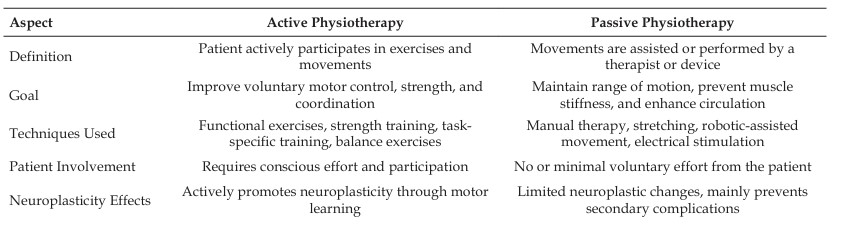
Background: Neurorehabilitation plays a pivotal role in improving functional outcomes for individuals with neurological impairments. Physiotherapy, encompassing both active and passive approaches, is a cornerstone of neurorehabilitation. Understanding the efficacy and applications of these modalities is crucial for optimizing patient recovery. Aim: This narrativere view aims to explore the efficacy and clinical applications of active and passive physiotherapy techniques in the rehabilitation of patients with neurological conditions such as stroke, traumatic brain injury, and spinal cord injury. Objective: To analyze and synthesize currentl iterature on the out comes, benefits, and limitations of active and passive physiotherapy techniques, discussing their integration into clinical practice for enhanced rehabilitation outcomes. Methods and Materials: A comprehensive review of published literature was conducted, focusing on studies evaluating active and passive physiotherapy interventions in neurorehabilitation. Relevant articles were sourced from databases such as PubMed, Scopus, and Google Scholar. The review included randomized controlled trials, cohort studies, and systematic reviews that examined the effects of these physiotherapy approaches on functional recovery, neuroplasticity, spasticity management, and patient independence. Results: Active physiotherapy, characterized by patient-driven movements, was found to promote strength, motor control, and functional independence by enhancing neuroplasticity. Passive physiotherapy, which involves external assistance,was beneficial inpreventing joint contractures, reducing spasticity, and maintaining range of motion. Evidence suggests that a combination of both approaches leads to better rehabilitation outcomes, accelerating recovery and improving overall quality of life. Conclusion: Both active and passive physiotherapy techniques hold distinct yet complementary roles in neurorehabilitation. Active physiotherapy fosters neuroplasticity and functional recovery, while passive interventions provide essential support for maintaining mobility and reducing secondary complications. A tailored, patient-specific approach integrating both modalities enhances rehabilitation efficacy. Future research should focus on exploring the long-term effects of combined therapies on neuroplasticity and patient quality of life.
References
- 1. Ada, L., Dorsch, S., & Canning, C.G. (2006). Strengthening interventions increase strength and improve activity in persons with poststroke hemiplegia: A systematic review. Clinical Rehabilitation, 20(2), 89-100. https:// doi.org/10.1191/0269215506cr945oa
- 2. Bohannon, R.W., Smith, M.B., & O’Neill, E. A. (2002). Chronic neurological disorders and physiotherapy: Strategies for management. Journal of Rehabilitation Research and Development, 39(6), 513-520. https://doi. org/10.1682/JRRD.2002.09.0513
- 3. Borges, M.L., Lima, L.D.C., Figueiredo, L.A., & Souza, R.M. (2016). Effects of functional electrical stimulation on muscle strength and function in individuals with spinal cord injury. Spinal Cord, 54(12), 937-942. https://doi. org/10.1038/sc.2016.79
- 4. Cacau, L.P., Oliveira, M.L., & Silva, D.B. (2018). Combined rehabilitation strategies in stroke: Integration of active and passive physiotherapy for improved outcomes. Neurorehabilitation and Neural Repair, 32(5), 404-412. https://doi. org/10.1177/1545968318761321
- 5. Daly, J.J., & Ruff, R.L. (2005). Electrical stimulation and its role in neurorehabilitation. Journal of Clinical Neuroscience, 12(6), 715-718. https://doi.org/10.1016/j.jocn.2004.11.023
- 6. de Leon, R.D., & Hodgson, T. (2016). Active and passive movement therapies in neurorehabilitation: A dual approach in spinal cord injury rehabilitation. Journal of Rehabilitation Research and Development, 53(5), 715-723. https://doi.org/10.1682/ JRRD.2015.06.0092
- 7. Dromerick, A.W., Lang, C.E., &Birkenmeier, R. L. (2009). Approaches to neuroplasticity in the treatment ofmotor deficits in stroke rehabilitation. Journal of Rehabilitation Research and Development, 46(3), 467-480. https://doi. org/10.1682/JRRD.2008.12.0180
- 8. Hodges, P.W., & Richardson, C.A. (2013). Preventing complications and secondary impairments in neurorehabilitation: An analysis of passive physiotherapy approaches. Physical Therapy, 93(7), 935-943. https://doi. org/10.2522/ptj.20120206
- 9. Kwakkel, G., Kollen, B.J., & Van der Grond, J. (2004). Probability of regaining dexterity in the accidupper limbafter acute stroke. Stroke, 35(3), 1076-1080. https://doi.org/10.1161/01. STR.0000111547.30226.61
- 10. Nash, M.S., Field-Fote, E.C., & Briceno, J.F. (2015). Spinal cord injury rehabilitation and the role of electrical stimulation: Advances in functional recovery. Spinal Cord, 53(1), 24-34. https://doi.org/10.1038/sc.2014.126
- 11. Perroni, F., Solla, F., &Siddi, M. (2012). The role of passive range of motion in preventing joint deformities in brain injury rehabilitation. Brain Injury, 26(9), 1133-1139. https://doi.org/10.31 09/02699052.2012.693598
- 12. Pomeroy, V. M., Grimshaw, J.M., &Berenbaum, A.M. (2006). Passive therapies in the management of spasticity: Review of manual therapies in post-stroke rehabilitation. Stroke, 37(5), 1127-1133. https://doi.org/10.1161/01. STR.0000214636.55452.43
- 13. van der Lee, J.H., Wagenaar, R.C., &Lankhorst, G. J. (2001). Effects of a task-oriented training program on the physical functioning of patients with chronic hemiparetic stroke. Stroke, 32(6), 1216-1221. https://doi.org/10.1161/01. STR.32.6.1216
Data Sharing Statement
There are no additional data available. All raw data and code are available upon request.
Funding
This research received no external funding.
Author Contributions
All authors contributed significantly to the work and approve its publication.
Ethics Declaration
This article does not involve any human or animal subjects, and therefore does not require ethics approval.
Acknowledgements
We would like to express our gratitude to the patients, their families, and all those who have contributed to this study.
Conflicts of Interest
The authors declare no confiict of interest.
About this article

Cite this article
Suresh SBK, Rajendran AJ, Kumar DS. Active and Passive Physiotherapy in Neurorehabilitation: Narrative Review. Physiother Occup Ther J. 2025;18(2):163–71.
Licence:
Attribution-Non-commercial 4.0 International (CC BY-NC 4.0)This license enables reusers to distribute, remix, adapt, and build upon the material in any medium or format for noncommercial purposes only, and only so long as attribution is given to the creator.
| Received | Accepted | Published |
|---|---|---|
| February 22, 2025 | May 26, 2025 | June 16, 2025 |
DOI: 10.21088/potj.0974.5777.18225.9
Keywords
Active Physiotherapy • Passive Physiotherapy • Neuro rehabilitationActive PhysiotherapyPassive PhysiotherapyNeuro rehabilitationSearch for Similar Articles
Similar Articles
- Cross-Cultural Adaptation, Reliability, and Validity of the Gujarati Version of...
- Physiotherapy Management of Multiple Sclerosis: An Overview of Recent Technologi...
- Converging Technologies in Cardiopulmonary Physiotherapy: A Review of VR, AR, AI...
- Cross-Cultural Adaptation, Reliability, and Validity of the Gujarati Version of...
- Effects of Kinesiotaping in Lateral Epicondylitis: A Narrative Review
Article Level Metrics
Last UpdatedWednesday 29 July 2026, 21:01:57 (IST)
1979
Accesses
17
429
00
Citations
NA
NA
NA
Download citation
Article Keywords
Keyword Highlighting
Highlight selected keywords in the article text.
Timeline
| Received | February 22, 2025 |
| Accepted | May 26, 2025 |
| Published | June 16, 2025 |
licence
Attribution-Non-commercial 4.0 International (CC BY-NC 4.0)
This license enables reusers to distribute, remix, adapt, and build upon the material in any medium or format for noncommercial purposes only, and only so long as attribution is given to the creator.