Full Text (PDF)
Indian Journal of Preventive Medicine 10(2):p 43-49, July - December 2022. | DOI: https://doi.org/10.21088/ijpm.2321.5917.10222.1
Original Article
A Study on the Characteristics of Animal Bites Reported at Immunisation Clinic of a Tertiary Care Centre in Thrissur District, Kerala
Jacob George Binoy, Jose Vincent, Greeshma George
Author Information
Licence:
Attribution-Non-commercial 4.0 International (CC BY-NC 4.0)This license enables reusers to distribute, remix, adapt, and build upon the material in any medium or format for noncommercial purposes only, and only so long as attribution is given to the creator.
Indian Journal of Preventive Medicine 10(2):p 43-49, July - December 2022. | DOI: https://doi.org/10.21088/ijpm.2321.5917.10222.1
How Cite This Article:
Jacob George Binoy, Jose Vincent, Greeshma George/ A Study on the Characteristics of Animal Bites Reported at Immunisation Clinic of a Tertiary Care Centre in Thrissur District, Kerala/Indian J Prev Med. 2022;10(2):43-49.Timeline
Received : October 01, 2022
Accepted : November 03, 2022
Published : December 30, 2022
Abstract
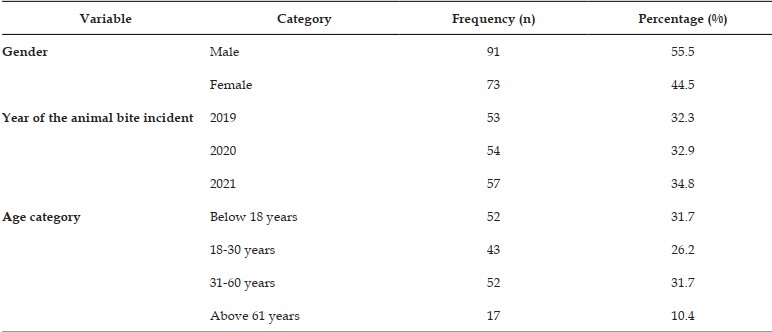
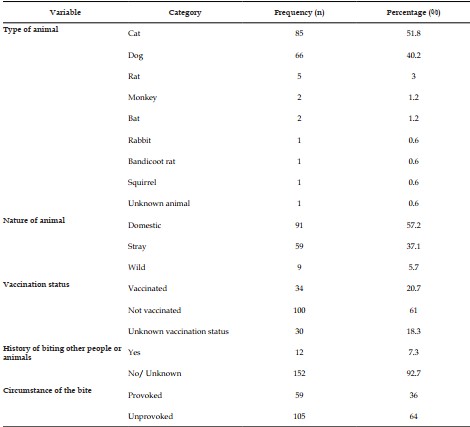
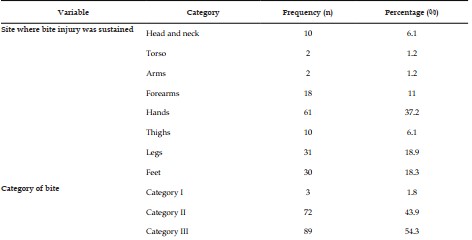
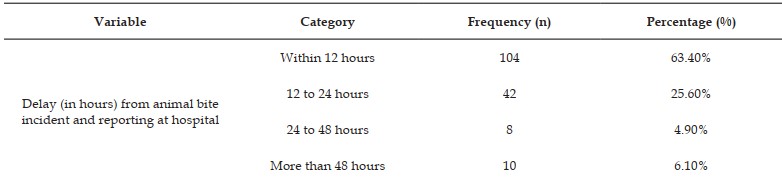
Background: Severe Context: Animal bites to humans are a public health problem, posing a potential threat of rabies. Rabies, once symptomatic, is almost universally fatal. Yet, deaths are preventable with timely provision of post-exposure prophylaxis. Aims: To describe the characteristics of animal bites and to identify the delay between exposure and arrival at hospital among reported casesin three years. Settings and Design: Record based study at a tertiary care centre in Thrissur, Kerala during 2019-2021. Methods and Material: Details of the patients with history of animal bite were accessed from the records maintained at Immunisation Clinic. Results: Among 164 victims, majority were males (55.5%). Cats (51.8%) were the most frequently involved animal followed by dogs (40.2%). 79.3% of animals were unvaccinated/with unknown vaccination status. Hands (37.2%) were the most common area involved in whole population and in children. More than half of the bites were category III (54.3%). 89% of victims reached hospital within 24 hours of exposure. Discussion: There was no significant increase in number of cases in the three study years. The major involved animal was cat in this study, in contrast to various other studies. Increase in incidence of injuries in head and neck region and category III wounds in children was observed, which point towards severity of bite injuries in children. Although majority of victims reported to hospital without much delay, 11% of people failed to report on the first day, which demand the need of more public consciousness on animal bite and rabies.
References
- 1. World Health Organization. Weekly epidemiological record. Rabies Vaccines: WHO position paper No. 16. Wkly Epidemiol Rec 2018;93:201-20.
- 2. Tarantola A. Four thousand years of concepts relating to rabies in animals and humans, its prevention and its cure. Trop Med Infect Dis 2017;2:e5.
- 3. Knobel DL, Cleaveland S, Coleman PG, Fèvre EM, Meltzer MI, Miranda ME, et al. Re-evaluating the burden of rabies in Africa and Asia. Bull World Health Organ 2005;83:360-8.
- 4. Sudarshan MK, Madhusudana SN, Mahendra BJ, Rao NS, Ashwath Narayana DH, Abdul Rahman S, et al. Assessing the burden of human rabies in India: Results of a national multi-center epidemiological survey. Int J Infect Dis 2007;11:29-35.
- 5. Rothe K, Tsokos M, Handrick W. Animal and human bite wounds. Dtsch Arztebl Int. 2015;112(25):433–442.
- 6. World Health Organization. WHO guide for rabies pre and post exposure prophylaxis in humans. 2010.
- 7. Morgan M, Palmer J. Dog bites. BMJ. 2007;334(7590):413-417.
- 8. Fleisher GR. The management of bite wounds. N Engl J Med. 1999;340(2):138-140.
- 9. Stevens DL, Bisno AL, Chambers HF, et al; Infectious Diseases Society of America; Practice guidelines for the diagnosis and management of skin and soft-tissue infections [published corrections appear in Clin Infect Dis. 2006;42(8):1219, and Clin Infect Dis. 2005;41(12):1830]. Clin Infect Dis. 2005;41(10):1373-1406.
- 10. Centers for Disease Control and Prevention. Rabies. http://www.cdc.gov/rabies/medical_care/index.html. Accessed June 19, 2013.
- 11. Oehler RL, Velez AP, Mizrachi M, Lamarche J, Gompf S. Bite-related and septic syndromes caused by cats and dogs [published correction appears in Lancet Infect Dis. 2009;9(9):536]. Lancet Infect Dis. 2009;9(7):439-447.
- 12. World Health Organization. WHO expert consultation on rabies, third report. World Health Organ Tech Rep Ser. 2018;1012:195.
- 13. OIE. Chapter 2.1.17, Rabies (Infection with Rabies virus and other Lyssaviruses) OIE Manual of Diagnostic Tests and Vaccines for Terrestrial Animals.
- 14. Hampson K, Coudeville L, Lembo T, Sambo M, Kieffer A, Attlan M, et al. Estimating the global burden of endemic canine rabies. PLOS Negl Trop Dis. 2015;9 4):e000370910.1371/journal. pntd.0003709.
- 15. Rupprecht CE, Briggs D, Brown CM, et al; Centers for Disease Control and Prevention; Use of a reduced (4-dose) vaccine schedule for postexposure prophylaxis to prevent human rabies: recommendations of the Advisory Committee on Immunization Practices [published correction appears in MMWR Recomm Rep. 2010;59(16):493]. MMWR Recomm Rep. 2010;59(RR-2):1-9.
- 16. World Health Organization., WHO Expert Consultation on Rabies. Second Report. World Health Organization technical report series. 2013;(982):1–139. Epub 2013/09/28.
- 17. Ngugi JN, Maza AK, Omolo OJ, Obonyo M. Epidemiology and surveillance of human animal-bite injuries and rabies post-exposure prophylaxis, in selected counties in Kenya, 2011-2016. BMC Public Health. 2018 Aug 9;18(1):996.
- 18. Alberghina D, Virga A, Buffa SP, Panzera M. Incidence and characteristics of hospitalizations after dog’s bite injuries in Sicily (Italy) between 2012-2015. Vet Ital. 2017 Dec 29;53(4):315–20.
- 19. Amiri S, Maleki Z, Nikbakht HA, Hassanipour S, Salehiniya H, Ghayour AR, et al. Epidemiological Patterns of Animal Bites in the Najafabad, Center of Iran (2012-2017). Ann Glob Health. 2020 Apr 7;86(1):38.
- 20. Sahu KK, Manar MK, Singh SK, Singh H. Epidemiological characteristics of patients attending for rabies post-exposure prophylaxis at the infectious diseases hospital of lucknow, India. J Glob Infect Dis. 2015 Mar;7(1):30–2.
- 21. Singh J, Jain DC, Bhatia R, Ichhpujani RL, Harit AK, Panda RC, et al. Epidemiological characteristics of rabies in Delhi and surrounding areas, 1998. Indian Pediatr. 2001 Dec;38(12):1354–60.
- 22. Sheikholeslami NZ, Rezaeian M, Salem Z. Epidemiology of animal bites in Rafsanjan, southeast of Islamic Republic of Iran, 2003-05. East Mediterr Health J Rev Sante Mediterr Orient Al-Majallah Al-Sihhiyah Li-Sharq Al-Mutawassit. 2009 Apr;15(2):455–7.
- 23. Munibullah, Habibullah, Rashid HB, Mushtaq MH, Sadiq S, Hasan S, et al. Incidence of AnimalBite Injuries Registered in Public Hospitals of Post-Conflict Swat District, Pakistan in 2014. Am J Trop Med Hyg. 2021 Jan;104(1):329–37.
- 24. Wangoda R, Nakibuuka J, Nyangoma E, Kizito S, Angida T. Animal bite injuries in the accident and emergency unit at Mulago Hospital in Kampala, Uganda. Pan Afr Med J. 2019;33:112.
- 25. Bashir K, Haq I, Khan SMS, Qurieshi MA. Oneyear descriptive analysis of patients treated at an anti-rabies clinic-A retrospective study from Kashmir. PLoS Negl Trop Dis. 2020 Aug;14(8):e0007477.
Data Sharing Statement
There are no additional data available. All raw data and code are available upon request.
Funding
This research received no funding.
Author Contributions
All authors contributed significantly to the work and approve its publication.
Ethics Declaration
This article does not involve any human or animal subjects, and therefore does not require ethics approval.
Acknowledgements
We would like to express our gratitude to the patients, their families, and all those who have contributed to this study.
Conflicts of Interest
No conflicts of interest in this work.
About this article

Cite this article
Jacob George Binoy, Jose Vincent, Greeshma George/ A Study on the Characteristics of Animal Bites Reported at Immunisation Clinic of a Tertiary Care Centre in Thrissur District, Kerala/Indian J Prev Med. 2022;10(2):43-49.
Licence:
Attribution-Non-commercial 4.0 International (CC BY-NC 4.0)This license enables reusers to distribute, remix, adapt, and build upon the material in any medium or format for noncommercial purposes only, and only so long as attribution is given to the creator.
| Received | Accepted | Published |
|---|---|---|
| October 01, 2022 | November 03, 2022 | December 30, 2022 |
DOI: https://doi.org/10.21088/ijpm.2321.5917.10222.1
Keywords
Animal biteRabiesPost exposure prophylaxisVaccinationDelaySearch for Similar Articles
Similar Articles
- Kidney Health Cannot Wait: Making CKD Screening Routine in Primary Care
- Young Onset Type 2 Diabetes in India: A Growing Preventive Challenge
- Climate Change and Human Health in India: Preventive Public Health Strategies fo...
- Maternal Mortality and Health Statistics in India: Legal Assumptions vs Medical...
- Behavioral and Environmental Determinants of Sleep Inequality in College Populat...
Article Level Metrics
Last UpdatedSunday 18 October 2026, 14:19:16 (IST)
1298
Accesses
8
253
00
Citations
NA
NA
NA
Download citation
Article Keywords
Keyword Highlighting
Highlight selected keywords in the article text.
Timeline
| Received | October 01, 2022 |
| Accepted | November 03, 2022 |
| Published | December 30, 2022 |
licence
Attribution-Non-commercial 4.0 International (CC BY-NC 4.0)
This license enables reusers to distribute, remix, adapt, and build upon the material in any medium or format for noncommercial purposes only, and only so long as attribution is given to the creator.