Full Text (PDF)
Indian Journal of Preventive Medicine 14(1):p 25-29, January-June 2026. | DOI: https://doi.org/10.21088/ijpm.2321.5917.14126.3
Review Article
Climate Change and Human Health in India: Preventive Public Health Strategies for Emerging Health Risks
Author Information
Licence:
Attribution-Non-commercial 4.0 International (CC BY-NC 4.0)This license enables reusers to distribute, remix, adapt, and build upon the material in any medium or format for noncommercial purposes only, and only so long as attribution is given to the creator.
Indian Journal of Preventive Medicine 14(1):p 25-29, January-June 2026. | DOI: https://doi.org/10.21088/ijpm.2321.5917.14126.3
How Cite This Article:
Rahul Saxena, Suyash Saxena. Climate Change and Human Health in India: Preventive Public Health Strategies for Emerging Health Risk. J Prev Med. 2026; 14(1): 25-29.Timeline
Received : May 18, 2026
Accepted : June 19, 2026
Published : June 30, 2026
Abstract
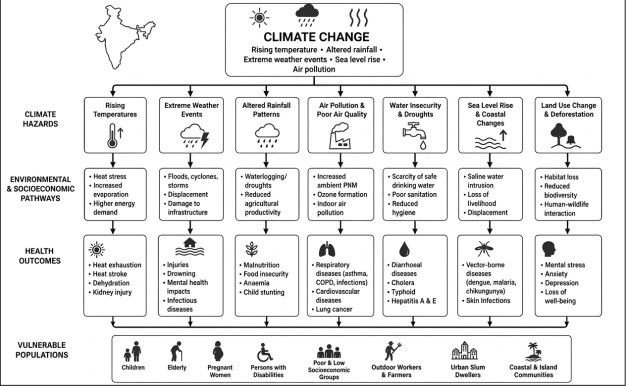
Climate change has emerged as one of the largest public health challenges of the twenty-first century, with India being particularly vulnerable due to its diverse climatic conditions, high population density, fast urbanization, and socioeconomic inequality. Rising temperatures, irregular rainfall, frequent floods, droughts, cyclones, and decreasing air quality are significantly influencing the prevalence and distribution of climate-sensitive diseases while compounding existing health inequities. This study synthesizes existing information on the relationship between climate change and human health in India, stressing its direct and indirect implications on communicable and non-communicable diseases, nutritional status, mental health, occupational health, and maternity and child health. The review also evaluates the disproportionate burden borne by vulnerable people, including children, older persons, pregnant women, economically disadvantaged communities, and individuals dwelling in climate-sensitive locations. Particular attention is placed on preventative public health interventions that can increase resistance against developing climate-related health concerns. These include climate-informed disease surveillance, early warning systems, climateresilient healthcare infrastructure, health promotion, community engagement, environmental risk communication, multisectoral collaboration, and the integration of digital technologies and the One Health approach into public health practice. The assessment also addresses the existing policy landscape in India, highlights significant implementation obstacles, and outlines future research goals for establishing sustainable and evidence-based solutions. By integrating scientific knowledge with public health views, this review highlights the critical need to incorporate climate adaptation and mitigation into national health strategy. Strengthening preventative public health systems through coordinated policy action, capacity building, and community-centered initiatives will be vital to safeguard population health and promote climate resilience in India.
References
- 1. Romanello M, Walawender M, Hsu SC, Moskeland A, et al. The 2024 report of the Lancet Countdown on health and climate change: facing record-breaking threats from delayed action. Lancet. 2024;404(10465):1847- 1896. doi:10.1016/S0140-6736(24)01822-1.
- 2. de Bont J, Jaganathan S, Krishna B, Stafoggia M, Banerjee T, Dholakia H, et al. Ambient air pollution and daily mortality in ten cities of India: a causal modelling study. Lancet Planet Health. 2024;8(7):e433-e440. doi:10.1016/ S2542-5196(24)00114-1.
- 3. Jaganathan S, Stafoggia M, de Bont J, Rajiva A, Mandal S, Dixit S, et al. Estimating the effect of annual PM2.5 exposure on mortality in India: a difference-in-differences approach. Lancet Planet Health. 2024;8(12):e987-e996. doi:10.1016/S2542-5196(24)00248-1.
- 4. Shrikhande SS, Lakshmanasamy R, Röösli M, Dalvie MA, Utzinger J, Cissé G. A review of climate change and cardiovascular diseases in the Indian policy context. Health Policy Plan. 2024;39(10):1109-1124. doi:10.1093/ heapol/czae076.
- 5. Dasgupta P, Bhatia H, Singh PK, et al. Responding to heat-related health risks: the urgency of an equipoise between emergency and equity. Lancet Planet Health. 2024;8(11):e933-e936. doi:10.1016/S2542- 5196(24)00246-8.
- 6. Basistha BB, Paul FA, Bhuyan K, Prasad JSR, Ali A. Climate change and mental health in India: a narrative review of vulnerabilities, impacts, and resilience pathways. Front Public Health. 2025;13:1686876.
- 7. Kumar S, Kumar A, Singh M. Building Climate-Resilient Health Systems in India: A Comprehensive Health Systems Approach. Cureus. 2024 Sep 8;16(9):e68951. doi: 10.7759/ cureus.68951. PMID: 39385862; PMCID: PMC11461095.
- 8. Wadhawan S, Bajpai A, Pandey V, Chitale V. How Can India Make Its Health Sector Climate Resilient? A District-Level Risk Assessment. New Delhi: Council on Energy, Environment and Water (CEEW) and UNICEF India; 2025.
- 9. World Health Organization. One Health: An integrated approach to sustainably balance the health of people, animals and ecosystems. Geneva: WHO; 2024.
- 10. Romanello M, Walawender M, Hsu SC, Moskeland A, Palmeiro-Silva Y, Scamman D, et al. The 2025 report of the Lancet Countdown on health and climate change: climate change action offers a lifeline. Lancet. 2025;406(10521):2804-2857. doi:10.1016/S0140- 6736(25)01919-1.
- 11. Lancet Countdown. India Policy Priorities 2024. London: Lancet Countdown on Health and Climate Change; 2024. Available from: https://lancetcountdown.org/resource_ country/india/
- 12. Lancet Countdown. India Data Sheet 2025. London: Lancet Countdown on Health and Climate Change; 2025. Available from: https:// lancetcountdown.org/resource_country/ india/
Data Sharing Statement
There are no additional data available. All raw data and code are available upon request.
Funding
This research received no funding.
Author Contributions
All authors contributed significantly to the work and approve its publication.
Ethics Declaration
This article does not involve any human or animal subjects, and therefore does not require ethics approval.
Acknowledgements
We would like to express our gratitude to the patients, their families, and all those who have contributed to this study.
Conflicts of Interest
No conflicts of interest in this work.
About this article

Cite this article
Rahul Saxena, Suyash Saxena. Climate Change and Human Health in India: Preventive Public Health Strategies for Emerging Health Risk. J Prev Med. 2026; 14(1): 25-29.
Licence:
Attribution-Non-commercial 4.0 International (CC BY-NC 4.0)This license enables reusers to distribute, remix, adapt, and build upon the material in any medium or format for noncommercial purposes only, and only so long as attribution is given to the creator.
| Received | Accepted | Published |
|---|---|---|
| May 18, 2026 | June 19, 2026 | June 30, 2026 |
DOI: https://doi.org/10.21088/ijpm.2321.5917.14126.3
Keywords
Climate ChangeHuman HealthPreventive Public HealthClimate ResilienceIndiaSearch for Similar Articles
Similar Articles
- Kidney Health Cannot Wait: Making CKD Screening Routine in Primary Care
- Young Onset Type 2 Diabetes in India: A Growing Preventive Challenge
- Maternal Mortality and Health Statistics in India: Legal Assumptions vs Medical...
- Behavioral and Environmental Determinants of Sleep Inequality in College Populat...
- A Study of Malaria in Bhutan
Article Level Metrics
Last UpdatedSaturday 17 October 2026, 13:01:43 (IST)
1293
Accesses
24
253
00
Citations
NA
NA
NA
Download citation
Article Keywords
Keyword Highlighting
Highlight selected keywords in the article text.
Timeline
| Received | May 18, 2026 |
| Accepted | June 19, 2026 |
| Published | June 30, 2026 |
licence
Attribution-Non-commercial 4.0 International (CC BY-NC 4.0)
This license enables reusers to distribute, remix, adapt, and build upon the material in any medium or format for noncommercial purposes only, and only so long as attribution is given to the creator.