Full Text (PDF)
Indian Journal of Preventive Medicine 14(1):p 7-11, January-June 2026. | DOI: https://doi.org/10.21088/ijpm.2321.5917.14126.1
Original Article
Behavioral and Environmental Determinants of Sleep Inequality in College Populations
Author Information
Licence:
Attribution-Non-commercial 4.0 International (CC BY-NC 4.0)This license enables reusers to distribute, remix, adapt, and build upon the material in any medium or format for noncommercial purposes only, and only so long as attribution is given to the creator.
Indian Journal of Preventive Medicine 14(1):p 7-11, January-June 2026. | DOI: https://doi.org/10.21088/ijpm.2321.5917.14126.1
How Cite This Article:
Sagar Bayaskar. Behavioral and Environmental Determinants of Sleep Inequality in College Populations. J Prev Med. 2026; 14(1): 07-11.Timeline
Received : September 02, 2025
Accepted : October 22, 2025
Published : June 30, 2026
Abstract
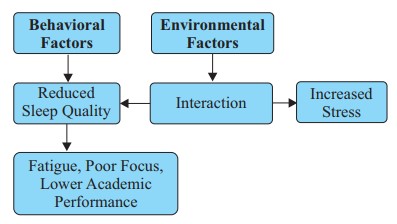
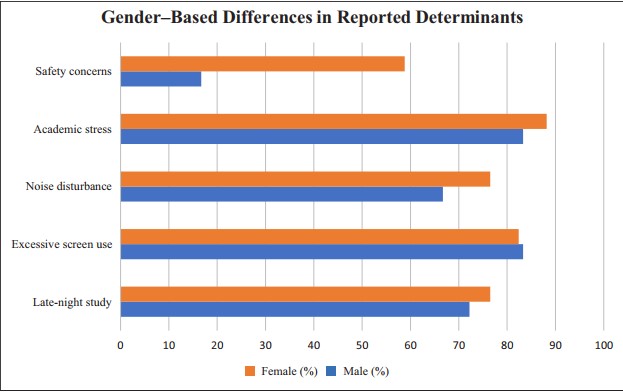
Background: Sleep inequality in college populations is an emerging public health concern, often shaped by both behavioral habits and environmental conditions. Objective: To explore behavioral and environmental determinants contributing to disparities in sleep quality among college students. Methods: Thirty-five participants (18 males, 17 females), aged 18–45 years, from diverse academic backgrounds, participated in in-depth qualitative interviews. Data were analyzed thematically to identify recurrent patterns influencing sleep. Results: Key behavioral factors included excessive screen use before bed (82.9%), academic stress (85.7%), and bedtime procrastination (77.1%). Environmental contributors were noise disturbance (71.4%), inconsistent lighting (62.9%), and poor ventilation or temperature extremes (48.6%). Interaction between behavioral and environmental factors amplified sleep inequality, with noticeable gender variations—female students more frequently cited safety concerns and environmental discomfort. Conclusion: Multifactorial interventions addressing both personal behaviors and environmental conditions are crucial to promoting equitable sleep health in college populations.
References
- 1. Becker SP, Sidol CA, Van Dyk TR, et al. Predicting sleep patterns in college students: The role of caffeine, technology use, and chronotype. Sleep Health. 2018;4(5):500-507. doi:10.1016/j.jval.2017.08.002
- 2. Kroese FM, De Ridder DTD, Evers C, et al. Bedtime procrastination: A behavioral perspective on sleep insufficiency. Sleep Med. 2014;15(5): 592–597. doi:10.1016/j. sleep.2013.12.005
- 3. Basner M, McGuire S. WHO environmental noise guidelines for the European Region: A systematic review on environmental noise and effects on sleep. Int J Environ Res Public Health. 2018;15(3):519. doi:10.3390/ijerph15030519
- 4. Troxel WM, Hunter GP, Scharf DM, et al. Student housing and sleep quality: The role of noise and room conditions. J Am Coll Health. 2019;67(6):528-535. doi:10.1080/07448481.2018. 1505753
- 5. Peltzer K, Pengpid S. Sleep duration and health correlates among university students in 26 countries. Psychol Health Med. 2016;21(2):208- 220. doi:10.1080/13548506.2014.998687
- 6. Lund HG, Reider BD, Whiting AB, Prichard JR. Sleep patterns and predictors of disturbed sleep in a large population of college students. J Adolesc Health. 2010;46(2):124-132. doi:10.1016/j.jadohealth.2009.06.016
- 7. Orzech KM, Salafsky DB, Hamilton LA. The state of sleep among college students at a large public university. J Am Coll Health. 2011;59(7):612-619. doi:10.1080/07448481.2010 .520051
- 8. Lo JC, Ong JL, Leong RL, Gooley JJ, Chee MW. Cognitive performance, sleepiness, and mood in partially sleep deprived adolescents: The need for sleep study. Sleep. 2016;39(3):687–698. doi:10.5665/sleep.5552
- 9. Hershner SD, Chervin RD. Causes and consequences of sleepiness among college students. Nat Sci Sleep. 2014;6:73-84. doi:10.2147/NSS.S62907
Data Sharing Statement
There are no additional data available. All raw data and code are available upon request.
Funding
This research received no funding.
Author Contributions
All authors contributed significantly to the work and approve its publication.
Ethics Declaration
This article does not involve any human or animal subjects, and therefore does not require ethics approval.
Acknowledgements
We would like to express our gratitude to the patients, their families, and all those who have contributed to this study.
Conflicts of Interest
No conflicts of interest in this work.
About this article

Cite this article
Sagar Bayaskar. Behavioral and Environmental Determinants of Sleep Inequality in College Populations. J Prev Med. 2026; 14(1): 07-11.
Licence:
Attribution-Non-commercial 4.0 International (CC BY-NC 4.0)This license enables reusers to distribute, remix, adapt, and build upon the material in any medium or format for noncommercial purposes only, and only so long as attribution is given to the creator.
| Received | Accepted | Published |
|---|---|---|
| September 02, 2025 | October 22, 2025 | June 30, 2026 |
DOI: https://doi.org/10.21088/ijpm.2321.5917.14126.1
Keywords
Sleep InequalityCollege StudentsBehavioral DeterminantsEnvironmental DeterminantsPublic HealthSleep HygieneSearch for Similar Articles
Similar Articles
- Kidney Health Cannot Wait: Making CKD Screening Routine in Primary Care
- Young Onset Type 2 Diabetes in India: A Growing Preventive Challenge
- Climate Change and Human Health in India: Preventive Public Health Strategies fo...
- Maternal Mortality and Health Statistics in India: Legal Assumptions vs Medical...
- A Study of Malaria in Bhutan
Article Level Metrics
Last UpdatedSunday 18 October 2026, 12:31:51 (IST)
1298
Accesses
18
253
00
Citations
NA
NA
NA
Download citation
Article Keywords
Keyword Highlighting
Highlight selected keywords in the article text.
Timeline
| Received | September 02, 2025 |
| Accepted | October 22, 2025 |
| Published | June 30, 2026 |
licence
Attribution-Non-commercial 4.0 International (CC BY-NC 4.0)
This license enables reusers to distribute, remix, adapt, and build upon the material in any medium or format for noncommercial purposes only, and only so long as attribution is given to the creator.