Full Text (PDF)
Indian Journal of Preventive Medicine 14(1):p 13-24, January-June 2026. | DOI: https://doi.org/10.21088/ijpm.2321.5917.14126.2
Review Article
Maternal Mortality and Health Statistics in India: Legal Assumptions vs Medical Realities
Vivekanshu Verma, Shri Gopal Kabra
Author Information
Licence:
Attribution-Non-commercial 4.0 International (CC BY-NC 4.0)This license enables reusers to distribute, remix, adapt, and build upon the material in any medium or format for noncommercial purposes only, and only so long as attribution is given to the creator.
Indian Journal of Preventive Medicine 14(1):p 13-24, January-June 2026. | DOI: https://doi.org/10.21088/ijpm.2321.5917.14126.2
How Cite This Article:
Shri Gopal Kabra, Vivekanshu Verma. Maternal Mortality and Health Statistics in India: Legal Assumptions vs Medical Realities. J Prev Med. 2026; 14(1): 13-24.Timeline
Received : May 23, 2026
Accepted : June 24, 2026
Published : June 30, 2026
Abstract
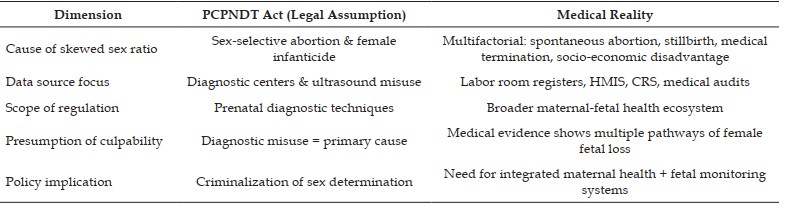
India’s maternal mortality and morbidity statistics remain contested due to methodological ambiguities and systemic data gaps. While the Maternal Mortality Ratio (MMR) is internationally standardized as deaths per 100,000 live births, confusion persists with the Maternal Mortality Rate, which uses women of reproductive age as the denominator. In India, estimates are derived largely from the Sample Registration System (SRS), household surveys such as the National Family Health Survey (NFHS), and facility-based reporting under the Health Management Information System (HMIS). These sources, however, are periodic, sample-based, and often modeled, rather than real-time. The PCPNDT Act presumes sex-selective abortion and female infanticide as the primary causes of skewed sex ratios, yet medical realities reveal a broader spectrum of female fetal loss — including spontaneous abortions, stillbirths, and medically indicated terminations — that household surveys cannot capture. Despite extensive digitization of hospitals, the absence of mandatory ICD coding and real-time reporting undermines the reliability of morbidity and mortality data.1 Consequently, policy formulations risk being based on self-supporting guesstimates rather than robust, coded health statistics. This paper argues for a shift from politically framed digitization claims to mandatory ICD-coded, real-time hospital reporting, centrally collated and analyzed state-wise. Only such a system can provide India with reliable health statistics, ensure medico-legal accountability, and support evidence-based policy in maternal and child health.
References
- 1. World Health Organization. International Statistical Classification of Diseases and Related Health Problems (ICD-11). Geneva: WHO; 2022.
- 2. Graham WJ. Maternal mortality: a global public health challenge. In: Global Public Health. Oxford University Press; 2019.
- 3. Office of the Registrar General & Census Commissioner, India. Sample Registration System Statistical Report 2022. New Delhi: Ministry of Home Affairs, Government of India; 2025.
- 4. Office of the Registrar General & Census Commissioner, India. SRS Special Bulletin on Maternal Mortality 2022-24. New Delhi: Ministry of Home Affairs, Government of India; 2026
- 5. International Institute for Population Sciences (IIPS) and ICF. National Family Health Survey (NFHS-5), 2019-21: India Report. Mumbai: IIPS; 2021.
- 6. IIPS and Macro International. National Family Health Survey (NFHS-4), 2015-16: India Report. Mumbai: IIPS; 2017.
- 7. Health Management Information System (HMIS)
- 8. Goli S, et al. Estimates and correlates of districtlevel maternal mortality ratio in India. PLOS Global Public Health. 2022.
- 9. Singh A, et al. Situational analysis of maternal death review in India: Evidence from health management information system. Journal of Health Management. 2020.
- 10. International Institute for Population Sciences. Civil Registration System in India: Challenges and Way Forward. Mumbai: IIPS; 2026.
- 11. Gupta A. Inadequacies of the Civil Registration System. The Hindu. 2022.
- 12. George SM. Stopping female feticide in India: the failure and unintended consequence of ultrasound restriction. Journal of Biosocial Science. 2017.
- 13. Retherford RD, Roy TK. Factors Affecting Sex-Selective Abortion in India. National Family Health Survey Subject Reports, No. 21. Mumbai: IIPS; 2003.
- 14. Jha P, et al. Trends in selective abortions of girls in India: analysis of nationally representative birth histories from 1990 to 2005 and census data from 1991 to 2011. The Lancet. 2011;377(9781):1921-1928.
- 15. Puri S, et al. A perspective on the PCPNDT Act. Indian Journal of Medical Ethics. 2010.
- 16. Jathanna PN, Prajwal S, Shreepathi U, et al. Implementation of International Classification of Diseases 10: Preparedness for E-medical records and health reporting. CHRISMED Journal of Health and Research. 2015;2(2):186-192.
- 17. Mony PK, Nag C. Health information management: An introduction to disease classification and coding. National Medical Journal of India. 2007;20(6):306-311.
- 18. Achari A, et al. Diagnosis by ICD coding on discharge and death: A medical record-based study on in-patients of a Medical College and Hospital of West Bengal, India. Journal of Medical Records. 2024.
- 19. Kumar R, et al. Trend of intestinal infectious diseases recorded at a tertiary care hospital in India: an ICD-10 analysis. BMJ Health & Care Informatics. 2019.
- 20. Goli S, et al. Estimates and correlates of districtlevel maternal mortality ratio in India. PLOS Global Public Health. 2022.
- 21. Ministry of Health and Family Welfare, Government of India. Electronic Medical Records Standards. New Delhi: MoHFW; 2013.
- 22. World Health Organization. Health Metrics Network: Framework and Standards for Country Health Information Systems. Geneva: WHO; 2008.
- 23. World Health Organization. Trends in Maternal Mortality 2000 to 2020. Geneva: WHO; 2023.
- 24. United Nations. Sustainable Development Goals: Goal 3 - Ensure healthy lives and promote well-being for all at all ages. New York: UN; 2015.
- 25. NITI Aayog, Government of India. Healthy States, Progressive India: Report on the Ranks of States and Union Territories. New Delhi: NITI Aayog; 2019.
Data Sharing Statement
There are no additional data available. All raw data and code are available upon request.
Funding
This research received no funding.
Author Contributions
All authors contributed significantly to the work and approve its publication.
Ethics Declaration
This article does not involve any human or animal subjects, and therefore does not require ethics approval.
Acknowledgements
We would like to express our gratitude to the patients, their families, and all those who have contributed to this study.
Conflicts of Interest
No conflicts of interest in this work.
About this article

Cite this article
Shri Gopal Kabra, Vivekanshu Verma. Maternal Mortality and Health Statistics in India: Legal Assumptions vs Medical Realities. J Prev Med. 2026; 14(1): 13-24.
Licence:
Attribution-Non-commercial 4.0 International (CC BY-NC 4.0)This license enables reusers to distribute, remix, adapt, and build upon the material in any medium or format for noncommercial purposes only, and only so long as attribution is given to the creator.
| Received | Accepted | Published |
|---|---|---|
| May 23, 2026 | June 24, 2026 | June 30, 2026 |
DOI: https://doi.org/10.21088/ijpm.2321.5917.14126.2
Keywords
Maternal Mortality Ratio (Mmr)Maternal Mortality RateSample Registration System (Srs)National Family Health Survey (Nfhs)Health Management Information System (Hmis)Civil Registration System (Crs)International Classification of Diseases (ICD) CodingReal-Time Health StatisticsSex Ratio At BirthFemale Fetal LossPcpndt ActSex-Selective AbortionFemale InfanticideMedico-Legal AccountabilityEvidence-Based Health PolicyDigitization Of HealthcareSearch for Similar Articles
Similar Articles
- Kidney Health Cannot Wait: Making CKD Screening Routine in Primary Care
- Young Onset Type 2 Diabetes in India: A Growing Preventive Challenge
- Climate Change and Human Health in India: Preventive Public Health Strategies fo...
- Behavioral and Environmental Determinants of Sleep Inequality in College Populat...
- A Study of Malaria in Bhutan
Article Level Metrics
Last UpdatedSunday 18 October 2026, 16:53:30 (IST)
1299
Accesses
22
253
00
Citations
NA
NA
NA
Download citation
Article Keywords
Keyword Highlighting
Highlight selected keywords in the article text.
Timeline
| Received | May 23, 2026 |
| Accepted | June 24, 2026 |
| Published | June 30, 2026 |
licence
Attribution-Non-commercial 4.0 International (CC BY-NC 4.0)
This license enables reusers to distribute, remix, adapt, and build upon the material in any medium or format for noncommercial purposes only, and only so long as attribution is given to the creator.