Full Text (PDF)
Indian Journal of Waste Management 8(2):p 65-71, July - Dec 2024. | DOI: na
Original Article
A Study on Ecological, Cultural Significance of Walnut and Yearly Walnut Production in Kashmir Valley
Bilal Ahmad Bhat, Rabia Lone, Tanzeela Habib, Ishrat Gull, Aasifa Akhter, Mumina Khan, Intizar Ahmad
Author Information
Licence:
Attribution-Non-commercial 4.0 International (CC BY-NC 4.0)This license enables reusers to distribute, remix, adapt, and build upon the material in any medium or format for noncommercial purposes only, and only so long as attribution is given to the creator.
Indian Journal of Waste Management 8(2):p 65-71, July - Dec 2024. | DOI: na
How Cite This Article:
Bilal Ahmad Bhat et al., A Study on Ecological, Cultural Significance of Walnut and Yearly Walnut Production in Kashmir Valley. Ind. Jr. Waste Manag. 2024; 8(2): 65–71.Timeline
Received : October 21, 2024
Accepted : November 25, 2024
Published : December 30, 2024
Abstract
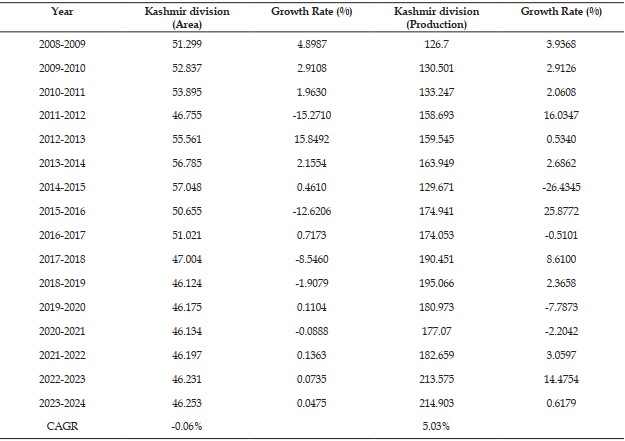
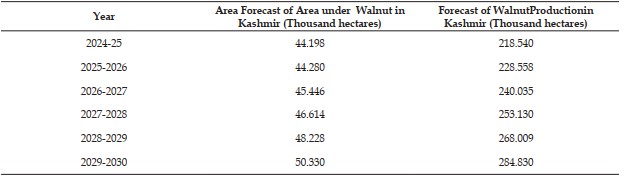
The horticulture sector in Jammu and Kashmir’s economy is one of the most dominant sectors and the backbone of the economy with a yearly turnover of over Rs. 1200 Crores. The Jammu and Kashmir region announced as the “Agri. Export zone for Apples and Walnuts” is the major producer of apples and walnuts as around 80 per cent of apple and 90 per cent of walnut production in India belongs to the Jammu and Kashmir region. Walnut (Akhrot in Urdu and Doon/ Doun in Kashmiri) is the edible seed of the tree of the genus Juglans and is well known for its health and environmental significance. In this paper, we study the annual growth rate of Walnut production in Kashmir Valley using secondary data from 2004-2005 to 2023-24 with the help of statistical techniques. Finally, we discuss the ecological significance of walnuts and show the forecasts of the area under walnuts and their production.
References
- 1. Ahmad, N., Singh, S. R., Rashid, M. and Mir, H. (2018). Fruit production in India (pp. 661-671).
- 2. Beiki, T.; Najafpour, G.D.; Hosseini, M. Evaluation of antimicrobial and dyeing properties of walnut (Juglans regia L.) green husk extract for cosmetics. Color. Technol. 2018, 134, 71–81
- 3. Cantarello, E.; Lovegrove, A.; Orozumbekov, A.; Birch, J.; Brouwers, N.; Newton, A.C. Human Impacts on Forest Biodiversity in Protected Walnut-Fruit Forests in Kyrgyzstan. J. Sustain. For. 2014, 33, 454–481
- 4. Chang, S.K.; Alasalvar, C.; Bolling, B.W.; Shahidi, F. Nuts and their co-products: The impact of processing (roasting) on phenolics, bioavailability, and health benefits—A comprehensive review. J. Funct. Foods 2016, 26, 88–122
- 5. Dong, N.; Hu, G.; Zhang, Y.; Qi, J.; Chen, Y.; Hao, Y. Effects of green-manure and tillage management on soil microbial community composition, nutrients and tree growth in a walnut orchard. Sci. Rep. 2021, 11, 16882.
- 6. Jasrotia, N., Sharma, M., Bhat, A., Mahajan, S., and Gupta, S. (2024). Forecasting models for the production of walnut in Jammu and Kashmir-A comparative study. In Proceedings of 26th Annual conference (pp. 51-60).
- 7. Khattak, P.; Khalil, T.F.; Bibi, S.; Jabeen, H.; Muhammad, N.; Khan, M.A.; Liaqat, S. Juglans regia (walnut tree) bark in dentistry. Pak. Biomed. J. 2022, 5, 152–156.
- 8. Malhotra, S. P. and McNeil, D. L. (2009). Economics of walnut production in India. International Walnut Symposium 861: 229-236.
- 9. McGranahan, G.H., Leslie, C., Badenes, M.L. and Byrne, D.H.(2012). Fruit breeding. Springer New York Dordrecht Heidelberg London 8(5): 875.
- 10. Shah, R.A. and Bakshi, P. 2016. Walnut industry in India-present status and future strategies (Jammu &Kashmir).
- 11. Venkatachalam, M and Sathe, S. K. (2006). Chemical composition of selected edible nut seeds. Journal of Agriculture and Food Chemistry 54: 4705-4714
- 12. Yilmaz, S.; Akça, Y.; Saçlik, S. Green husk and inshell biomass production capabilities of six walnut cultivars. Agric Food 2017, 5, 389–397
Data Sharing Statement
There are no additional data available. All raw data and code are available upon request.
Funding
This research received no funding.
Author Contributions
All authors contributed significantly to the work and approve its publication.
Ethics Declaration
This article does not involve any human or animal subjects, and therefore does not require ethics approval.
Acknowledgements
We would like to express our gratitude to the patients, their families, and all those who have contributed to this study.
Conflicts of Interest
No conflicts of interest in this work.
About this article

Cite this article
Bilal Ahmad Bhat et al., A Study on Ecological, Cultural Significance of Walnut and Yearly Walnut Production in Kashmir Valley. Ind. Jr. Waste Manag. 2024; 8(2): 65–71.
Licence:
Attribution-Non-commercial 4.0 International (CC BY-NC 4.0)This license enables reusers to distribute, remix, adapt, and build upon the material in any medium or format for noncommercial purposes only, and only so long as attribution is given to the creator.
| Received | Accepted | Published |
|---|---|---|
| October 21, 2024 | November 25, 2024 | December 30, 2024 |
DOI: na
Keywords
WalnutGrowth rateForecastEconomic DevelopmentProductionSearch for Similar Articles
Similar Articles
- Pet Poop, Waste Management, Strays
- Recycling of Waste Materials Generated in the streets of Puducherry (Pondicherr...
- A Study on Benefits, Challenges and Role of Artificial Intelligence in Law
- Evaluation of MPKV Central Campus (West), Rahuri (M.S.) Watershed for Priority...
- Indus Waters Treaty Hidden Tensions, Flowing Rivers
Article Level Metrics
Last UpdatedSunday 27 September 2026, 14:19:13 (IST)
906
Accesses
13
183
00
Citations
NA
NA
NA
Download citation
Article Keywords
Keyword Highlighting
Highlight selected keywords in the article text.
Timeline
| Received | October 21, 2024 |
| Accepted | November 25, 2024 |
| Published | December 30, 2024 |
licence
Attribution-Non-commercial 4.0 International (CC BY-NC 4.0)
This license enables reusers to distribute, remix, adapt, and build upon the material in any medium or format for noncommercial purposes only, and only so long as attribution is given to the creator.