Full Text (PDF)
Indian Journal of Waste Management 10(1):p 21-27, Jan - June 2026. | DOI: 0
Original Article
Recycling of Waste Materials Generated in the streets of Puducherry (Pondicherry), India
Author Information
Licence:
Attribution-Non-commercial 4.0 International (CC BY-NC 4.0)This license enables reusers to distribute, remix, adapt, and build upon the material in any medium or format for noncommercial purposes only, and only so long as attribution is given to the creator.
Indian Journal of Waste Management 10(1):p 21-27, Jan - June 2026. | DOI: 0
How Cite This Article:
P. Sivasankaran. Recycling of Waste materials Generated in the streets of Puducherry(Pondicherry), India. Ind. Jr. Waste Manag. 2026; 10(1): 21-27.Timeline
Received : May 17, 2026
Accepted : June 25, 2026
Published : June 30, 2026
Abstract
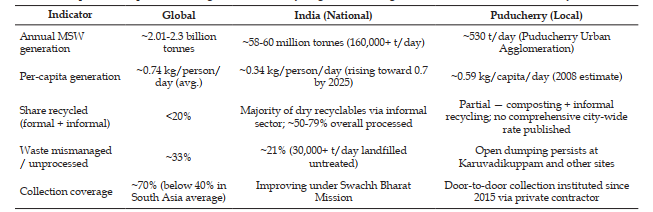
Rapid urbanisation, tourism growth, and changing consumption patterns have made municipal solid waste (MSW) management a critical civic challenge in Puducherry (formerly Pondicherry), a Union Territory on India’s south-eastern coast. This paper presents a systematic review of published research, government reports, and grey literature on the generation, composition, collection, and recycling of waste found on Puducherry’s streets, situating local findings against national and global statistics. Sixty-one records were initially identified through structured searches of academic databases and institutional repositories; after removing duplicates and screening for relevance, 19 studies and reports met the inclusion criteria and were synthesised narratively following a PRISMA-informed protocol. Results show that Puducherry Urban Agglomeration generates approximately 350-530 tonnes of municipal solid waste per day, with a per-capita generation rate historically around 0.59 kg/capita/day, dominated by biodegradable material (about 65%) followed by paper, plastics, and other dry recyclables. Formal doorto-door collection and composting programmes coexist with a substantial informal recycling economy of waste pickers and scrap dealers who intercept dry recyclables before they reach dumpsites. Compared with global recycling rates below 20% and India’s national processing rate of roughly 50-79%, Puducherry’s performance is mixed: source segregation and NGO-led awareness programmes have mproved outcomes in some wards, yet open dumping, leachate contamination near disposal sites, and incomplete segregation persist. The discussion identifies infrastructure, behavioural, and governance gaps and situates Puducherry within India’s Swachh Bharat Mission trajectory. The review concludes that a scaled-up, decentralised, and formally integrated recycling model—combining source segregation, material recovery facilities, and legal recognition of informal waste
References
- 1. Centre for Science and Environment (CSE). (2024). State of India’s Environment in Figures 2024. New Delhi: CSE / Down To Earth.
- 2. Central Pollution Control Board (CPCB). (2020-21). Annual Report on Solid Waste Management. Government of India.
- 3. Local Administration Department, Government of Puducherry. (n.d.). Solid Waste Management [Official government webpage]. https://lad. py.gov.in/solid-waste-management
- 4. Rajamanikam, R., Poyyamoli, G., Kumar, S., & Lekshmi, R. (2014). The role of nongovernmental organizations in residential solid waste management: A case study of Puducherry, a coastal city of India. Waste Management & Research, 32(9), 867-881.
- 5. [Author(s) not specified]. (2009). Assessment of Municipal Solid Waste management in Puducherry (Pondicherry), India. Resources, Conservation and Recycling / ScienceDirect.
- 6. [Author(s) not specified]. (2008). Perspective Development Plan for Solid Waste Management in Pondicherry.
- 7. Mordor Intelligence. (2025). India Municipal Solid Waste Management Market — Size, Share and Trends.
- 8. Trade. gov / International Trade Administration. (n.d.). India Solid Waste Management: Market Intelligence.
- 9. United Nations Environment Programme (UNEP) & International Solid Waste Association (ISWA). (2024). Global Waste Management Outlook 2024: Beyond an Age of Waste.
- 10. World Bank. (2018). What a Waste 2.0: A Global Snapshot of Solid Waste Management to 2050. Washington, DC: World Bank.
- 11. Statista. (2024-2026). Municipal waste generation, treatment, and recycling statistics — Global and India datasets (OECD, UNEP, MoHUA source data).
- 12. Clean India Journal. (2024). India to generate 0.7 kg waste per person per day by 2025: Report.
- 13. Earth5R. (2026). 10 Cities Leading India’s Waste Management Revolution.
- 14. DevelopmentAid. (2026). World waste: Statistics by country and brief facts.
Data Sharing Statement
There are no additional data available. All raw data and code are available upon request.
Funding
This research received no funding.
Author Contributions
All authors contributed significantly to the work and approve its publication.
Ethics Declaration
This article does not involve any human or animal subjects, and therefore does not require ethics approval.
Acknowledgements
We would like to express our gratitude to the patients, their families, and all those who have contributed to this study.
Conflicts of Interest
No conflicts of interest in this work.
About this article

Cite this article
P. Sivasankaran. Recycling of Waste materials Generated in the streets of Puducherry(Pondicherry), India. Ind. Jr. Waste Manag. 2026; 10(1): 21-27.
Licence:
Attribution-Non-commercial 4.0 International (CC BY-NC 4.0)This license enables reusers to distribute, remix, adapt, and build upon the material in any medium or format for noncommercial purposes only, and only so long as attribution is given to the creator.
| Received | Accepted | Published |
|---|---|---|
| May 17, 2026 | June 25, 2026 | June 30, 2026 |
DOI: 0
Keywords
Municipal Solid WasteRecyclingStreet WastePondicherrySystematic ReviewCircular EconomyInformal Waste Sectorndia • Swachh Bharat MissionSearch for Similar Articles
Similar Articles
- Pet Poop, Waste Management, Strays
- A Study on Benefits, Challenges and Role of Artificial Intelligence in Law
- Evaluation of MPKV Central Campus (West), Rahuri (M.S.) Watershed for Priority...
- Indus Waters Treaty Hidden Tensions, Flowing Rivers
- SWM & Agricultural Residue Management Through Case Studies
Article Level Metrics
Last UpdatedSunday 18 October 2026, 14:55:56 (IST)
1003
Accesses
18
188
00
Citations
NA
NA
NA
Download citation
Article Keywords
Keyword Highlighting
Highlight selected keywords in the article text.
Timeline
| Received | May 17, 2026 |
| Accepted | June 25, 2026 |
| Published | June 30, 2026 |
licence
Attribution-Non-commercial 4.0 International (CC BY-NC 4.0)
This license enables reusers to distribute, remix, adapt, and build upon the material in any medium or format for noncommercial purposes only, and only so long as attribution is given to the creator.