Full Text (PDF)
Indian Journal of Ancient Medicine and Yoga 19(3):p 159-164, July - September 2026. | DOI: 10.21088/ijamy.2455.8621.19326.3
Original Article
A Comparison of Participant Rated Relaxation and affect following Yoga Nidra and Ayurvedic Massage an exploratory Observational Study
Shirley Telles, Archana Yadav, Sachin Kumar Sharma, Sachin Kumar Tyagi, Acharya Balkrishna
Author Information
Licence:
Attribution-Non-commercial 4.0 International (CC BY-NC 4.0)This license enables reusers to distribute, remix, adapt, and build upon the material in any medium or format for noncommercial purposes only, and only so long as attribution is given to the creator.
Indian Journal of Ancient Medicine and Yoga 19(3):p 159-164, July - September 2026. | DOI: 10.21088/ijamy.2455.8621.19326.3
How Cite This Article:
Archana Yadav, Sachin Kumar Sharma, Sachin Kumar Tyagi et. al, A Comparison of Participant Rated Relaxation and affect following Yoga Nidra and Ayurvedic Massage an exploratory Observational Study. Ind J Anct Med Yoga. 2026; 19(3): 159-164.Timeline
Received : July 29, 2026
Accepted : August 30, 2026
Published : September 30, 2026
Abstract
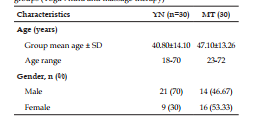
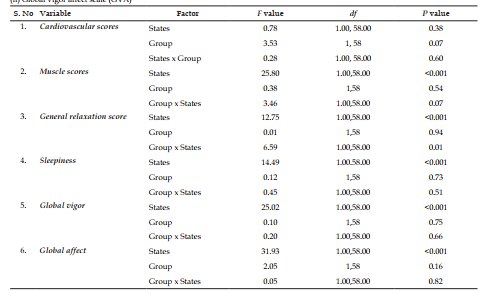
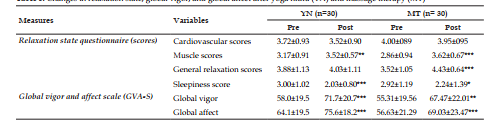
Aim of the study: The study compared the immediate effects of a single session of yoga nidra (YN) and massage therapy (MT) on relaxation levels, vigor and affect in patients receiving either of the two therapies, both administered when supine and intended for relaxation. Methods and Material: In this exploratory comparative study, sixty patients were recruited from a wellness center in north India. Of these, thirty patients received YN (average age ± SD: 40.80 ± 14.10 years; male:female ratio: 21:9), while thirty patients received MT (average age ± SD: 47.10 ± 13.26 years; male:female: 14:16). Patients completed the relaxation state questionnaire (RSQ) and global vigor and affect scale (GVA) before and after YN or MT. Data were analysed using SPSS 24.0. Results: MT alone increased general relaxation (p<0.05; RM-ANOVA). Both interventions (1) increased muscle relaxation, (2) decreased sleepiness and (3) increased global vigor and global affect (p<0.05; in all cases RM-ANOVA). Conclusion: The present findings support both YN and MT as relaxing practices which increase positive affect and vigor, YN may be preferred if relaxation is to be accompanied by better awareness (lower sleepiness 32.33 versus 23.29 percent, YN vs. MT respectively), whereas MT facilitates muscle and overall relaxation.
References
- 1. Mortada EM. Evidence-based complementary and alternative medicine in current medical practice. Cureus. 2024 Jan 10;16(1).
- 2. Rajalekshmy PR, Toshikhane HD. A comparative clinical trial to rule out the impact of Yoga Nidra and Padabhyanga on Insomnia Disorder. Journal of Ayurveda and Integrated Medical Sciences. 2025 Apr 27;10(3):31-9.
- 3. Pandi-Perumal SR, Spence DW, Srivastava N, Kanchibhotla D, Kumar K, Sharma GS, Gupta R, Batmanabane G. The origin and clinical relevance of yoga nidra. Sleep and vigilance. 2022 Jun;6(1):61-84.
- 4. Nayak K, Verma K. Yoga-Nidra as a mental health booster: A narrative review. Journal of Ayurveda and integrative medicine. 2023 Nov 1;14(6):100842.
- 5. Sabna P P et al: Review On Physiological Evaluation Of Abhyanga. International Ayurvedic Medical Journal {online} 2021 {cited December 2021} Available from: http://www. iamj.in/posts/images/upload/3074_3080.pdf
- 6. Madhukar LS, Nivrutti BA, Bhatngar V, Bhatnagar S. Physio-anatomical explanation of abhyanga: An ayurvedic massage technique for healthy life. J Tradit Med Clin Natur. 2018;7(252):2.
- 7. Yadavaji Trikamaji (editor), Sushruta Samhita of Sushruta with the Nibandhasangraha Commentary of Shri Dalhanacharya and the Nyayachandrika Panjika of Shri Gayadasacharya on Nidansthana: Edited by Vaidya Jadavji Trikamji Acharya: Sharir Sthana; Siravyadha vidhi Shariram shlok 8/20. Chaukhamba Surbharti Prakashana, Varanasi, Edition: 2014, Page no- 383
- 8. Ivanova S. The effect of massage therapy on the sleep quality in healthy adults. Current Trends in Natural Sciences 2024;13(26):160-7.
- 9. Steghaus S, Poth CH. Assessing momentary relaxation using the Relaxation State Questionnaire (RSQ). Scientific Reports. 2022 Sep 29;12(1):16341.
- 10. Monk TH. A Visual Analogue Scale technique to measure global vigor and affect. Psychiatry Res 1989 Jan 1;27(1):89-99. doi:10.1016/0165- 1781(89)90013-9
- 11. Parker S, Bharati SV, Fernandez M. Defining yoga-nidra: traditional accounts, physiological research, and future directions. International Journal of Yoga Therapy. 2013 Jan 1;23(1):11-6.
- 12. Markil N, Whitehurst M, Jacobs PL, Zoeller RF. Yoga Nidra relaxation increases heart rate variability and is unaffected by a prior bout of Hatha yoga. The Journal of Alternative and Complementary Medicine: Paradigm, Practice, and Policy Advancing Integrative Health. 2012 Oct;18(10):953-8.
- 13. Datta K, Mallick HN, Tripathi M, Ahuja N, Deepak KK. Electrophysiological evidence of local sleep during yoga nidra practice. Frontiers in neurology. 2022 Jul 12;13:910794.
- 14. Gandharva K, Sharma SK, Aggithaya MG, Narahari SR, Valliyodan SM, Telles S. Heart rate variability following an integrative treatment consisting of Ayurveda, biomedicine, and yoga in patients with lymphedema. Indian Journal of Physiology and Pharmacology. 2022 Apr;66(2):153-4.
- 15. Daneau C, Cantin V, Descarreaux M. Effect of massage on clinical and physiological variables during muscle fatigue task in participants with chronic low back pain: a crossover study. Journal of manipulative and physiological therapeutics. 2019 Jan 1;42(1):55-65.
- 16. Hemmings BJ. Physiological, psychological and performance effects of massage therapy in sport: a review of the literature. Physical therapy in sport. 2001 Nov 1;2(4):165-70.
- 17. Kaada B, Torsteinbø O. Increase of plasma beta-endorphins in connective tissue massage. General pharmacology. 1989 Jan 1;20(4):487-9.
- 18. Morhenn V, Beavin LE, Zak PJ. Massage increases oxytocin and reduces adrenocorticotropin hormone in humans. Alternative therapies in health and medicine. 2012 Nov 1;18(6):11.
- 19. Pilozzi A, Carro C, Huang X. Roles of β-endorphin in stress, behavior, neuroinflammation, and brain energy metabolism. International journal of molecular sciences. 2020 Dec 30;22(1):338
Data Sharing Statement
There are no additional data available. All raw data and code are available upon request.
Funding
This research received no funding.
Author Contributions
All authors contributed significantly to the work and approve its publication.
Ethics Declaration
This article does not involve any human or animal subjects, and therefore does not require ethics approval.
Acknowledgements
We would like to express our gratitude to the patients, their families, and all those who have contributed to this study.
Conflicts of Interest
No conflicts of interest in this work.
About this article

Cite this article
Archana Yadav, Sachin Kumar Sharma, Sachin Kumar Tyagi et. al, A Comparison of Participant Rated Relaxation and affect following Yoga Nidra and Ayurvedic Massage an exploratory Observational Study. Ind J Anct Med Yoga. 2026; 19(3): 159-164.
Licence:
Attribution-Non-commercial 4.0 International (CC BY-NC 4.0)This license enables reusers to distribute, remix, adapt, and build upon the material in any medium or format for noncommercial purposes only, and only so long as attribution is given to the creator.
| Received | Accepted | Published |
|---|---|---|
| July 29, 2026 | August 30, 2026 | September 30, 2026 |
DOI: 10.21088/ijamy.2455.8621.19326.3
Keywords
Yoga NidraMassage therapySleepinessRelaxationGlobal VigorGlobal affecSearch for Similar Articles
Similar Articles
- Effect of Ayurvedic Drugs on Fungal Infection: A Case Report
- Nabhi Chyuti in Hatha Yoga Literature: A Systematic Review of Textual Evidence...
- Integrative Role of Yogic Interventions in Epilepsy Management: A Systematic an...
- Stability Study of Bramhyadi Tablet’ used in the Management of PreOperative Anxi...
- Balance Promotes Cognition: An Experimental Study with Balancing Asana in Early...
Article Level Metrics
Last UpdatedSunday 18 October 2026, 14:55:10 (IST)
5225
Accesses
15
891
00
Citations
NA
NA
NA
Download citation
Article Keywords
Keyword Highlighting
Highlight selected keywords in the article text.
Timeline
| Received | July 29, 2026 |
| Accepted | August 30, 2026 |
| Published | September 30, 2026 |
licence
Attribution-Non-commercial 4.0 International (CC BY-NC 4.0)
This license enables reusers to distribute, remix, adapt, and build upon the material in any medium or format for noncommercial purposes only, and only so long as attribution is given to the creator.