Full Text (PDF)
Indian Journal of Emergency Medicine 10(3):p 125-130, July-Sept. 2024. | DOI: https://doi.org/10.21088/ijem.2395.311X.10324.3
Original Article
A Comparison of Four Score with the Glasgow Coma Scale score in Predicting Outcomes among Patients with Altered Mental Status Admiotted to Emergency
Kiran Tatti, C.A Bopanna, Harold Maxim Lewis, Snehith C Patil, Shankarachari S Mayachari, Chandankumar N R
Author Information
Licence:
Attribution-Non-commercial 4.0 International (CC BY-NC 4.0)This license enables reusers to distribute, remix, adapt, and build upon the material in any medium or format for noncommercial purposes only, and only so long as attribution is given to the creator.
Indian Journal of Emergency Medicine 10(3):p 125-130, July-Sept. 2024. | DOI: https://doi.org/10.21088/ijem.2395.311X.10324.3
How Cite This Article:
Tatti K, Bopanna CA, Lewis HM, et al. A comparison of FOUR score with the Glasgow Coma Scale score in predicting outcomes among patients with altered mental status admitted to emergency. Ind J Emerg Med. 2024;10(3):125-30.Timeline
Received : March 23, 2024
Accepted : July 23, 2024
Published : September 10, 2024
Abstract
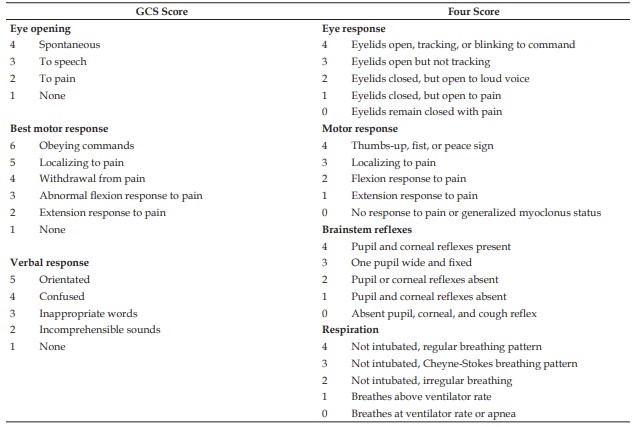
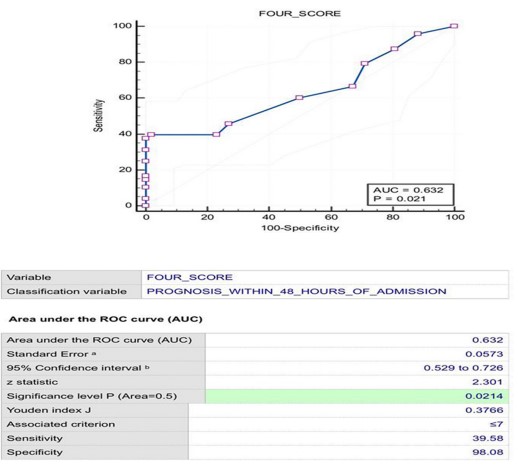
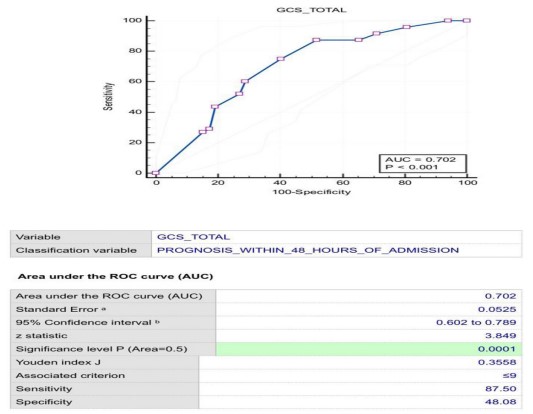
Aim: To know which is the best GCS score and FOUR score to be used in patients presenting to Emergency Medicine department with altered mental status and also predicting the outcome of patient. Materials and Methods: This is a prospective observational comparative study. It included 100 patients of altered sensorium, whose GCS and FOUR scores were calculated at admission and followed up till discharge or death to note the outcome. Individual demographics and diagnosis were recorded, and the results were analyzed statistically. Results: The ROC curve analysis for FOUR score in determining prognosis within 48 hours of admission indicates moderate predictive power, with an area under the curve (AUC) of 0.632. The ROC curve analysis for GCS total demonstrated a stronger predictive power with an AUC of 0.702. Conclusion: Both GCS and FOUR score can be used with same reliability in emergency to predict outcome.Taking into account the possible inter observer variation FOUR score can be used with upper hand. Clinical significance: In critically-ill patients with altered sensorium, explaining the prognosis to the attendants is a challenge for the physician. The commonly used GCS score has several shortcomings, especially in intubated patients. Use of the FOUR score can overcome these shortcomings and help in prognostication of these patients. In view of its good correlation with GCS score and equal efficacy in predicting outcomes in varied etiologies, it can be used as a good alternative to the GCS score.
References
- 1. Teasdale G, Jennett B. Assessment of coma and impaired consciousness: a practical scale. Lancet 1974;304(7872):81–84. DOI: 10.1016/ s0140-6736(74)91639-0.
- 2. Kasprowicz M, Burzynska M, Melcer T, Kübler A. A comparison of the Full Outline of UnResponsiveness (FOUR) score and Glasgow Coma Score (GCS) in predictive modelling in traumatic brain injury. Br J Neurosurg 2016;30(2):211–220. DOI: 10.3109/02688697.2016.1161173.
- 3. Wijdicks EF, Bamlet WR, Maramattom BV, Manno EM, McClelland RL. Validation of a new coma scale: the FOUR score. Ann Neurol 2005;58(4):585–593. DOI: 10.1002/ana.20611.
- 4. Mishra RK, Mahajan C, Kapoor I, Prabhakar H, Bithal PK. Comparison of Full Outline of UnResponsiveness (FOUR) score and the conventional scores in predicting outcome in aneurysmal subarachnoid haemorrhage patients. Indian J Anaesth 2019;63(4):295. DOI: 10.4103/ ija.IJA_786_18.
- 5. Singhal V. Clinical approach to acute decline in sensorium. Indian J Crit Care Med 2019;23(Suppl. 2):S120. DOI: 10.5005/ jp-journals-10071-23188.
- 6. Iyer VN, Mandrekar JN, Danielson RD, Zubkov AY, Elmer JL, Wijdicks EF. Validity of the FOUR score coma scale in the medical intensive care unit. Mayo Clinic Proc 2009;84(8):694–701. DOI: 10.1016/ S0025- 6196(11)60519-3.
- 7. Ghelichkhani P, Esmaeili M, Hosseini M, Seylani K. Glasgow Coma Scale and FOUR Score in predicting the mortality of trauma patients; a diagnostic accuracy study. Emergency 2018;6(1):e42. DOI: https:// pubmed.ncbi.nlm.nih.gov/30584558.
- 8. Kishor K, Sanjeeb S. Comparison of outcome predictions by the Glasgow Coma Scale and the Full Outline of Unresponsiveness Score in the neurological and neurosurgical patients in the intensive care unit. Indian J Crit Med 2016;20(8):473–476. DOI: 10.4103/0972- 5229.188199.
- 9. Sepahvand E, Jalali R, Mrzae M, Ebrahmzadeh F, Ahmad M, Amra E. Glasgow Coma Scale versus full outline of unresponsiveness Scale for prediction of outcomes in patients with traumatic brain injury in the intensive care unit. Turk Neurosurg 2016;26(5):720–724. DOI: 10.5137/1019-5149.JTN.13536-14.0.
- 10. Eken C, Kartal M, Bacanli A, Eray O. Comparison of the Full Outline of Unresponsiveness Score Coma Scale and the Glasgow Coma Scale in an emergency setting population. Eur J Emerg Med 2009;16(1):29– 36. DOI: 10.1097/MEJ.0b013e32830346ab.
- 11. Foo CC, Loan JJ, Brennan PM. The relationship of the FOUR score to patient outcome: a systematic review. J Neurotrauma 2019;36(17):2469–2483. DOI: 10.1089/neu.2018.6243.
Data Sharing Statement
There are no additional data available.
Funding
This research received no funding.
Author Contributions
All authors contributed significantly to the work and approve its publication.
Acknowledgements
Information not provided.
Conflicts of Interest
The authors report no conflicts of interest in this work.
About this article

Cite this article
Tatti K, Bopanna CA, Lewis HM, et al. A comparison of FOUR score with the Glasgow Coma Scale score in predicting outcomes among patients with altered mental status admitted to emergency. Ind J Emerg Med. 2024;10(3):125-30.
Licence:
Attribution-Non-commercial 4.0 International (CC BY-NC 4.0)This license enables reusers to distribute, remix, adapt, and build upon the material in any medium or format for noncommercial purposes only, and only so long as attribution is given to the creator.
| Received | Accepted | Published |
|---|---|---|
| March 23, 2024 | July 23, 2024 | September 10, 2024 |
DOI: https://doi.org/10.21088/ijem.2395.311X.10324.3
Keywords
Altered sensoriumFull Outline of Unresponsiveness scoreGlasgow Coma Scale scoreSearch for Similar Articles
Similar Articles
- Covid 19 Vaccine: Associated Henoch Schonlein Purpura in Young Adult Female
- A Rare Case of Intolerance to Medically Approved Dose of Sildenafil Citrate in a...
- Acute Mesenteric Ischemia: An Unusual Cause of Hematemesis in a 48 Year Old Man
- Brachial Artery Pseudoaneurysm Related Causally to Iatrogenic Coagulopathy in a...
- Combination Therapy for Acute Management of Yellow Oleander Poisoning: A Case Re...
Article Level Metrics
Last UpdatedSunday 06 September 2026, 21:54:53 (IST)
4083
Accesses
24
922
00
Citations
NA
NA
NA
Download citation
Article Keywords
Keyword Highlighting
Highlight selected keywords in the article text.
Timeline
| Received | March 23, 2024 |
| Accepted | July 23, 2024 |
| Published | September 10, 2024 |
licence
Attribution-Non-commercial 4.0 International (CC BY-NC 4.0)
This license enables reusers to distribute, remix, adapt, and build upon the material in any medium or format for noncommercial purposes only, and only so long as attribution is given to the creator.