Full Text (PDF)
Indian Journal of Anesthesia and Analgesia 9(1):p 15-19, January-Febuary 2022. | DOI: https://doi.org/10.21088/ijaa.2349.8471.9122.2
Original Article
A Comparison of Analgesic Effect of Different Doses of Intrathecal Nalbuphine Hydrocloride with Bupivacaine and Bupivacaine alone for Lower Abdominal and Orthopedic Surgeries
Deepak M Kokane null, Mude Bhaskar Naik 1 null, Vinayak S Sirsat 2 null, Shailendra Chauhan 3 null, Deepak M Kokane 4 null
Author Information
Licence:
Attribution-Non-commercial 4.0 International (CC BY-NC 4.0)This license
enables reusers to distribute, remix, adapt, and build upon the material in any
medium or format for noncommercial purposes only, and only so long as
attribution is given to the creator.
Indian Journal of Anesthesia and Analgesia 9(1):p 15-19, January-Febuary 2022. | DOI: https://doi.org/10.21088/ijaa.2349.8471.9122.2
How Cite This Article:
Mude Bhaskar Naik, Vinayak S Sirsat, Shailendra Chauhan, Deepak M Kokane/A Comparison of Analgesic Effect
of Different Doses of Intrathecal Nalbuphine Hydrocloride with Bupivacaine and Bupivacaine alone for Lower
Abdominal and Orthopedic Surgeries/Indian J Anesth Analg. 2022;9(1):15-19.
Timeline
Received : October 06, 2021
Accepted : October 29, 2021
Published : February 01, 2022
Abstract
Objective: To compare the analgesic effect of different doses of nalbuphine when added to bupivacaine in spinal anaesthesia. To compare the onset of sensory blockade (time taken form 3, 5 min and then every 5 min until the end of the procedure.
Methods: 100 ASA grade 1 and 2 patients grouped into group A, group B, group C and group D randomly. Age group of 18-60 years. Patient undergoing elective lower abdominal and orthopedic surgery received with Group A : included 25patients with 0.5% hyperbaric bupivacaine 3 cc (15mg) + N.S. 0.2 ml. Group B: included 25 patients with 0.5% hyperbaric bupivacaine (3 cc) 15 mg + 0.8mg nalbuphine + N.S. 0.2 ml. Group C: included 25 patients with 0.5% hyperbaric bupivacaine (3 cc) 15 mg + 1.6mg nalbuphine + N.S. 0.2 ml. Group D: included 25 patients with 0.5% hyperbaric bupivacaine (3 cc) 15 mg + 2.4 mg nalbuphine + N.S. 0.2 ml.
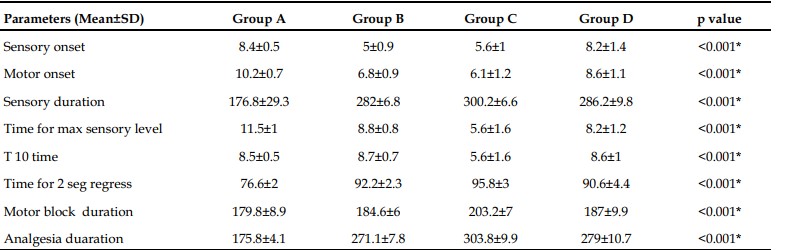
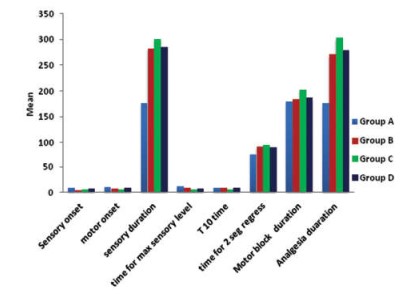
Results: The mean sensory onset of study subjects in group A, B, C and D were 8.4±0.5, 5±0.9, 5.6±1 and 8.2±1.4 respectively and this difference was statistically significant. The mean motor onset of study subjects in group A, B, C and D were 10.2±0.7, 6.8±0.9, 6.1±1.2 and 8.6±1.1 respectively and this difference was statistically significant. The mean sensory duration of study subjects in group A, B, C and D were 176.8±29.3, 282±6.8, 300.2±6.6 and 286.2±9.8 respectively and this difference was statistically significant. The mean time for maximum sensory level of study subjects in group A, B, C and D were 11.5±1, 8.8±0.8, 5.6±1.6 and 8.2±1.2 respectively and this difference was statistically significant. The mean T 10 time of study subjects in group A, B, C and D were 8.5±0.5, 8.7±0.7, 5.6±1.6 and 8.6±1 respectively and this difference was statistically significant. The mean time for 2 segment regression of study subjects in group A, B, C and D were 76.6±2, 92.2±2.3, 95.8±3 and 90.6±4.4 respectively and this difference was statistically significant. The mean motor duration of study subjects in group A, B, C and D were 179.8±8.9, 184.6±6, 203.2±7 and 187±9.9 respectively and this difference was statistically significant. The mean analgesic duration of study subjects in group A, B, C and D were 175.8±4.1, 271.1±7.8, 303.8±9.9 and 279±10.7 respectively and this difference was statistically significant.
Conclusion: We came to conclusion that 0.5% hyperbaric bupivacaine (15mg) with nalbuphine (0.8mg, 1.6 mg, 2.4 mg) in subarachnoid block. Therefore addition of 1.6 mg nalbuphine to 15mg of 0.5% hyperbaric bupivacaine 15 mg in subarachnoid block can be considered safe with minimum complication, and provides excellent quality and longer duration of postoperative analgesia with good sedation compared with 0.8 mg and 2.4 of nalbuphine. So it is useful for prolonged duration of postoperative analgesia.
References
- 1. Bhattacharya R, Dutta B. Postoperative analgesia with local anesthetic and opioid combination using double space CSE technique. Indian J Anaesth 2007;51:409-14.
- 2. Chakraborty S, Chakrabarti J, Bhattacharya D. Intrathecal tramadol added to bupivacaine as spinal anesthetic increases analgesic effect of the spinal blockade after major gynecological surgeries. Indian J Pharmacol 2008;40:4180-2.
- 3. Loeser JD, Butler SH, Chapman CR, Turk DC. Measurement of pain, in: Bonicas Management of pain, 3rd edition 2001, Philadelphia, Lippincott Williams and Wilkins : 310-326.
- 4. Bromage PR. Epidural anaesthesia, Philadelphia: WB Saunders; 1978: 144.
- 5. Gunion MW, Marchionne AM, Anderson TM. Use of the mixed agonist-antagonist nalbuphine in opioid based analgesia. Acute pain 2004;6:29-39.
- 6. Dahan A, Yassen A, Romberg R, Sarton E, Teppema L, Olofsen E, et al. Buprenorphine induces ceiling effect in respiratory depression but not in analgesia. Br J Anaesth 2006;96:627-32.
- 7. Manjula R et al; Comparative Study of Bupivacaine with Nalbuphine and Bupivacaine alone for PostOperative Analgesia in Subarachnoid Block for Lower Limb Surgeries Prospective Randomised Study, Journal Anesthesia & Intensive Care Medicine 2(2): JAICM.MS.ID.555581 (2017) 1-5.
- 8. Gurunath BB, Madhusudhana R. Postoperative analgesic efficacy of intrathecal fentanyl compared to nalbuphine with bupivacaine in spinal anesthesia for lower abdominal surgeries. Anesthesia Essays Res 2018;12:535-8.
Data Sharing Statement
There are no additional data available. All raw data and code are available upon request.
Funding
This research received no funding.
Author Contributions
All authors contributed significantly to the work and approve its publication.
Ethics Declaration
Provide information related to the Ethics Committee approval with approval number OR write, This article does not involve any human or animal subjects, and therefore does not require ethics approval.
Acknowledgements
We would like to express our gratitude to the patients, their families, and all those who have contributed to this study.
Conflicts of Interest
The authors report no conflicts of interest in this work.
About this article

Cite this article
Mude Bhaskar Naik, Vinayak S Sirsat, Shailendra Chauhan, Deepak M Kokane/A Comparison of Analgesic Effect
of Different Doses of Intrathecal Nalbuphine Hydrocloride with Bupivacaine and Bupivacaine alone for Lower
Abdominal and Orthopedic Surgeries/Indian J Anesth Analg. 2022;9(1):15-19.
Licence:
Attribution-Non-commercial 4.0 International (CC BY-NC 4.0)This license
enables reusers to distribute, remix, adapt, and build upon the material in any
medium or format for noncommercial purposes only, and only so long as
attribution is given to the creator.
| Received | Accepted | Published |
|---|---|---|
| October 06, 2021 | October 29, 2021 | February 01, 2022 |
DOI: https://doi.org/10.21088/ijaa.2349.8471.9122.2
Keywords
Analgesic Effect; Intrathecal Nalbuphine; Orthopedic Surgeries.Analgesic Effect; Intrathecal Nalbuphine; Orthopedic Surgeries.Search for Similar Articles
Similar Articles
- Awake Fibreoptic Intubation for Airway Management in Massive Thyroid Enlargement...
- A Case of Thoracotomy with One Lung Ventilation for Carcinoma Oesophagus
- A Case of Empyema for Thoracotomy and Decortication-Anaesthesia Management
- Full Mouth Rehabilitation in a 3-Year-Old Female Child with Repaired Tetralogy o...
- Do Gel Manicures Affect SpO2 Readings ? A Clinical Investigation
Article Level Metrics
Last UpdatedTuesday 14 July 2026, 07:49:02 (IST)
5689
Accesses
6
679
00
Citations
NA
NA
NA
Download citation
Article Keywords
Keyword Highlighting
Highlight selected keywords in the article text.
Timeline
| Received | October 06, 2021 |
| Accepted | October 29, 2021 |
| Published | February 01, 2022 |
licence
Attribution-Non-commercial 4.0 International (CC BY-NC 4.0)
This license
enables reusers to distribute, remix, adapt, and build upon the material in any
medium or format for noncommercial purposes only, and only so long as
attribution is given to the creator.