Full Text (PDF)
Indian Journal of Research in Anthropology 11(2):p 91-101, July - Dec 2025. | DOI: https://doi.org/10.21088/ijra.2454.9118.11225.2
Original Article
Traditional Healthcare Practices and use of Local Medicine Among the Lodhas of Bhalia Ghati Village of Jhargram District, West Bengal, India
Author Information
Licence:
Attribution-Non-commercial 4.0 International (CC BY-NC 4.0)This license enables reusers to distribute, remix, adapt, and build upon the material in any medium or format for noncommercial purposes only, and only so long as attribution is given to the creator.
Indian Journal of Research in Anthropology 11(2):p 91-101, July - Dec 2025. | DOI: https://doi.org/10.21088/ijra.2454.9118.11225.2
How Cite This Article:
Bigitendriya Debsharma. Traditional Healthcare Practices and use of Local Medicine Among the Lodhas of Bhalia Ghati Village of Jhargram District, West Bengal, India. Ind J Res Anthropol 2025; 11(2): 91-101.Timeline
Received : August 05, 2025
Accepted : December 16, 2025
Published : December 30, 2025
Abstract
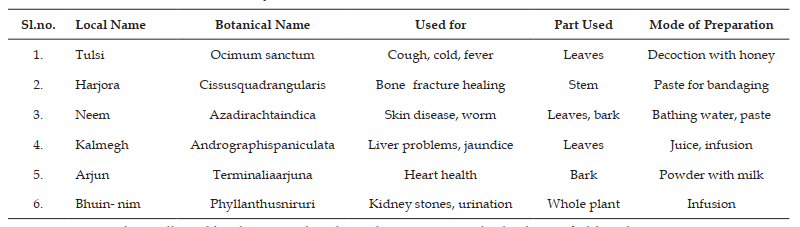
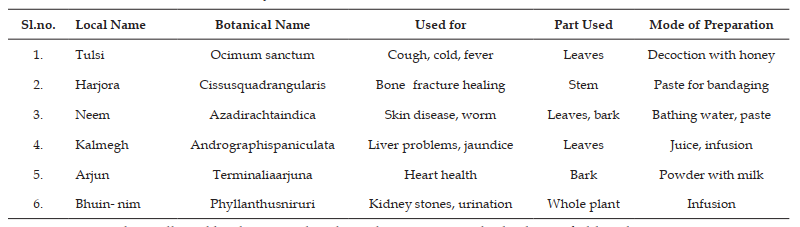
This research explores the indigenous healthcare practices and ethno-medicinal knowledge of the Lodha community of Bhalia Ghati village in Nayagram block, Jhargram, West Bengal. As a Particularly Vulnerable Tribal Group (PVTG), the Lodhas have historically relied on forest-based knowledge systems, particularly in the face of limited access to modern healthcare facilities. Through a mixedmethod approach including primary field interviews, door-to-door census survey, observation, case studies and secondary data from academic literature and government records, this study reveals the role of traditional healers (ojhas), herbal remedies and community rituals in treating ailments ranging from fevers and wounds to snake bites and childbirth complications. Findings suggest that more than 70% of the population first consults a traditional healer before seeking clinical aid. The reliance on local medicinal plants such as tulsi, harjora, neem, and kalmegh is high. However, due to deforestation, migration of youth and cultural shifts, traditional knowledge is declining. Case studies of elderly healers, women caregivers and community health outcomes are presented. The paper concludes by advocating for the documentation and preservation of tribal ethnomedicine alongside improved access to public health services under schemes like PM-JANMAN and Ayushman Bharat.
References
- 1. Banerjee, S. (2013). Cultural dimensions of health and disease in tribal societies. Kolkata: Anthropological Survey of India.
- 2. Basu, A. (1987). The Lodhas of West Bengal: Socioeconomic and cultural change. New Delhi: Anthropological Survey of India.
- 3. Basu, S. (1987). The Lodhas of West Bengal: Structural and cultural dimensions. Indian Anthropologist.
- 4. Bera, S. (2016). Ethnomedicinal practices among Lodha tribe. International Journal for Research in Applied Science and Engineering Technology (IJRASET), 4(3), 45–52.
- 5. Bhowmick, P.K. (2004). Indigenous medicine and healers among the tribes of India. Kolkata: Institute of Social Research and Applied Anthropology.101 IJRA/Volume 11 Number 2/July - December 2025
- 6. Census of India. (2011). District Census Handbook: Jhargram (Series 20, Part XII-B).
- 7. Directorate of Census Operations, West Bengal. https://censusindia.gov.in
- 8. Debnath, S. (2019). Ethnomedicine among the Lodha tribe in Jhargram, West Bengal. Journal of Tribal Studies, 21(2), 45–58.
- 9. Field notes and interviews. (2025, May–June). Ethnographic observations in Bhalia Ghati village, Jhargram District. Unpublished field data collected by the researcher.
- 10. Jain, S.K. (1995). Manual of ethnobotany. New Delhi: Scientific Publishers.
- 11. Livolink Foundation. (2024). Indigenous knowledge systems and herbal care: Field initiatives in Odisha and West Bengal. Retrieved from https://livolinkfoundation.org
- 12. Ministry of Health and Family Welfare. (2023). National Health Mission: Annual report 2022– 2023. Government of India. https://nhm.gov. in
- 13. Ministry of Tribal Affairs. (2022). Report on implementation of the Forest Rights Act (FRA), 2006. Government of India. https://tribal.nic. in
- 14. Murmu, J., & Hansda, S. (2020). Healthcare seeking behaviour among particularly vulnerable tribal groups in West Bengal. Indian Journal of Social Research, 61(3), 45–57.
- 15. Nayagram Block Health Office Reports, 2023.
- 16. Nichter, M. (1994). The social relations of therapy management in South Asia. Culture, Medicine and Psychiatry, 18(2), 141–195.
- 17. Patra, A. (2021). Healthcare access and inequity among tribes in Eastern India. Bhubaneswar: Tribal Health Studies Institute.
- 18. Pradan. (2024). Community-led herbal gardens: Reviving ethnomedicine in tribal India. Retrieved from https://pradan.net
- 19. Sen, S., & Roy, A. (2017). Traditional healthcare practices among the Lodha community. Eastern Anthropologist, 70(1), 83–98.
- 20. Sen, S., & Roy, P. (2017). Traditional health practices among the Lodhas of Nayagram Block. Bengal Anthropological Forum.
- 21. World Health Organization. (2013). WHO traditional medicine strategy: 2014–2023. https://www.who.int/publications/i/ item/9789241506090
Data Sharing Statement
There are no additional data available. All raw data and code are available upon request.
Funding
This research received no funding.
Author Contributions
All authors contributed significantly to the work and approve its publication.
Ethics Declaration
This article does not involve any human or animal subjects, and therefore does not require ethics approval.
Acknowledgements
We would like to express our gratitude to the patients, their families, and all those who have contributed to this study.
Conflicts of Interest
No conflicts of interest in this work.
About this article

Cite this article
Bigitendriya Debsharma. Traditional Healthcare Practices and use of Local Medicine Among the Lodhas of Bhalia Ghati Village of Jhargram District, West Bengal, India. Ind J Res Anthropol 2025; 11(2): 91-101.
Licence:
Attribution-Non-commercial 4.0 International (CC BY-NC 4.0)This license enables reusers to distribute, remix, adapt, and build upon the material in any medium or format for noncommercial purposes only, and only so long as attribution is given to the creator.
| Received | Accepted | Published |
|---|---|---|
| August 05, 2025 | December 16, 2025 | December 30, 2025 |
DOI: https://doi.org/10.21088/ijra.2454.9118.11225.2
Keywords
Lodha communityPVTGHealthcareEthnomedicineMedicinal PlantSearch for Similar Articles
Similar Articles
- Contemporary Issues and Challenges in Women’s Weavers in the Varanasi Silk Saree...
- Understanding through Traversing the Corridors of History: Richness of Indian He...
- Challenges and Opportunities in Digital Preservation of Intangible Culture Herit...
- Assessment of Nutritional Indicators: A Comparative Study among Pre-School Child...
- Prenatal and Postnatal Health-Seeking Behaviour among the Muria Tribe of Bastar...
Article Level Metrics
Last UpdatedTuesday 20 October 2026, 08:35:22 (IST)
2422
Accesses
37
522
00
Citations
NA
NA
NA
Download citation
Article Keywords
Keyword Highlighting
Highlight selected keywords in the article text.
Timeline
| Received | August 05, 2025 |
| Accepted | December 16, 2025 |
| Published | December 30, 2025 |
licence
Attribution-Non-commercial 4.0 International (CC BY-NC 4.0)
This license enables reusers to distribute, remix, adapt, and build upon the material in any medium or format for noncommercial purposes only, and only so long as attribution is given to the creator.