Full Text (PDF)
Journal of Social Welfare and Management 18(2):p 86-96, May -Aug 2026. | DOI: https://doi.org/10.21088/jswm.0975.0231.18226.6
Case Report
The Digital Heart: Integrating Emotional Intelligence and Empathy for Effective Leadership in Tech-Mediated Environments
Rohit Kumar Pal, Sagnika Pal, Kalyan Ghosh
Author Information
Licence:
Attribution-Non-commercial 4.0 International (CC BY-NC 4.0)This license enables reusers to distribute, remix, adapt, and build upon the material in any medium or format for noncommercial purposes only, and only so long as attribution is given to the creator.
Journal of Social Welfare and Management 18(2):p 86-96, May -Aug 2026. | DOI: https://doi.org/10.21088/jswm.0975.0231.18226.6
How Cite This Article:
Rohit Kumar Pal, Sagnika Pal, Kalyan Ghosh. The Digital Heart: Integrating Emotional Intelligence and Empathy for Effective Leadership in Tech-Mediated Environments. J Soc Welfare Manag. 2026; 18(2): 86–96.Timeline
Received : May 26, 2026
Accepted : June 30, 2026
Published : August 30, 2026
Abstract
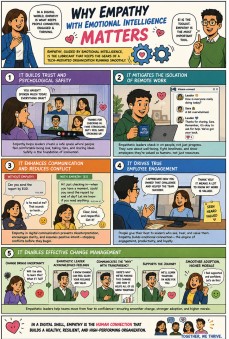
Digital communication platforms and remote work models, combined with artificial intelligence, have created a complete transformation of how organizations conduct their leadership functions. The article demonstrates that contemporary technological advancements make traditional command-and-control leadership systems no longer relevant. The article demonstrates that effective leadership requires leaders to develop their ability to use Emotional Intelligence (EI) and authentic empathy throughout their online communication. This article begins by defining EI and empathy within a technological context, distinguishing between cognitive, emotional, and compassionate empathy. The research study conducts a comprehensive review of present literature to demonstrate how essential soft skills function as the basis for building trust and psychological safety and team collaboration in remote work environments. We have used eight case studies from various fields including technology and finance and healthcare to demonstrate how empathetic leadership brings real advantages while its absence leads to major disadvantages. The system fails to evaluate human dimensions because it depends on performance metrics which rely exclusively on data. It concludes with personal perspectives, acknowledges limitations, and proposes a robust agenda for future research, positing that the future of effective leadership lies not in competing with technology, but in leveraging uniquely human capabilities to create more resilient, adaptive, and humane organizations.
References
- 1. Castrillon, C. (2021, August 29). How to combat proximity bias in a hybrid workplace. Forbes. https://www.forbes. com/sites/carolinecastrillon/2021/08/29/ how-to-combat-proximity-bias-in-a-hybridworkplace/
- 2. Duhigg, C. (2016, February 25). What Google Learned From Its Quest to Build the Perfect Team. The New York Times Magazine. https:// www.nytimes.com/2016/02/28/magazine/ what-google-learned-from-its-quest-to-buildthe-perfect-team.html
- 3. Edmondson, A. C. (2018). The fearless organization: Creating psychological safety in the workplace for learning, innovation, and growth. John Wiley & Sons.
- 4. Garton, E., & Mankins, M. (2015). Engaging your employees is good, but don’t stop there. Harvard Business Review. https://hbr. org/2015/12/engaging-your-employees-isgood-but-dont-stop-there
- 5. Gibson, C. B., & Gibbs, J. L. (2006). Unpacking the concept of virtuality: The effects of geographic dispersion, electronic dependence, dynamic structure, and national diversity on team innovation. Administrative Science Quarterly, 51(3), 451–495.
- 6. Golden, T. D. (2006). Avoiding depletion in virtual work: Telework and the intervening impact of work exhaustion on commitment and turnover intentions. Journal of Vocational Behavior, 69(1), 176–187.
- 7. Goleman, D. (1995). Emotional intelligence: Why it can matter more than IQ. Bantam Books.
- 8. Goleman, D. (1998). Working with emotional intelligence. Bantam Books.
- 9. Goleman, D. (2013). Focus: The hidden driver of excellence. HarperCollins.
- 10. Grenny, J., & Maxfield, D. (2017). A study of 1,100 employees found that remote workers feel shunned and left out. Harvard Business Review. https://hbr.org/2017/11/a-study-of- 1100-employees-found-that-remote-workersfeel-shunned-and-left-out
- 11. https://www.ccl.org/articles/leadingeffectively-articles/empathy-in-leadership/
- 12. Kellogg, K. C., Valentine, M. A., & Christin, A. (2020). Algorithms and the future of work: A research agenda. In The future of work: A research agenda. Academy of Management Annals.
- 13. Kreitner, R., & Kinicki, A. (2013). Organizational behavior (10th ed.). McGraw-Hill/Irwin.
- 14. Lorenz, T. (2021, April 27). Basecamp’s New Policies Are a Recipe for Disaster, Employees Say. The New York Times. https:// www.nytimes.com/2021/04/27/business/ basecamp-policies.html
- 15. Merlino, J. (2017, October 26). The CEO of Cleveland Clinic on Putting Patients First. Harvard Business Review. https://hbr. org/2017/10/the-ceo-of-cleveland-clinic-onputting-patients-first
- 16. Miao, C., Humphrey, R. H., & Qian, S. (2017). A meta-analysis of emotional intelligence and work attitudes. Journal of Career Assessment, 25(4), 1–15.
- 17. Nadella, S. (2017). Hit refresh: The quest to rediscover Microsoft’s soul and imagine a better future for everyone. HarperCollins.
- 18. Pal, R.K. (2024). A Short Overview of Various Leadership Theories and their Approach in the Teaching Sector. Journal of Social Welfare and Management, 16(3).
- 19. Pal, R. K. (2025). The future of Coaching Institutes in India in the age of AI. Journal of Social Welfare and Management, 17(2).
- 20. Salovey, P., & Mayer, J. D. (1990). Emotional intelligence. Imagination, Cognition and Personality, 9(3), 185–211.
- 21. Scott, K., Leroy, H., & psychological safety, A. C. E. (2020). Empathy and leadership: The key to unlocking performance. Center for Creative Leadership.
- 22. Wang, B., Liu, Y., Qian, J., & Parker, S. K. (2020). Achieving effective remote working during the COVID-19 pandemic: A work design perspective. Applied Psychology, 70(1), 16–59.
Data Sharing Statement
There are no additional data available. All raw data and code are available upon request.
Funding
This research received no funding.
Author Contributions
All authors contributed significantly to the work and approve its publication.
Ethics Declaration
This article does not involve any human or animal subjects, and therefore does not require ethics approval.
Acknowledgements
We would like to express our gratitude to the patients, their families, and all those who have contributed to this study.
Conflicts of Interest
No conflicts of interest in this work.
About this article

Cite this article
Rohit Kumar Pal, Sagnika Pal, Kalyan Ghosh. The Digital Heart: Integrating Emotional Intelligence and Empathy for Effective Leadership in Tech-Mediated Environments. J Soc Welfare Manag. 2026; 18(2): 86–96.
Licence:
Attribution-Non-commercial 4.0 International (CC BY-NC 4.0)This license enables reusers to distribute, remix, adapt, and build upon the material in any medium or format for noncommercial purposes only, and only so long as attribution is given to the creator.
| Received | Accepted | Published |
|---|---|---|
| May 26, 2026 | June 30, 2026 | August 30, 2026 |
DOI: https://doi.org/10.21088/jswm.0975.0231.18226.6
Keywords
Emotional IntelligenceEmpathyTech-Mediated LeadershipRemote WorkDigital CommunicationPsychological SafetyData-Driven Decision MakingDistributed TeamsLeadership DevelopmentFuture of WorkSearch for Similar Articles
Similar Articles
- Electronic Publishing: A Powerful Tool in Academic Environment
- Natural Farming & the Concept of Recycle, Reuse through Case Studies
- From Home to the Gig: Empowering Women in Thoothukudi District of Tamil Nadu sta...
- Determinants of FinTech Adoption: An Analysis of Perceptual and Behavioural Infl...
- The Illusion of Prestige: Pay-and-Take Awards and the Glorified Profile Culture...
Article Level Metrics
Last UpdatedSaturday 17 October 2026, 08:53:09 (IST)
3359
Accesses
44
298
00
Citations
NA
NA
NA
Download citation
Article Keywords
Keyword Highlighting
Highlight selected keywords in the article text.
Timeline
| Received | May 26, 2026 |
| Accepted | June 30, 2026 |
| Published | August 30, 2026 |
licence
Attribution-Non-commercial 4.0 International (CC BY-NC 4.0)
This license enables reusers to distribute, remix, adapt, and build upon the material in any medium or format for noncommercial purposes only, and only so long as attribution is given to the creator.