Full Text (PDF)
Journal of Social Welfare and Management 18(2):p 77-85, May -Aug 2026. | DOI: https://doi.org/10.21088/jswm.0975.0231.18226.5
Review Article
Elective and Emergency Cesarean Sections: Risks, Complications, Catastrophes, and Management
Vivekanshu Verma, Shri Gopal Kabra
Author Information
Licence:
Attribution-Non-commercial 4.0 International (CC BY-NC 4.0)This license enables reusers to distribute, remix, adapt, and build upon the material in any medium or format for noncommercial purposes only, and only so long as attribution is given to the creator.
Journal of Social Welfare and Management 18(2):p 77-85, May -Aug 2026. | DOI: https://doi.org/10.21088/jswm.0975.0231.18226.5
How Cite This Article:
Shri Gopal Kabra, Vivekanshu Verma. Elective and Emergency Cesarean Sections: Risks, Complications, Catastrophes, and Management. J Soc Welfare Manag. 2026; 18(2): 77–85.Timeline
Received : July 03, 2026
Accepted : August 05, 2026
Published : August 30, 2026
Abstract
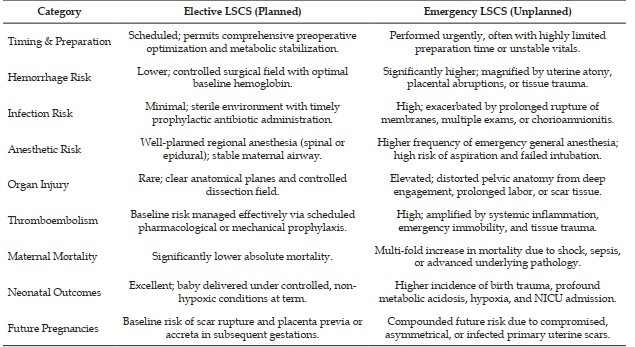
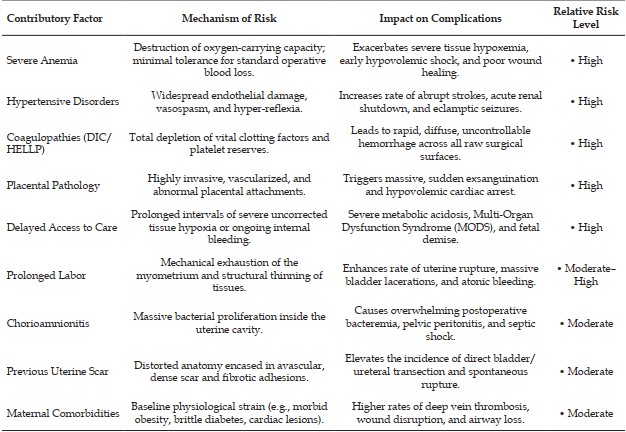
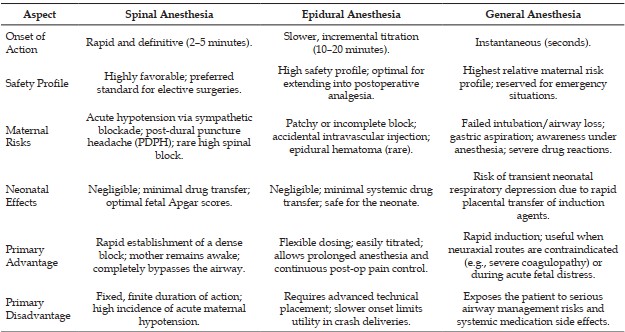
Background: Cesarean section (C-section) is a lifesaving surgical intervention in obstetrics. However, rising rates of both elective and emergency procedures have raised concerns about maternal and neonatal risks, complications, and catastrophic outcomes. Understanding these risks and establishing clear management protocols is essential for improving outcomes. Objectives: To analyze the causes, complications, and contributory factors associated with elective and emergency cesarean sections, and to outline stepwise management strategies for major complications such as postpartum hemorrhage, acute kidney injury, and anesthesia-related risks. Methods: A narrative review of clinical literature, institutional data, and reported maternal outcomes was conducted. Key areas of focus included surgical complications, anesthesia risks, nosocomial infections, and rare but catastrophic events such as amniotic fluid embolism. Preventive and management protocols were synthesized into structured flowcharts and stratification charts. Results: Elective cesarean sections generally carry lower risks due to preparation and controlled conditions, while emergency cesareans are associated with higher rates of hemorrhage, infection, organ injury, and neonatal distress. Contributory factors such as anemia, hypertensive disorders, coagulopathies, and prolonged labor significantly increase maternal morbidity and mortality. Stepwise management protocols for PPH, AKI, and anesthesia complications emphasize early recognition, resuscitation, and escalation to advanced interventions. Conclusion: Cesarean sections, though often necessary, carry significant risks that vary between elective and emergency contexts. Rising rates of cesarean deliveries highlight the need for balanced policies that respect maternal autonomy while minimizing unnecessary surgical exposure. Structured management protocols and preventive strategies are critical to reducing maternal and neonatal morbidity and mortality.
References
- 1. Betran AP, Torloni MR, Zhang JJ, Gülmezoglu AM. WHO Statement on Caesarean Section Rates. BJOG: An International Journal of Obstetrics & Gynaecology. 2015;123(5):667-670. Available from:https://doi.org/10.1111/1471- 0528.13526
- 2. Josi R. Caesarean section epidemic: Tackling the rise of unnecessary cuts. European Journal of Midwifery. 2019;3:1-3. Available from: https://doi.org/10.18332/ejm/105892
- 3. Pandey AK, Raushan MR, Gautam D, Neogi SB. Alarming Trends of Cesarean Section— Time to Rethink: Evidence From a LargeScale Cross-sectional Sample Survey in India. Journal of Medical Internet Research. 2023;25:e41892. Available from: https://doi. org/10.2196/41892
- 4. Parasiliti M, Vidiri A, Perelli F, Scambia G, Lanzone A, Cavaliere AF. Cesarean section rate: navigating the gap between WHO recommended range and current obstetrical challenges. The Journal of Maternal-Fetal & Neonatal Medicine. 2023;36(1):2284112. Available from: https://doi.org/10.1080/1476 7058.2023.2284112
- 5. Betran AP, Ye J, Moller AB, Souza JP, Zhang J. Trends and projections of caesarean section rates: global and regional estimates. BMJ Global Health. 2021;6(6):e005671. Available from: https://doi.org/10.1136/bmjgh-2021-005671
- 6. Haftel A, StatPearls Publishing. Amniotic Fluid Embolism. StatPearls [Internet]. 2024. Available from: https://www.ncbi.nlm.nih. gov/books/NBK559107/
- 7. Rath WH. Amniotic Fluid Embolism: an Interdisciplinary Challenge: Epidemiology, Diagnosis and Treatment. Deutsches Ärzteblatt International. 2014;111(8):126-132. Available from: https://pmc.ncbi.nlm.nih.gov/articles/ PMC3959223/
- 8. Gentilomo A, Tambuzzi S, Gentile G, Boracchi M, Andreola S, Zoia R. Post-mortem diagnosis of amniotic fluid embolism. Autopsy and Case Reports. 2024;14:e2024472. Available from: https://doi.org/10.4322/acr.2024.472
Data Sharing Statement
There are no additional data available. All raw data and code are available upon request.
Funding
This research received no funding.
Author Contributions
All authors contributed significantly to the work and approve its publication.
Ethics Declaration
This article does not involve any human or animal subjects, and therefore does not require ethics approval.
Acknowledgements
We would like to express our gratitude to the patients, their families, and all those who have contributed to this study.
Conflicts of Interest
No conflicts of interest in this work.
About this article

Cite this article
Shri Gopal Kabra, Vivekanshu Verma. Elective and Emergency Cesarean Sections: Risks, Complications, Catastrophes, and Management. J Soc Welfare Manag. 2026; 18(2): 77–85.
Licence:
Attribution-Non-commercial 4.0 International (CC BY-NC 4.0)This license enables reusers to distribute, remix, adapt, and build upon the material in any medium or format for noncommercial purposes only, and only so long as attribution is given to the creator.
| Received | Accepted | Published |
|---|---|---|
| July 03, 2026 | August 05, 2026 | August 30, 2026 |
DOI: https://doi.org/10.21088/jswm.0975.0231.18226.5
Keywords
Cesarean SectionElective LscsEmergency LscsPostpartum HemorrhageAcute Kidney InjuryAmniotic Fluid EmbolismAnesthesia ComplicationsNosocomial InfectionMaternal MorbidityBodily AutonomySearch for Similar Articles
Similar Articles
- Electronic Publishing: A Powerful Tool in Academic Environment
- Natural Farming & the Concept of Recycle, Reuse through Case Studies
- From Home to the Gig: Empowering Women in Thoothukudi District of Tamil Nadu sta...
- Determinants of FinTech Adoption: An Analysis of Perceptual and Behavioural Infl...
- The Illusion of Prestige: Pay-and-Take Awards and the Glorified Profile Culture...
Article Level Metrics
Last UpdatedSaturday 17 October 2026, 07:39:52 (IST)
3359
Accesses
13
298
00
Citations
NA
NA
NA
Download citation
Article Keywords
Keyword Highlighting
Highlight selected keywords in the article text.
Timeline
| Received | July 03, 2026 |
| Accepted | August 05, 2026 |
| Published | August 30, 2026 |
licence
Attribution-Non-commercial 4.0 International (CC BY-NC 4.0)
This license enables reusers to distribute, remix, adapt, and build upon the material in any medium or format for noncommercial purposes only, and only so long as attribution is given to the creator.