Full Text (PDF)
Indian Journal of Research in Anthropology 10(1):p 39-53, January – June 2024. | DOI: http://dx.doi.org/10.21088/ijra.2454.9118.10124.5
Original Article
The Changing Trend of Tribal Education in West Bengal with Special Emphasis on the Girl Students
Suchismita Sen Chowdhury, Suman Das
Author Information
Licence:
Attribution-Non-commercial 4.0 International (CC BY-NC 4.0)This license enables reusers to distribute, remix, adapt, and build upon the material in any medium or format for noncommercial purposes only, and only so long as attribution is given to the creator.
Indian Journal of Research in Anthropology 10(1):p 39-53, January – June 2024. | DOI: http://dx.doi.org/10.21088/ijra.2454.9118.10124.5
How Cite This Article:
Chowdhury SS, Das S. The changing trend of tribal education in West Bengal. Ind J Res Anthropol. 2024;10(1):39-53.Timeline
Received : March 30, 2024
Accepted : May 25, 2024
Published : June 28, 2024
Abstract
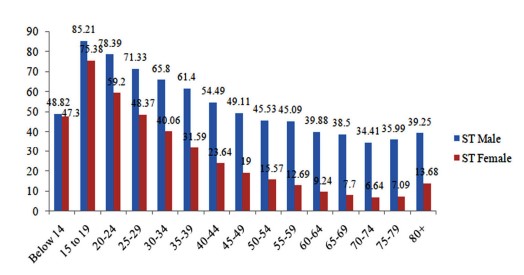
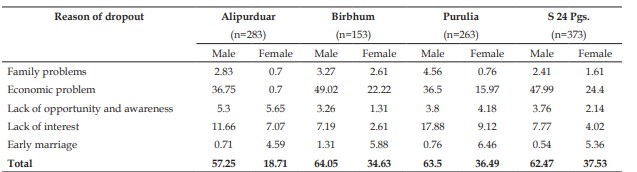
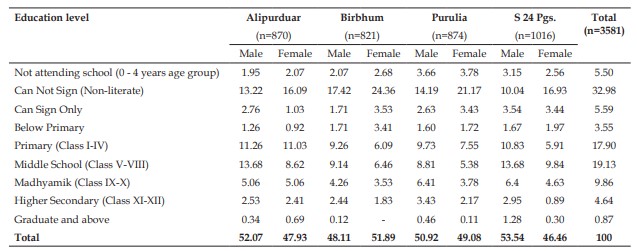
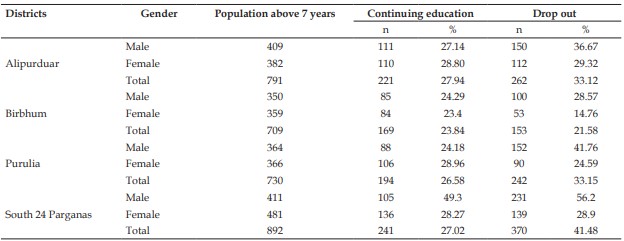
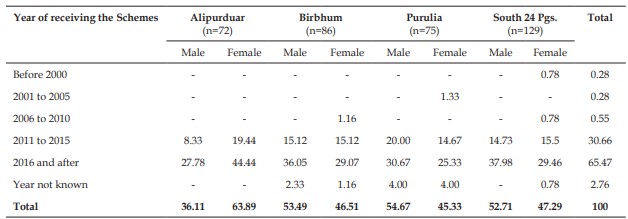
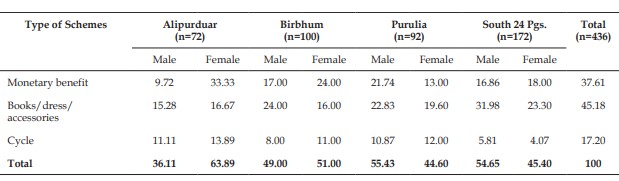
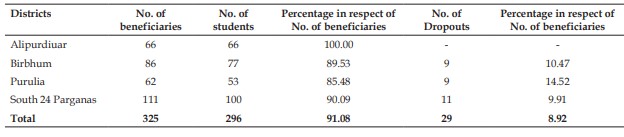
Education is an investment towards development. Gender gap in education is common among the backward classes of people in India. Aim of this study is to understand the recent trend of tribal education among the Scheduled Tribes of West Bengal. Study covered four districts from different zones of West Bengal. These were Alipurduar from north, Birbhum from central part, Purulia from west and South 24Parganafromthesouthernpart.Theselected villages were chiefly inhabited by the tribal population. Secondary data related to tribal education were collected from Census of India (2011) and Statistics of School Education (2010 11), while primary data were collected through field work in four districts. Both qualitative and quantitative methods of data collection were followed. A structured schedule was used for collection of household level data, which covered education related questions. Personal interviews with the teachers, parents and case studies of the students supplemented the quantitative data. Fourteen different tribal groups were studied in the selected areas during field work. Secondary sources suggest educational backwardness and gender gap among the tribal population. Findings show district wise and community specific variation in status of education among the studied population. A positive development was observed in case of girl’s education. The gender gap is gradually decreasing. Among many factors responsible for this changing trend, major was development programmes meant for girl’s education in West Bengal.
References
- 1. Nawal Kishor Ambasht, A critical study of tribal education. New Delhi: S. Chand and Co. 1970.
- 2. Probodh Kumar Bhowmik, Tribal literacy in West Bengal. Calcutta: R. N. Bhattacharya. 2000.
- 3. Census,
- 4. Buddhadeb Chaudhuri, “Education and Literacy Programmes”, in Tribal Transformation in India (Vol. IV), Buddhadeb Chaudhuri Ed. New Delhi: Inter India Publications. 1992.
- 5. Prasenjit Debbarman, “Education Among the Lepchas of Darjeeling: A Sociological Study”,in TribalTransformationinIndia(Vol.IV),Buddhadeb Chaudhuri Ed. NewDelhi: Inter India Publications. 1992.
- 6. Ayyappan Madhava Kurup, “Extent and Problems of Tribal Education”, in Tribal Transformation in India (Vol. IV), Buddhadeb Chaudhuri Ed. New Delhi: Inter India Publications. 1992.
- 7. “List of Functional EMRSs in India”, Ministry of Tribal Affairs: Government of India. https://tribal. nic.in/DivisionsFiles/sg/ListEMRS060418.pdf (accessed on April 20, 2020)
- 8. National Policy on Education, 1986, programme on action 1992. https://mhrd.gov.in/sites/upload_ files/mhrd/files/upload_document/npe.pdf (accessed on January 19, 2020).
- 9. Sanjay Kumar Roy, Tribes, Education and Gender Question. New Delhi: Northern Book Centre, 2005.
- 10. Bertrand Russel, Education and the Social Order. London: Unwin Paperbacks, 1932.
- 11. Sachchidananda. 1992. “Structural Constraints in the Education of Scheduled Tribes and Scheduled Castes”, in Tribal Transformation in India (Vol. IV), Buddhadeb Chaudhuri Ed. New Delhi: Inter India Publications. 1992.
- 12. Statistics of School Education (2010-11). https:// mhrd.gov.in/sites/upload_files/mhrd/files/ statistics-new/SES-School_2010-11.pdf (accessed on June 25, 2019).
- 13. S. Venkataiah, Modern Tribal Education. New Delhi: Anmol Publications Pvt. Ltd.2001.
- 14. A.V.Yadappanavar, Tribaleducation in India.New Delhi: Discovery Publishing House.2003.
Data Sharing Statement
There are no additional data available.
Funding
This research received no funding.
Author Contributions
All authors contributed significantly to the work and approve its publication.
Ethics Declaration
This article does not involve any human or animal subjects, and therefore does not require ethics approval
Acknowledgements
Information Not Provided
Conflicts of Interest
No conflicts of interest in this work.
About this article

Cite this article
Chowdhury SS, Das S. The changing trend of tribal education in West Bengal. Ind J Res Anthropol. 2024;10(1):39-53.
Licence:
Attribution-Non-commercial 4.0 International (CC BY-NC 4.0)This license enables reusers to distribute, remix, adapt, and build upon the material in any medium or format for noncommercial purposes only, and only so long as attribution is given to the creator.
| Received | Accepted | Published |
|---|---|---|
| March 30, 2024 | May 25, 2024 | June 28, 2024 |
DOI: http://dx.doi.org/10.21088/ijra.2454.9118.10124.5
Keywords
ChangeEducationTribal girlsGender gapDevelopment SchemesSearch for Similar Articles
Similar Articles
- Indigenous Knowledge System in Formal Education
- Contemporary Issues and Challenges in Women’s Weavers in the Varanasi Silk Sare...
- Understanding through Traversing the Corridors of History: Richness of Indian He...
- Challenges and Opportunities in Digital Preservation of Intangible Culture Herit...
- Assessment of Nutritional Indicators: A Comparative Study among Pre-School Child...
Article Level Metrics
Last UpdatedWednesday 08 July 2026, 14:28:03 (IST)
807
Accesses
2
223
00
Citations
NA
NA
NA
Download citation
Article Keywords
Keyword Highlighting
Highlight selected keywords in the article text.
Timeline
| Received | March 30, 2024 |
| Accepted | May 25, 2024 |
| Published | June 28, 2024 |
licence
Attribution-Non-commercial 4.0 International (CC BY-NC 4.0)
This license enables reusers to distribute, remix, adapt, and build upon the material in any medium or format for noncommercial purposes only, and only so long as attribution is given to the creator.