Full Text (PDF)
Journal of Orthopedic Education 11(1):p 21-24, Jan -April 2025. | DOI: https://doi.org/10.21088/joe.2454a.7956.11125.4
Case Report
Surgical Innovation: A New Technique to Avoid False Incisions in Modified Henry’s Approach for Distal Radius Fractures
R.B. Uppin, R.B. Patil, Arun Joy, Halesh N.B., S.G. Vastrad, S.S. Ghatwalimath, Anand N.K.
Author Information
Licence:
Attribution-Non-commercial 4.0 International (CC BY-NC 4.0)This license enables reusers to distribute, remix, adapt, and build upon the material in any medium or format for noncommercial purposes only, and only so long as attribution is given to the creator.
Journal of Orthopedic Education 11(1):p 21-24, Jan -April 2025. | DOI: https://doi.org/10.21088/joe.2454a.7956.11125.4
How Cite This Article:
R.B. Uppin, R.B. Patil, Arun Joy et al. Surgical Innovation: A New Technique to Avoid False Incisions in Modified Henry’s Approach for Distal Radius Fractures. Jr. Orth. Edu. 2025; 11(1): 21–24.Timeline
Received : February 17, 2025
Accepted : April 01, 2025
Published : April 30, 2025
Abstract
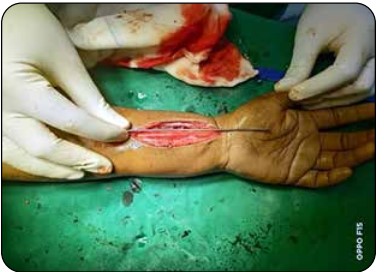
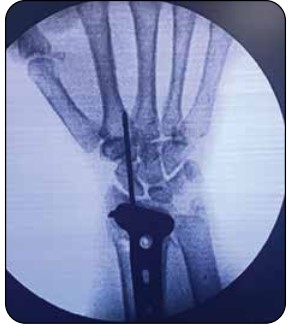
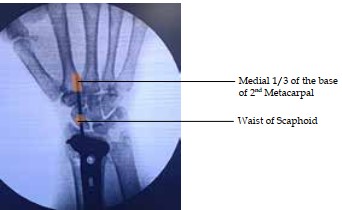
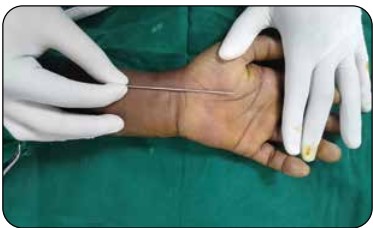
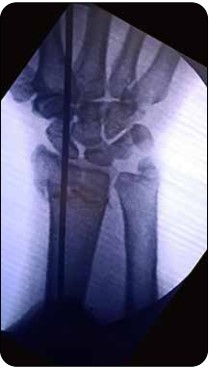
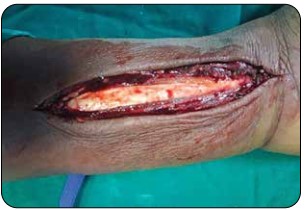
This study presents a novel technique employing fluoroscopy and K wire to accurately locate the Flexor Carpi Radialis (FCR) tendon during the modified Henry’s approach for distal radius fracture fixation. Conventional palpation methods can be unreliable, especially in cases of swelling, potentially leading to false incisions that endanger surrounding structures such as the radial artery and median nerve. Our method identified consistent radiological landmarks the waist of the scaphoid and medial one-third of the base of the second metacarpal allowing for precise incision placement in fifty clinically tested patients. This technique enhances the safety and efficacy of the modified Henry’s approach, providing valuable guidance for novice surgeons.
References
- 1. Conti Mica M.A., Bindra R., Moran S.L. Anatomic considerations when performing the modified Henry approach for exposure of distal radius fractures. J Orthop. 2017 Mar; 14(1): 104–107. PMCID: PMC5096598.
- 2. Parvizi J., Kim G.K. Distal Radius Fractures. High Yield Orthopaedics. Elsevier; 2010. pp. 145–147.
- 3. Wu M., Ilyas A.M. Surgical exposures of the distal radius for fracture fixation. SurgiColl. 2023 Mar 22; 1(1).
- 4. Bell D., Knipe H. Flexor carpi radialis muscle. Radiopaedia.org. Radiopaedia.org; 2005.
- 5. Flexor carpi radialis muscle | Radiology Reference Article | Radiopaedia.org [Internet]. [cited 2025 Mar 4]. Available from: https:// radiopaedia.org/articles/flexor-carpi-radialismuscle-1
- 6. Rednam M., Tiwari V. Fluoroscopy orthopedic assessment, protocols, and interpretation. Stat Pearls. Treasure Island (FL): Stat Pearls Publishing; 2025. PMID: 34424638.
- 7. Flexor carpi radialis: Origin, insertion and action | Kenhub [Internet]. [cited 2025 Mar 4]. Available from: https://www.kenhub.com/ en/library/anatomy/flexor-carpi-radialismuscle
- 8. Salva-Coll G., Garcia-Elias M., Leon-Lopez M.T., Llusa-Perez M., Rodríguez-Baeza A. Effects of forearm muscles on carpal stability. J Hand SurgEur Vol. 2011 Sep; 36(7): 553–559. PMID: 21593070.
- 9. Salvà-Coll G., Garcia-Elias M., Llusá-Pérez M., Rodríguez-Baeza A. The role of the flexor carpi radialis muscle in scapholunate instability. J Hand Surg Am. 2011 Jan; 36(1): 31–36. PMID: 21093178.
- 10. Yeager K., Heifner J., Rubio F., Gray R., Orbay J., Mercer D. Flexor carpi radialis tendon insertion onto the trapezial ridge: an anatomic description. Journal of Hand Surgery Global Online. 2023 Jan; 5(1): 55–57. PMCID: PMC9870792
Data Sharing Statement
There are no additional data available. All raw data and code are available upon request.
Funding
This research received no funding.
Author Contributions
All authors contributed significantly to the work and approve its publication.
Ethics Declaration
This article does not involve any human or animal subjects, and therefore does not require ethics approval.
Acknowledgements
We would like to express our gratitude to the patients, their families, and all those who have contributed to this study.
Conflicts of Interest
No conflicts of interest in this work.
About this article

Cite this article
R.B. Uppin, R.B. Patil, Arun Joy et al. Surgical Innovation: A New Technique to Avoid False Incisions in Modified Henry’s Approach for Distal Radius Fractures. Jr. Orth. Edu. 2025; 11(1): 21–24.
Licence:
Attribution-Non-commercial 4.0 International (CC BY-NC 4.0)This license enables reusers to distribute, remix, adapt, and build upon the material in any medium or format for noncommercial purposes only, and only so long as attribution is given to the creator.
| Received | Accepted | Published |
|---|---|---|
| February 17, 2025 | April 01, 2025 | April 30, 2025 |
DOI: https://doi.org/10.21088/joe.2454a.7956.11125.4
Keywords
Distal Radius FracturesModified Henrys ApproachFluoroscopyRadiological LandmarksSearch for Similar Articles
Similar Articles
- Use of Ocular Biomarkers for Predicting Systemic Bone Health in Orthopaedic Pati...
- Management of Pathological Fracture with Metastasis of Proximal Femur Secondary...
- Impact of Blood Transfusion on Bone Healing and Regeneration in Orthopaedic Surg...
- Cognitive Behavioural Interventions for Freezing of Gait in Parkinson’s Disease:...
- A Case Report: Reverse Shoulder Joint Replacement - Neer’s Four Part Fractures o...
Article Level Metrics
Last UpdatedSunday 18 October 2026, 20:38:56 (IST)
2691
Accesses
12
319
00
Citations
NA
NA
NA
Download citation
Article Keywords
Keyword Highlighting
Highlight selected keywords in the article text.
Timeline
| Received | February 17, 2025 |
| Accepted | April 01, 2025 |
| Published | April 30, 2025 |
licence
Attribution-Non-commercial 4.0 International (CC BY-NC 4.0)
This license enables reusers to distribute, remix, adapt, and build upon the material in any medium or format for noncommercial purposes only, and only so long as attribution is given to the creator.